What Kepler was capable of detecting
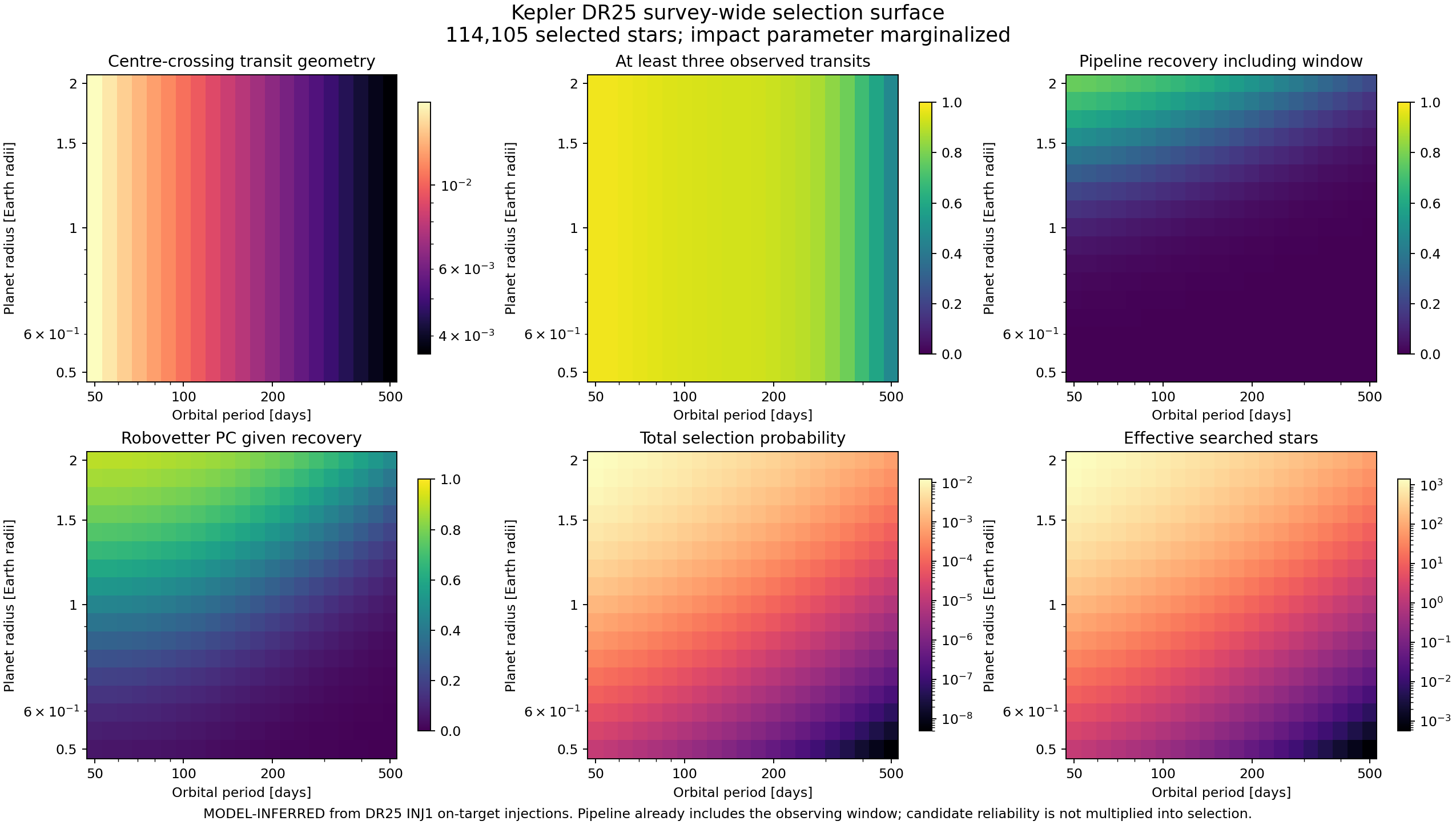
A planet can exist and still never enter the catalogue. This surface combines transit geometry, the observed phase window, injection-calibrated pipeline recovery and vetting across a declared target sample.
21 periods × 17 radii · 357 evaluated cells
114,105
selected GK targets
unique DR25 stars
43,350
injection trials
inside model domain
357
surface cells
50–500 d · 0.5–2.0 R⊕
4 factors
selection chain
geometry · window · recovery · vetting
What the analysis found
Survey sensitivity is a physical part of the answer
Longer-period, smaller planets are harder to see for several independent reasons. The selected cell view exposes those factors separately, preventing a low catalogue count from being read as direct evidence that such planets are intrinsically rare.
Interactive selection surface
Move through period–radius space
Each cell asks how often a planet signal at this period and radius would transit, land in an observed phase window, pass the DR25 pipeline and survive vetting across the selected GK-dwarf targets.
Selected survey cell
MODEL-INFERRED354.0 d · 1.00 R⊕
- Transit geometry
- 0.450%
- Observed phase window
- 78.1%
- Pipeline incl. window
- 0.668%
- Vetting | recovered
- 11.7%
- Total selection
- 0.002%
Equivalent exposure: 2.5 stars. This is detection exposure, not an inferred planet count.