Exoearth evidence observatory · climate
A habitable zone moves with its star
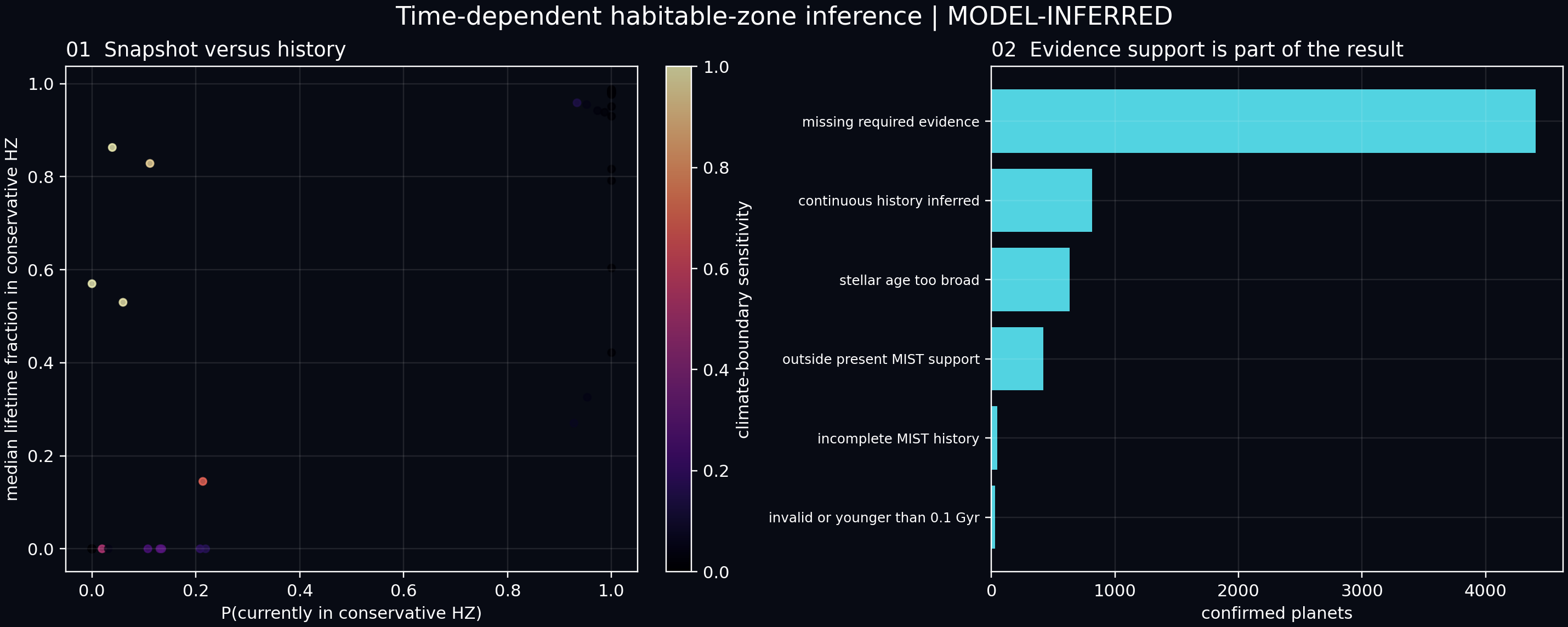
The present-day orbit is only one frame. MIST stellar tracks and three named Kopparapu boundary prescriptions test whether a planet stays inside a modelled irradiation range through time.
Stellar evolution × climate boundary × measurement uncertainty
6,354
planets evaluated
full confirmed catalogue
815
supported histories
measurement and grid gates passed
22
robustly inside
all implemented prescriptions
16
boundary sensitive
classification changes
What the analysis found
Most planets cannot support a time-resolved claim
The dominant climate result is missing support. Only a subset has the stellar age, mass, metallicity, luminosity and uncertainties needed for a continuous history. Among supported systems, model agreement and disagreement remain explicit rather than being averaged away.