OBSERVED
89
catalogue candidates
what passed the observed KOI contract
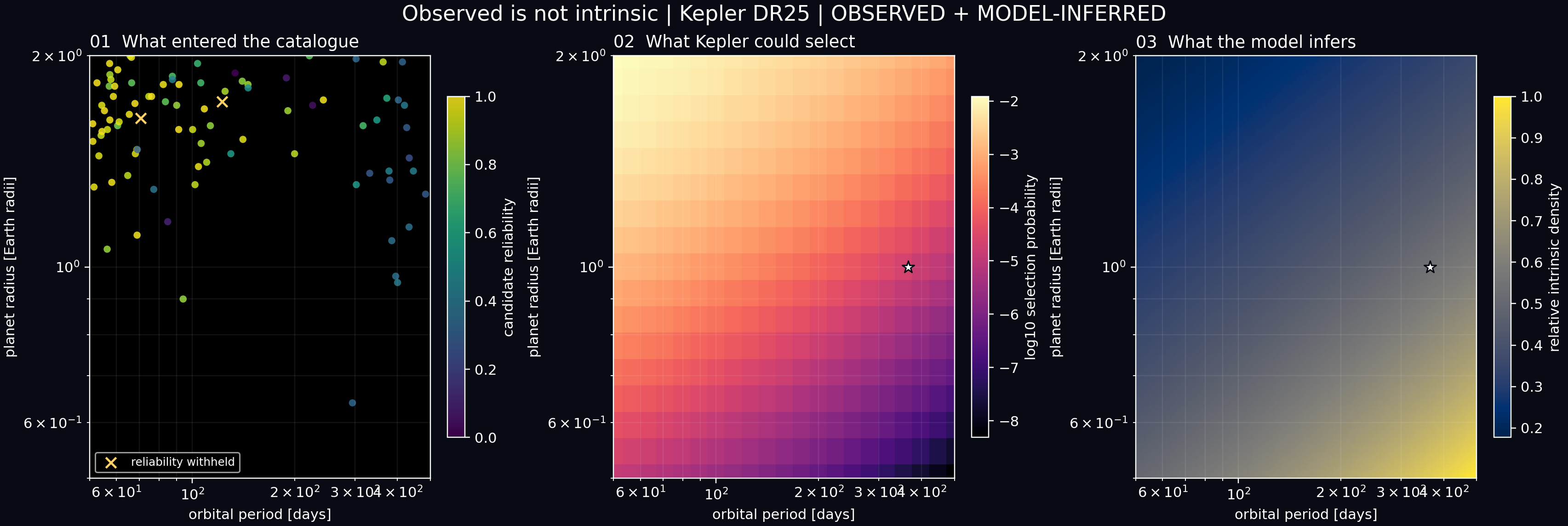
A catalogue records what a telescope could see. To ask how common small, long-period planets may be, I had to reconstruct the selection process, account for unreliable candidates and carry those uncertainties into a population model.
50–500 days · 0.5–2 Earth radii · conditional on the selected GK-dwarf sample
OBSERVED
89
what passed the observed KOI contract
MODEL-INFERRED
54
mean after reliability + FPP imputation
MODEL-INFERRED
78.3
median exposure for the inferred shape
MODEL-INFERRED
0.692
0.267–1.918 · 95% interval
Checking the newest verified posterior…
Selection lens
Step through the reasoning. Each transition changes the question being asked, so every number keeps its evidence label and unit.
01
Evidence changes meaning here
Eighty-nine KOIs pass the fixed stellar and planet-domain contract. That count describes the selected catalogue, not the intrinsic population.
What the posterior can say
0.246
per selected star per d ln P d ln R at the Earth pivot
0.122
237–500 days · 0.75–1.5 Earth radii
0.041
fixed period and radius · not a habitable-zone rate
Claim boundary
This is a fixed period-radius occurrence result. It is not a probability of habitability, biology or a star-dependent habitable-zone eta Earth.
What I learned
I used to read a planet catalogue as if it were a map of what exists. This analysis taught me to read it as the output of an instrument, an observing schedule, a detection pipeline and a human-designed vetting process.
The posterior is broad because the data are genuinely weak near an Earth-like period and radius. Keeping that width visible is part of the finding. It tells me where a future survey can add the most knowledge.
Continue to my research dictionary and conclusion →