Finding Earth 2.0
Exoearth evidence observatory · decisions

What should we measure next?

Candidate ranking identifies interesting worlds. Expected information gain asks a different question: which supported measurement would reduce a declared uncertainty the most?

25 candidates × 6 actions · 83 supported calculations

25

candidate worlds

leading ranked sample

6

measurement actions

explicit synthetic likelihoods

83

supported actions

67 remain undetermined

bits

information unit

expected KL divergence

What the analysis found

The highest score is not always the most useful next target

A precise parameter offers little information if it is already known well. A weaker parameter can dominate the decision if a plausible measurement sharply contracts its posterior. Unsupported actions remain withheld because information gain requires both a calibrated prior and a defensible observation model.

Decision laboratory

Choose a world and a measurement

The calculator compares a declared current uncertainty with a synthetic future precision. It reports expected posterior shrinkage and expected KL information in bits.

Expected update

SIMULATED

Proxima Cen b

planet mass or minimum mass

Prior σ

0.055 Earth masses

Synthetic σ

0.106 Earth masses

Expected posterior σ

0.0488 Earth masses

0.1734 bits

Expected KL information · target-local action rank 2

Observing time and cost: not modelled. This is a precision requirement, not an observing proposal or instrument guarantee.
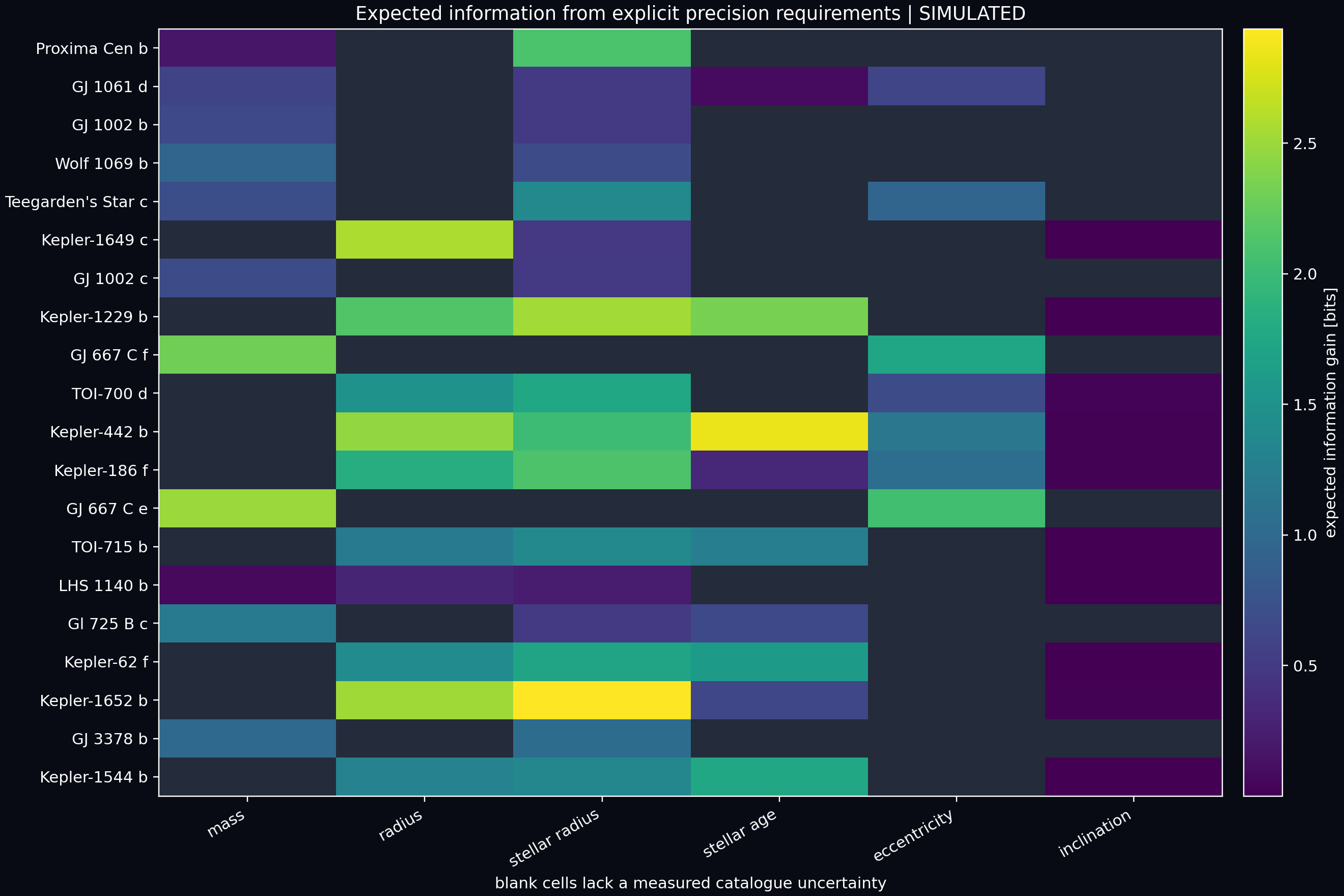
Expected information gain for measurement actions across leading candidates
The heatmap reports synthetic linear-Gaussian information in bits. Cost, observing time and instrument feasibility are not modelled.