Earth
- ESI
- 1.000
- Conservative HZ
- 1.00
only known inhabited control
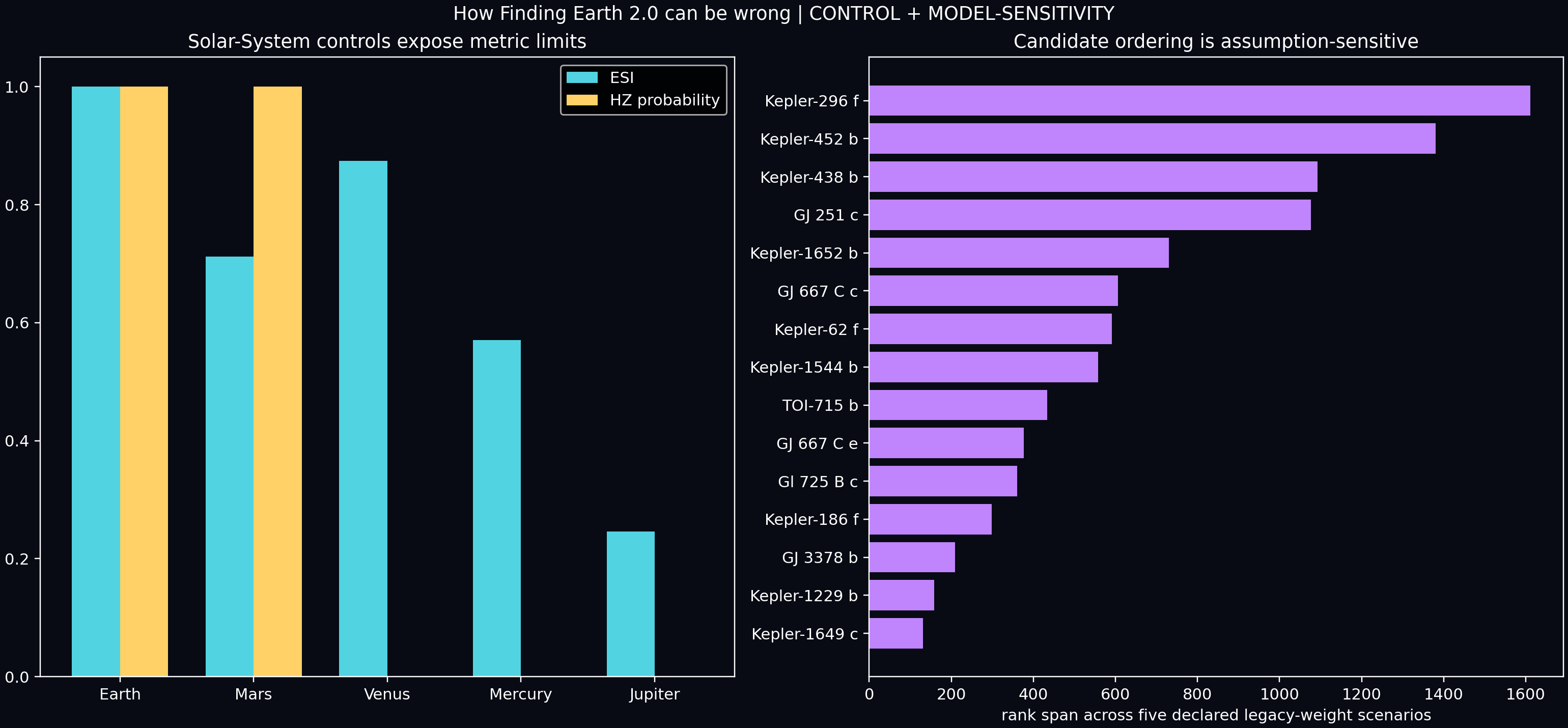
Earth, Venus, Mars, Mercury and Jupiter pass through the same scoring machinery as the exoplanets. Their known outcomes reveal what the metrics cannot infer.
Five unranked Solar-System controls · same equations · known physical counterexamples
5
control worlds
kept outside exoplanet ranks
0.874
Venus ESI
high bulk similarity
0.0
Venus HZ probability
conservative boundary
0
life probabilities
no metric estimates biology
What the analysis found
Venus receives a high Earth Similarity Index even though its observed surface is hostile. Mars can satisfy a nominal habitable-zone test while remaining cold, arid and low-pressure. These controls falsify the reading of similarity or orbital irradiation as a habitability detector.
only known inhabited control
cold arid low-pressure control
hostile runaway-greenhouse control
airless hot/cold control
gas-giant control