The catalogue is the visible tip
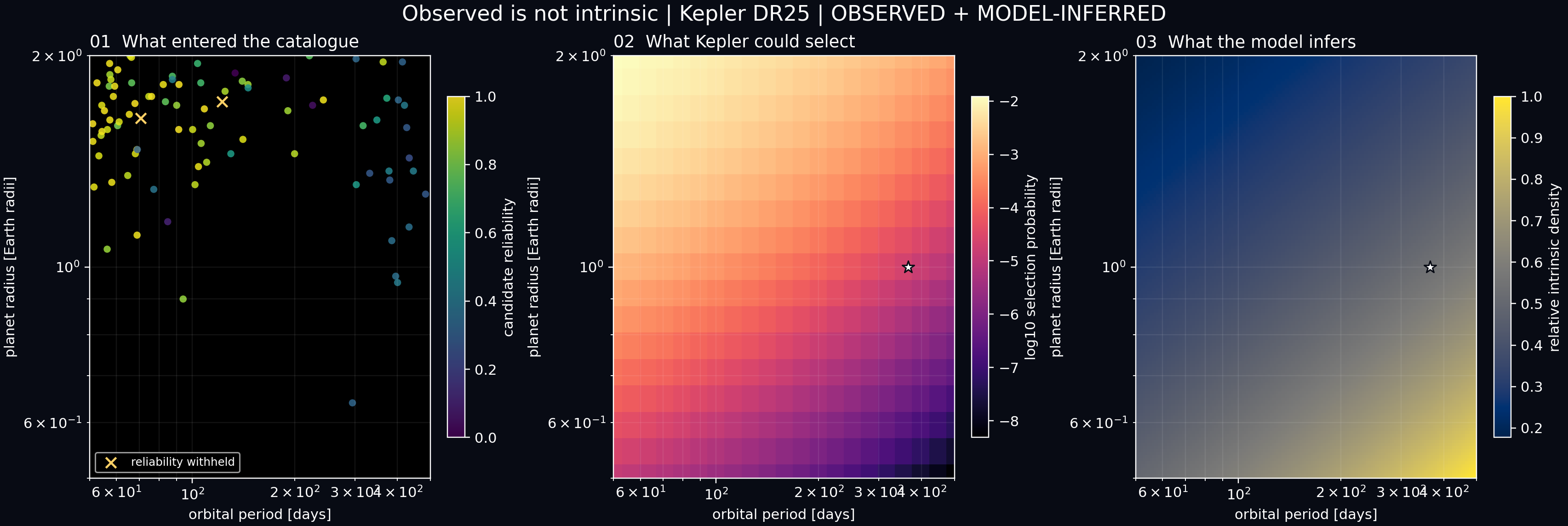
Finding Earth 2.0 reconstructs the selection that shaped Kepler DR25, then asks which intrinsic population is consistent with the signals that survived.
Fixed domain · selected GK dwarfs · reliability and completeness propagated
114,105
selected target stars
survey denominator
89
catalogue candidates
observed entries
78.3
effective stars
selection-corrected exposure
0.692
planets per star
0.412–1.209 (16–84%)
What the analysis found
Detection losses dominate near an Earth-like orbit
The difference between a catalogue count and a population estimate is the missing part of the survey: geometric transits that never occur, phases that were not observed, signals the pipeline misses, candidates rejected by vetting, and remaining false-alarm uncertainty. Reversing that chain produces a broad posterior rather than a single corrected count.
Observed / corrected lens
One survey, two different questions
What entered the catalogue
OBSERVED114,105
searched stars · selected GK dwarfs
89
catalogue candidates · KOIs in the fixed box
These counts describe detected and reliability-adjusted signals in the declared DR25 sample. They retain the imprint of transit geometry, observing windows, pipeline recovery and vetting.