What the corrected fit shows
The timing-adjusted transit is strongly preferred by ΔBIC = 133598.4. Its fitted midpoint is -0.008 hours from the historical prediction; the model's mid-transit depth is 34333.5 ± 146.3 ppm. The support decision uses ΔBIC ≥ 10; timing-search p-values are not presented as blind-detection probabilities.
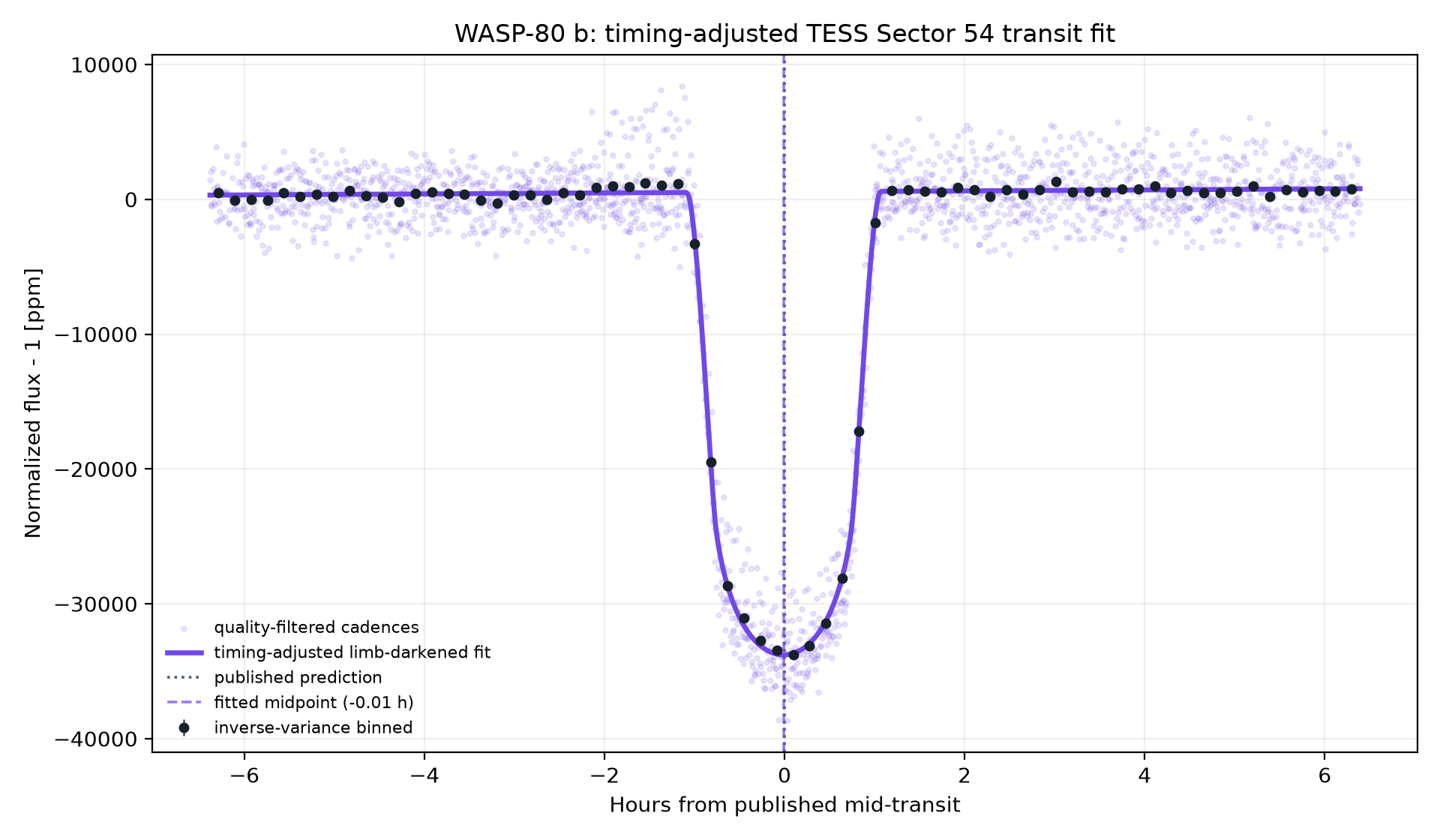
Explicit model comparison
BIC = 138027.24
BIC = 4428.83
The null fits a local intercept and slope. The transit adds bounded midpoint, radius-ratio, and impact-parameter freedom while retaining the same baseline terms. Fixed limb darkening and circular geometry make this a diagnostic fit rather than a full system retrieval.
Available-sector robustness and noise
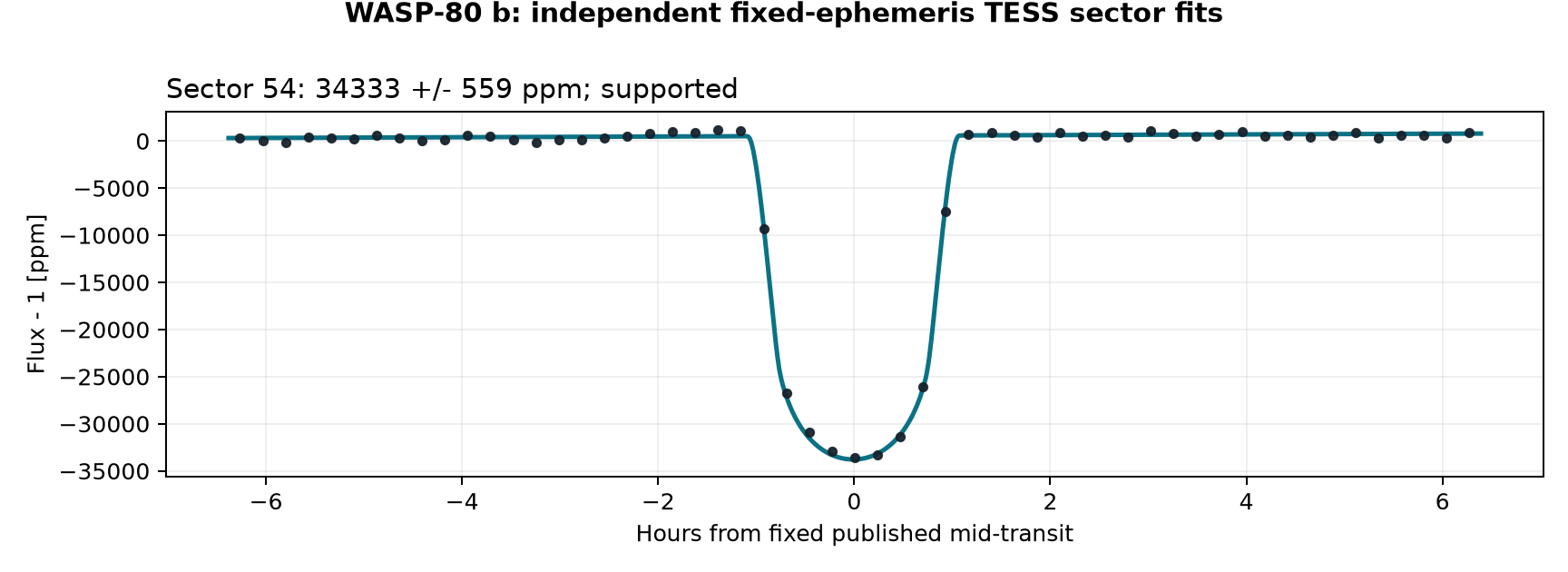
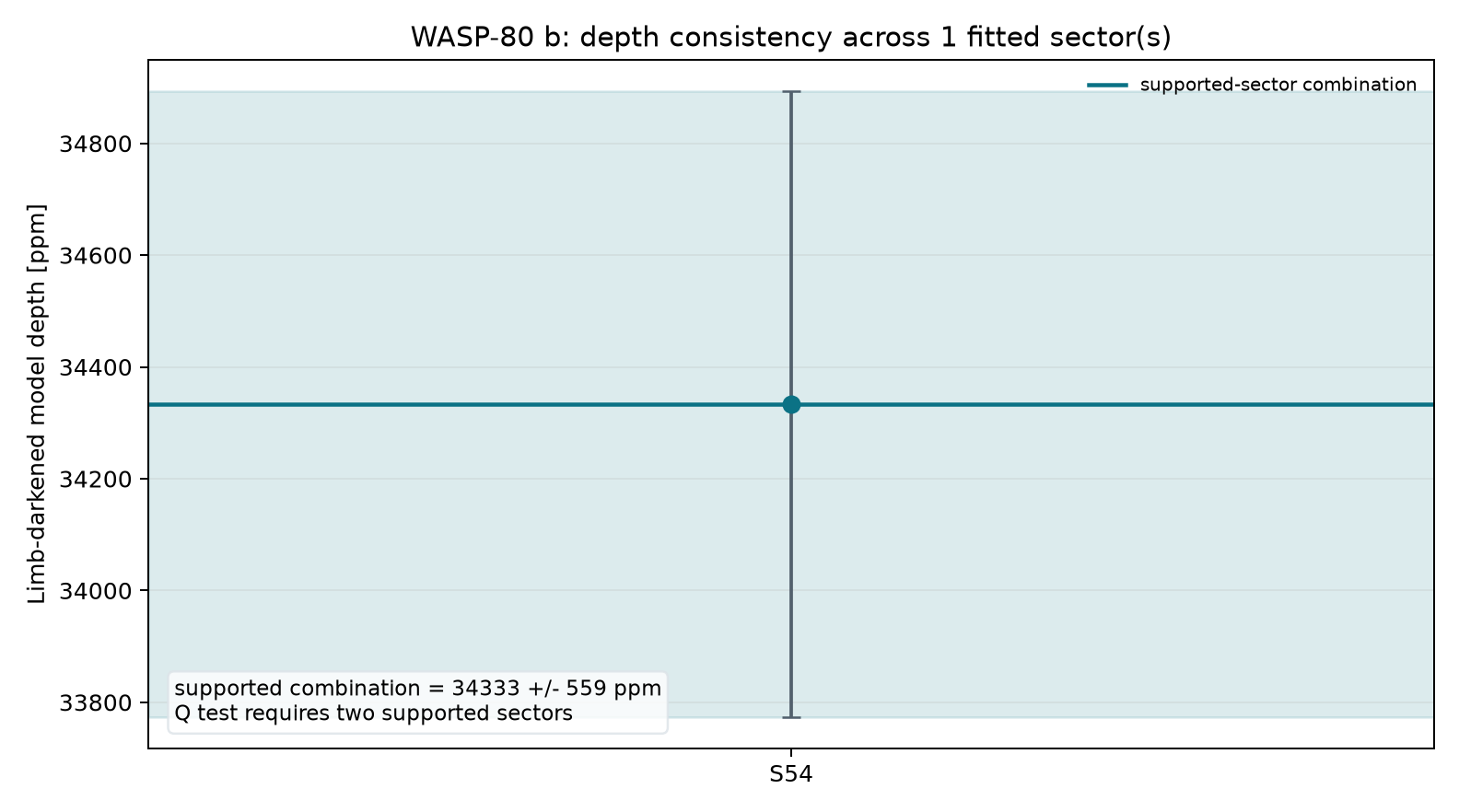
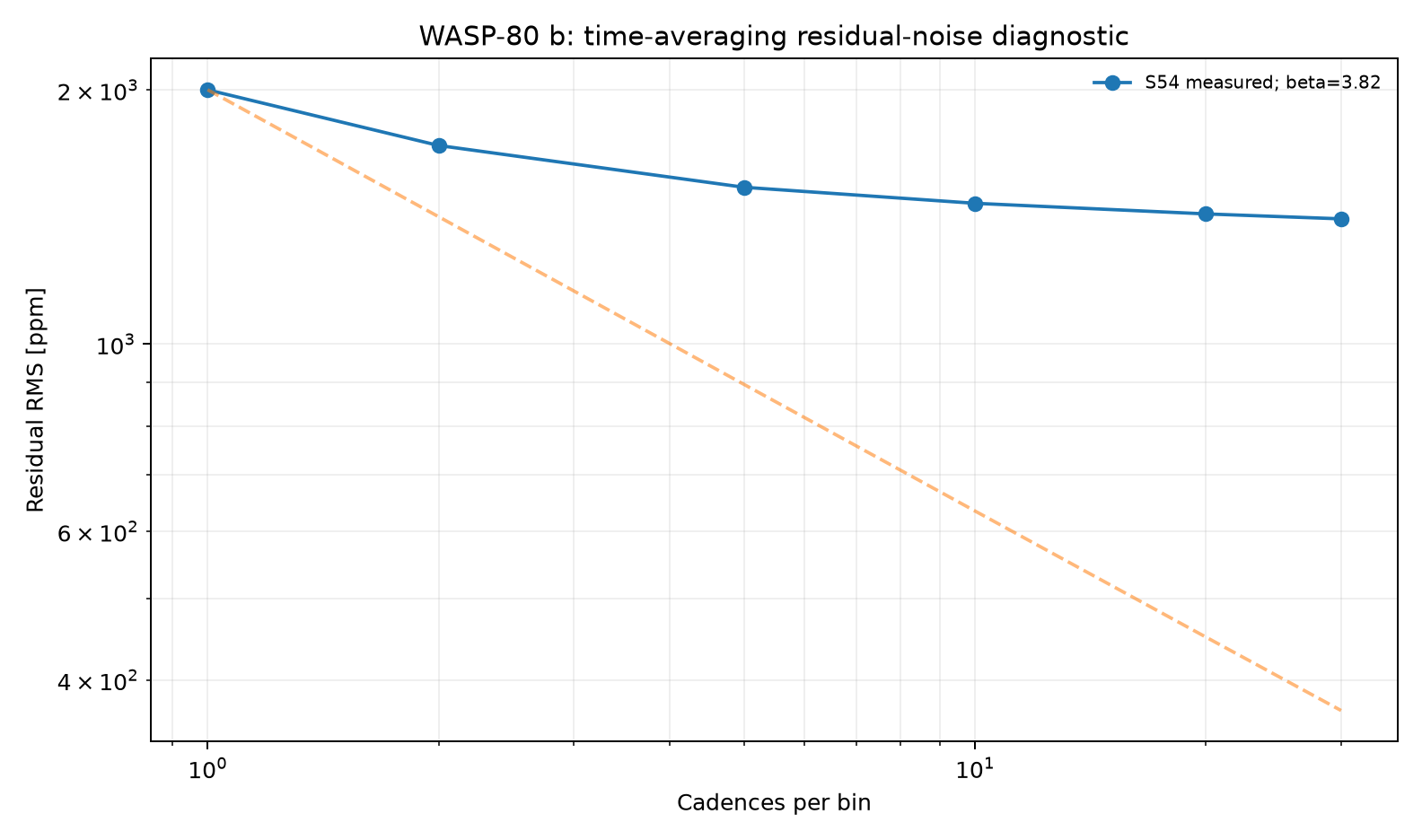
MAST exposes one SPOC time-series sector for this target in the queried result: S54. Its timing-adjusted fit meets Delta BIC >= 10, and the formal depth error is inflated by sqrt(max(reduced chi-square, 1)) times the residual time-averaging beta factor. A sector-to-sector Q test is impossible with one sector; this is an explicit acquisition-limit diagnostic, not evidence of cross-sector stability.
Atmospheric evidence: detection, limit, or unknown?
The Nature retrieval reports methane from both transmission and emission and water at differing significance. CO, CO2, NH3, and SO2 were included but not constrained in the narrow NIRCam band. This repository records the evidence hierarchy without pretending that TESS photometry can measure composition.
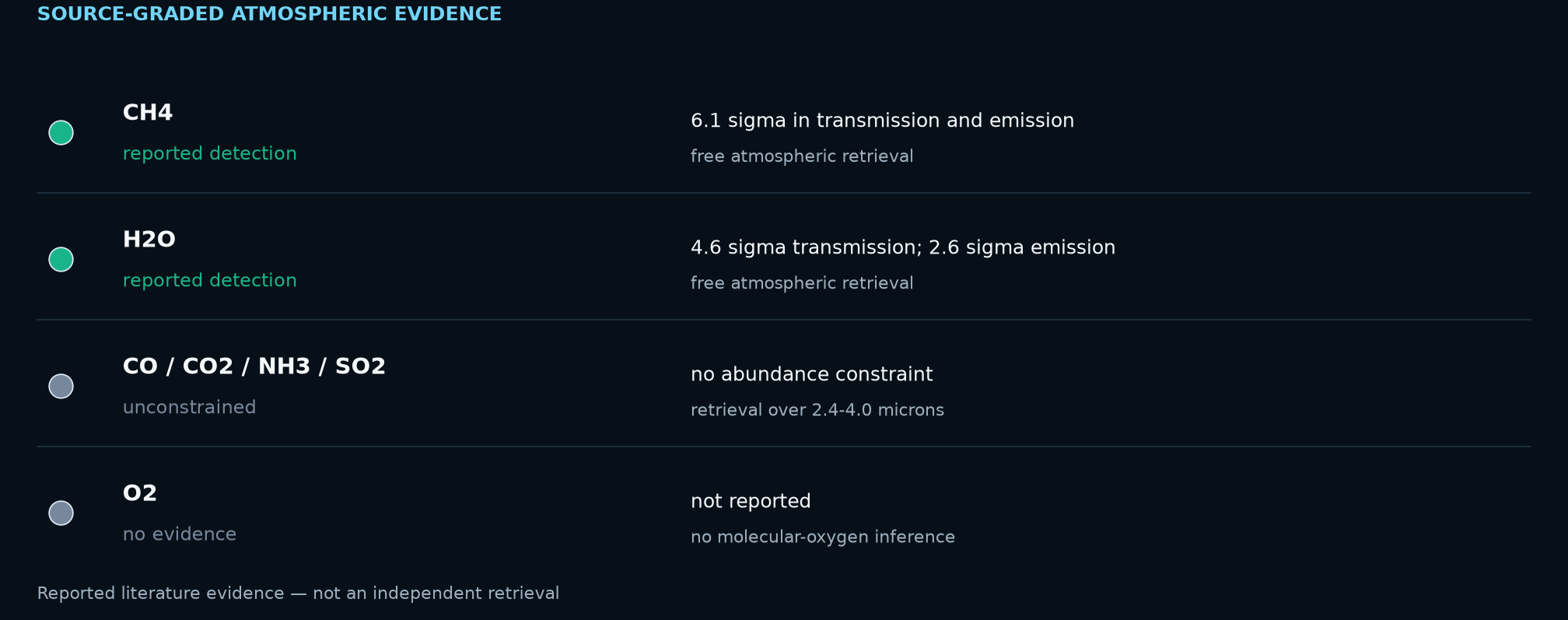
| Species | Status | Evidence | Basis |
|---|---|---|---|
| CH4 | reported detection | 6.1 sigma in transmission and emission | free atmospheric retrieval |
| H2O | reported detection | 4.6 sigma transmission; 2.6 sigma emission | free atmospheric retrieval |
| CO / CO2 / NH3 / SO2 | unconstrained | no abundance constraint | retrieval over 2.4-4.0 microns |
| O2 | no evidence | not reported | no molecular-oxygen inference |
Primary source: Bell et al. 2023, Nature. Oxygen-bearing molecules are not detections of molecular oxygen (O2) and are not, by themselves, biosignatures.
Does the supplied methane morphology depend on binning?
The source workbook is reconstructed at native sampling, then evaluated at bin factors 1, 2, 4, 5, 8, and 10 with every possible integer origin. The no-CH4-minus-full residual contrast stays positive in all 60 reported designs. The smallest leave-one-complete-bin values are 39.80 in transmission and 154.20 in emission.
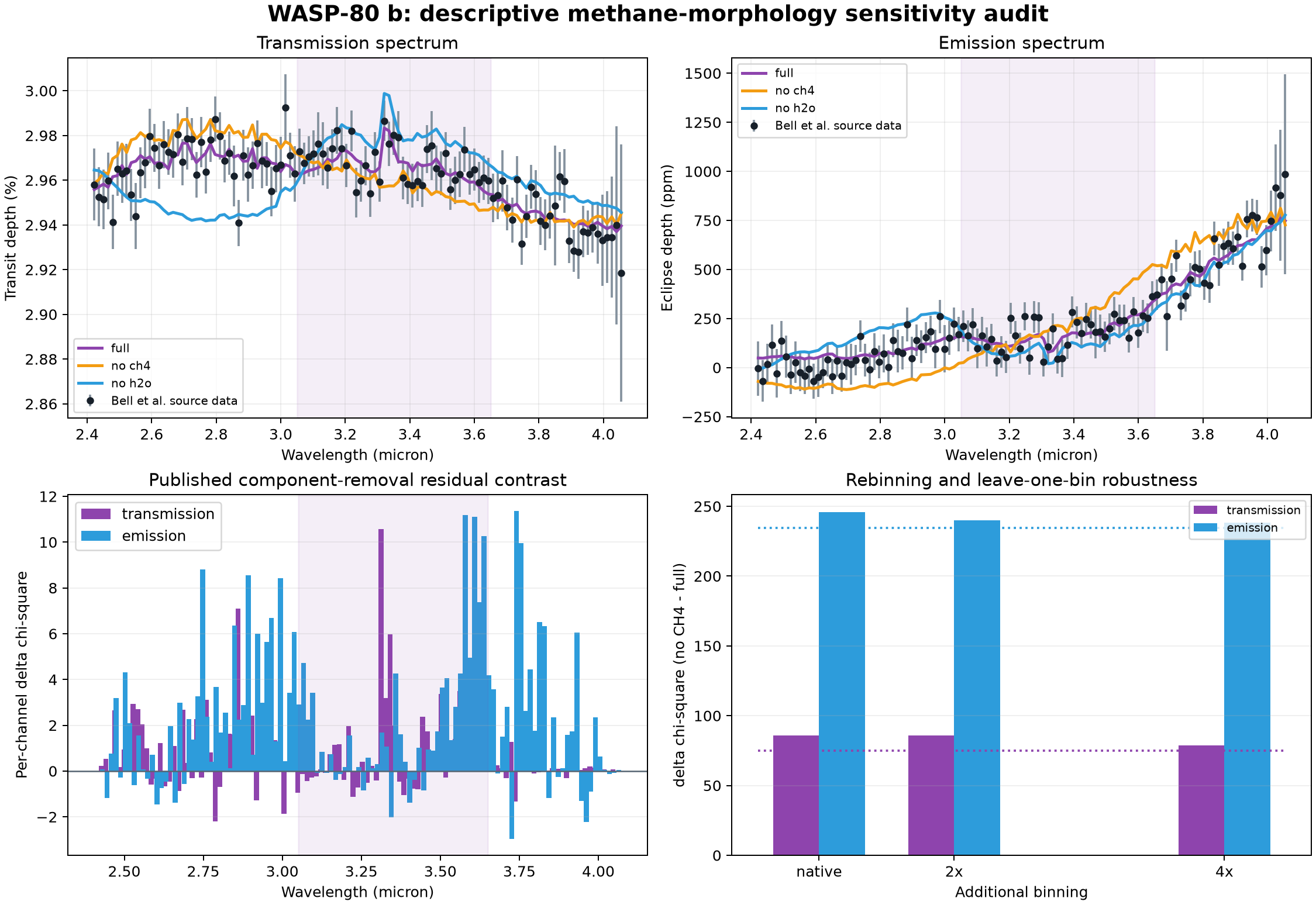
Boundary: the component-removed curves are posterior spectral post-processing from a retrieval fitted to these same observations—not independently refitted nested null models. The contrast is a morphology sensitivity diagnostic, not an independent detection significance or validation set.
Published log10(CH4) abundances of -4.2 (+0.5/-0.7) in transmission and -3.9 (+0.6/-0.7) in emission differ by 0.34 sigma under a simple symmetrized independent-error comparison. That descriptive agreement does not replace the joint posteriors.
Research upgrade: before and after
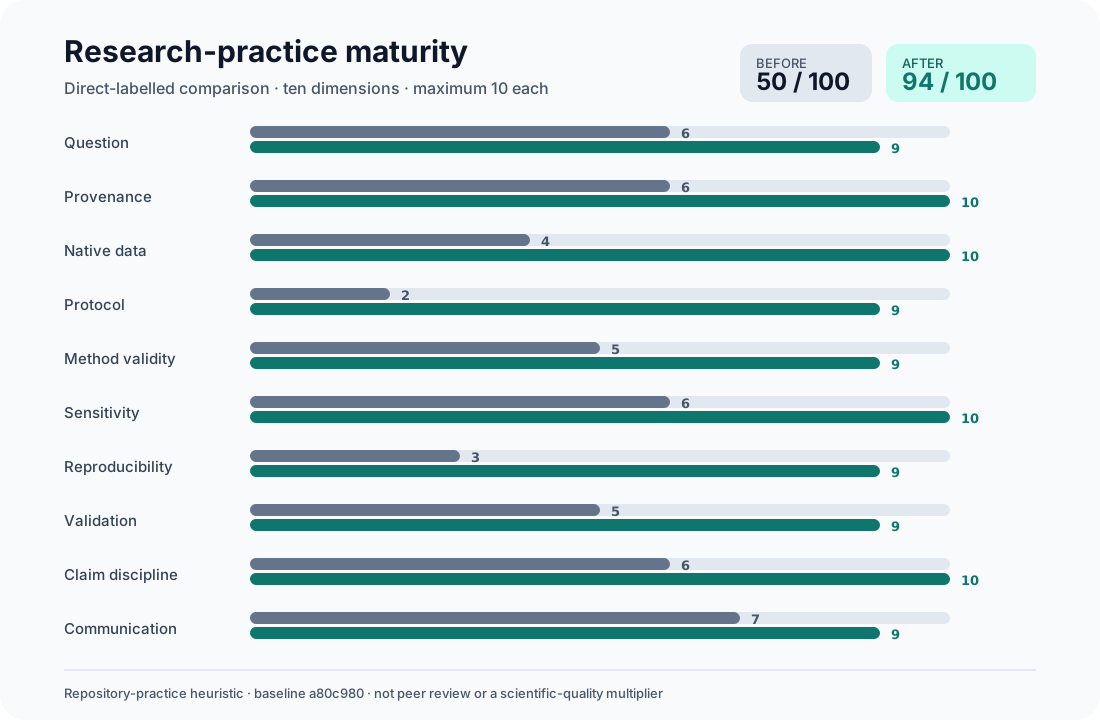
Read the methods, claims ledger, limitations, reproducibility guide, and machine-readable result summary.
The system
| Radius | 11.20 Earth radii |
|---|---|
| Mass | 170.99 Earth masses |
| Orbital period | 3.067852 days |
| Transit duration | 2.131 hours |
| Semi-major axis | 0.0344 AU |
| Equilibrium temperature | 825 K |
| Host and distance | WASP-80 · 49.79 pc |
| Discovery | 2012 · Transit · SuperWASP |
Values are from the exact saved NASA Exoplanet Archive pscomppars row in data/system_parameters.csv.
Data and reproducibility
The observed photometry is the public MAST file tess2022190063128-s0054-0000000243921117-0227-s_lc.fits, TESS Sector 54, collection DOI 10.17909/t9-nmc8-f686. The observed spectra and supplied atmospheric-model contours come from the Bell et al. Nature source workbook. Exact archive URLs, transformations, retrieval dates, and checksums are in data/SOURCE.md.
Run python scripts/prepare_spectral_data.py for an explicit source replay, then the four analysis scripts and pytest tests/ -v. Numerical CSV and JSON evidence is regenerated and diff-checked in CI on Python 3.10, 3.12, and 3.13.
Limitations
- The component-removed curves are posterior spectral post-processing, not independently refitted nested null models.
- Spectral covariance matrices and posterior samples are absent from the source workbook; the sensitivity audit uses diagonal observed errors.
- The 60 binning designs reuse the same observations and are not independent replications.
- Only one SPOC time-series sector is available in the queried MAST result, so cross-sector stability cannot be tested.
- The TESS fit fixes circular geometry, limb darkening, and scaled semi-major axis; published global fits remain authoritative.
References
- Triaud et al. 2013 — discovery reference listed by the NASA Exoplanet Archive.
- Ricker et al. (2015), Transiting Exoplanet Survey Satellite (TESS), doi:10.1117/1.JATIS.1.1.014003.
- TESS Team, TESS Light Curves — All Sectors, MAST, doi:10.17909/t9-nmc8-f686; Sector 54 used here.
- Bell et al. (2023), Methane throughout the atmosphere of the warm exoplanet WASP-80b, Nature 623, 709-712, doi:10.1038/s41586-023-06687-0.
- NASA Exoplanet Archive, saved TAP row retrieved 2026-08-15.