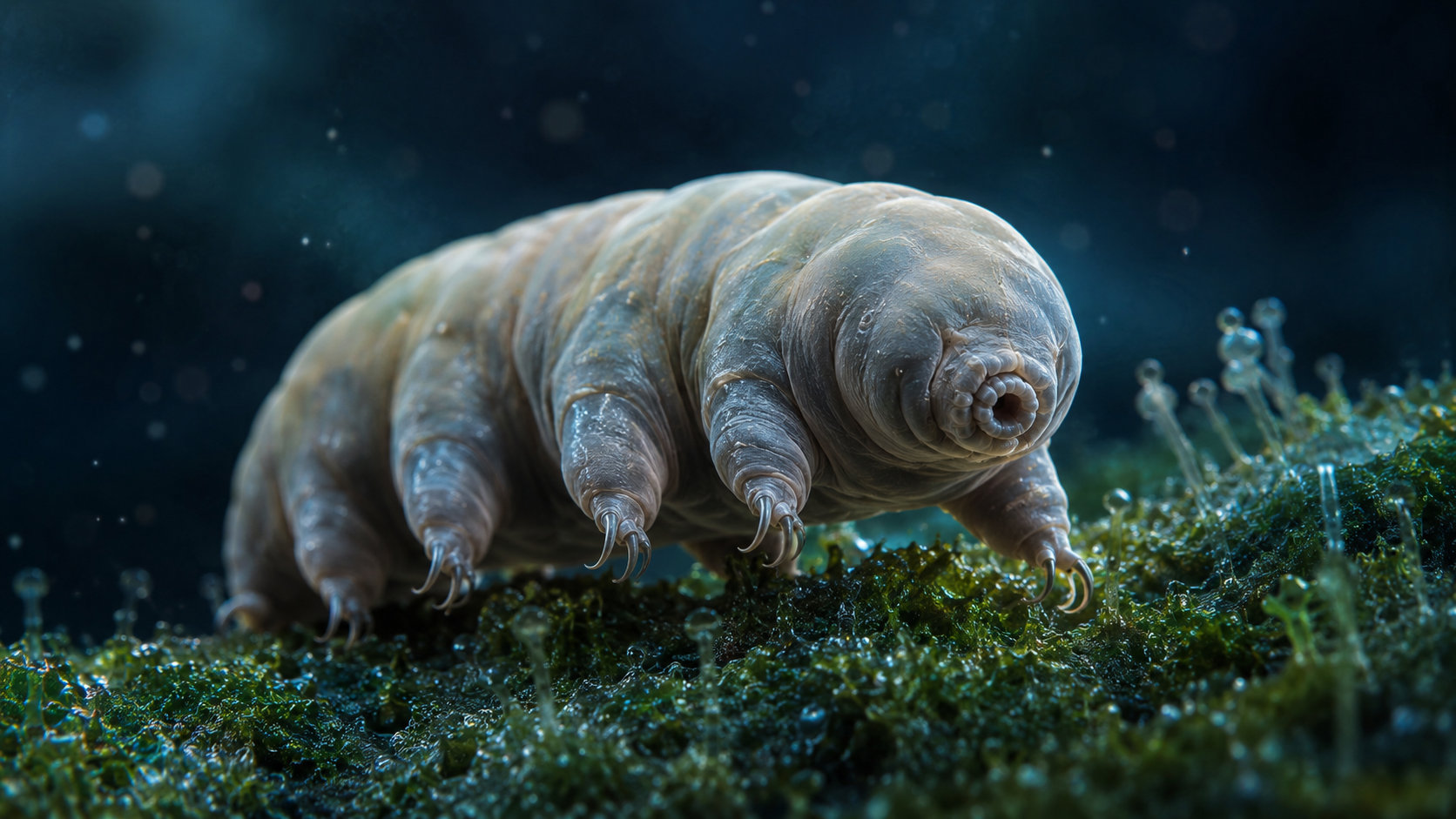
They are tiny animals, not mythical dust particles.
Tardigrades are microscopic invertebrates with eight legs, claws, a mouth apparatus called a buccal-pharyngeal system, a cuticle, muscles, a nervous system and a digestive tract. They are small, but not simple in the way bacteria are simple.
Most live in water films around mosses, lichens, leaf litter, soil, freshwater and marine sediments. Even when they are described as “terrestrial”, they still usually need liquid water around their bodies to feed, move and reproduce. Their active life is watery and ordinary-looking. Their survival state is the dramatic part.
When conditions become awful, they stop participating.
Cryptobiosis is the central trick. During drying, a tardigrade can pull in its legs, contract its body and form a compact “tun”. In this state, normal metabolism becomes extremely low or undetectable, water content drops, and the animal becomes much more resistant to physical and chemical damage.
This is not ordinary sleep. It is a survival architecture. The body becomes a protected package: membranes must not tear, proteins must not unfold irreversibly, DNA damage must be limited or repaired, and cells must survive long enough to restart once water returns.
Active state: feeding, moving, reproducing. Tun state: metabolism suppressed, water reduced, stress tolerance increased.
They tolerate extremes, but context matters.
Tardigrades can survive drying, freezing, vacuum, radiation and pressure conditions that would destroy most animals. But the headline numbers often hide the caveats: species differ, active animals differ from dried tuns, exposure time matters, and survival after rehydration is not the same as healthy reproduction.
For example, active tardigrades are much more vulnerable to high temperature than the internet version suggests. Some spectacular tolerance values come from short exposures or cryptobiotic states. Biology is impressive, but it still reads the small print.
They survived exposure to space, which is ridiculous and also limited.
In the 2007 FOTON-M3/BIOPAN experiments, dehydrated tardigrades were exposed in low Earth orbit to space vacuum, and some groups also to solar ultraviolet radiation. The result became famous because animals returned from direct exposure to space and some revived after rehydration.
The key nuance is ultraviolet radiation. Vacuum alone was much less damaging than the combined space-vacuum plus full solar UV case. Samples shielded from solar UV had much better recovery than those exposed to the full radiation environment. In other words, the headline is not “space is fine”. The headline is closer to: “if dried, shielded and lucky, some tardigrades can survive parts of space long enough to make everyone uncomfortable.”
The most important lesson is restraint.
Tardigrades are often presented as proof that life can survive anywhere. That is too strong. They show that some biological systems can endure temporary extremes, especially in dormant form. They do not prove that active ecosystems can grow on the Moon, Mars, Europa, or a random hostile exoplanet.
A surviving tardigrade still needs the basics: liquid water, usable chemistry, a suitable temperature range, food and time. Without those, it is not building a civilisation. It is just a microscopic raisin waiting for better management.
Survival is short-term persistence through stress. Habitability requires conditions that allow metabolism, repair, growth and reproduction.
Why should astrophysics care about tiny water bears?
Tardigrades sit at a useful boundary between biology and planetary environments. They help us ask better questions about desiccation, radiation, dormancy, repair and the limits of multicellular life. That matters for astrobiology because worlds are not judged only by whether life is comfortable; they are also judged by whether life can persist through bad intervals.
For exoplanets, that means climate cycles, flares, ultraviolet radiation, atmospheric loss, frozen phases and dry phases are not just background details. They define whether biology gets repeated chances. Tardigrades are not aliens, but they are a useful warning against assuming life is fragile in only one simple way.
The Moon tardigrade story is funny until it becomes a contamination problem.
In 2019, the Israeli Beresheet lunar lander crashed on the Moon carrying a small archive that reportedly included dehydrated tardigrades. The realistic scientific view is not that tiny bears are now colonising the Moon. The Moon lacks liquid water, food and a friendly environment. Even if some dormant organisms survived impact, revival would not happen without the missing conditions.
Still, the incident is useful because it highlights planetary protection. If we send biology into space casually, we make future life-detection questions harder. Contamination can be scientifically annoying even when it is biologically unlikely to bloom.
The lesson is not immortality. It is resilience.
Tardigrades remind us that life can be more flexible than intuition suggests. Still, surviving an extreme environment is not the same as thriving there. Even water bears have limits. Very rude of physics, honestly.
The reason they are fascinating is not that they break biology. It is that they reveal how biology can pause, protect itself, and restart when the world becomes reasonable again.
References
- Jönsson, K.I., Rabbow, E., Schill, R.O., Harms-Ringdahl, M. and Rettberg, P. (2008) ‘Tardigrades survive exposure to space in low Earth orbit’, Current Biology, 18(17), pp. R729–R731. doi:10.1016/j.cub.2008.06.048.
- Erdmann, W. and Kaczmarek, Ł. (2017) ‘Tardigrades in space research — past and future’, Origins of Life and Evolution of Biospheres, 47, pp. 545–553. doi:10.1007/s11084-016-9522-1.
- Møbjerg, N. et al. (2011) ‘Survival in extreme environments — on the current knowledge of adaptations in tardigrades’, Acta Physiologica, 202(3), pp. 409–420.
- Neves, R.C. et al. (2020) ‘Thermotolerance experiments on active and desiccated states of Ramazzottius varieornatus emphasize that tardigrades are sensitive to high temperatures’, Scientific Reports, 10, 94.
- NASA (n.d.) ‘The Human Body in Space’. Available at: NASA Humans in Space.