Astrobiology · exoplanets · orbital comfort zone

The Habitable Zone: Astronomy’s Most Misunderstood Comfort Zone

The habitable zone is not a cosmic estate-agent brochure. It is a rough energy-balance idea, and life still has to do the hard part.

Welcome to the habitable zone: the region where liquid water might exist, assuming the planet is not being rude in twelve other ways.
2026-05-08 · Hertford, London, UK 11 min read Interactive habitable-zone lab
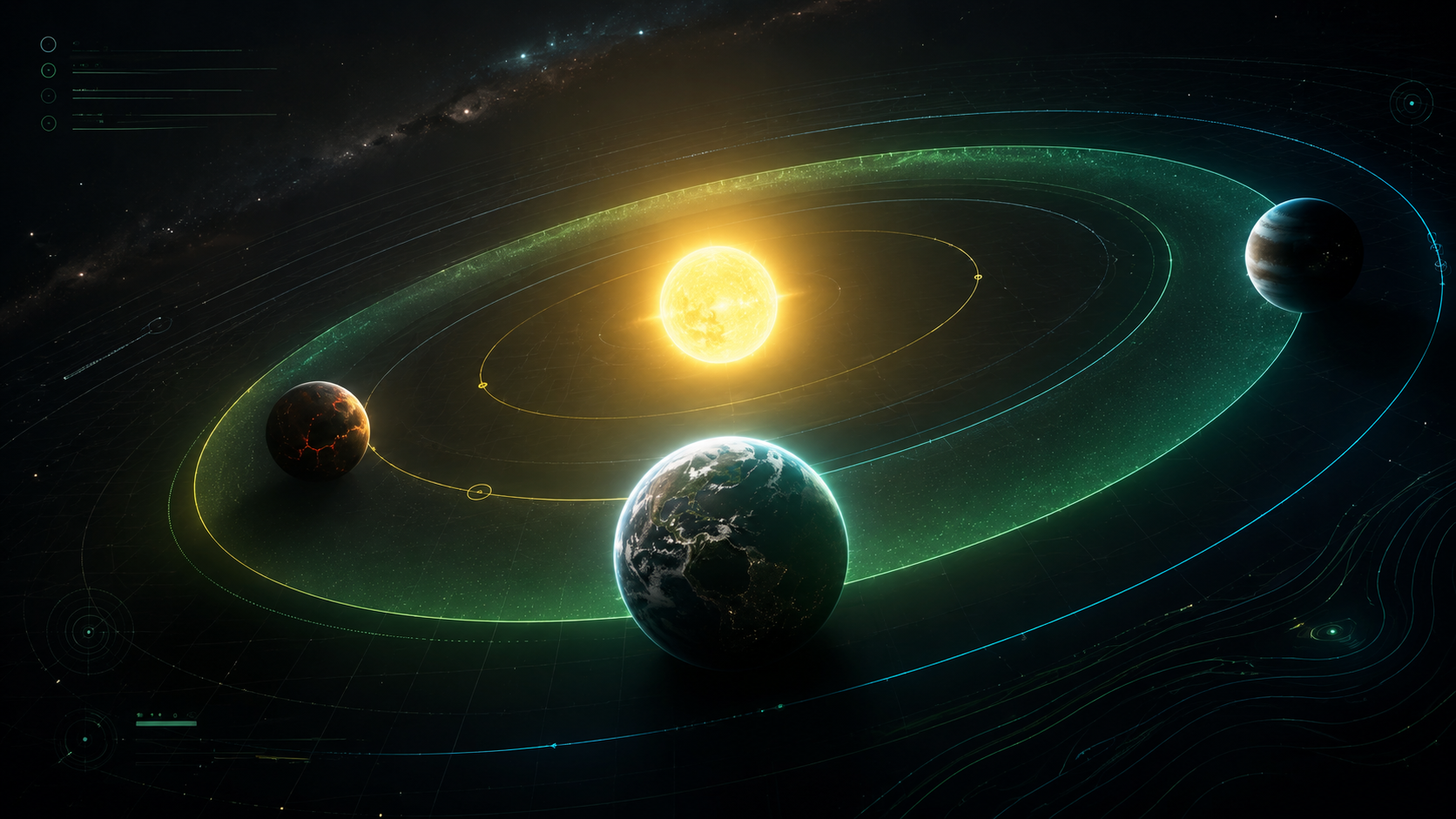
Habitable zone exoplanet diagram hero image
A planet in the habitable zone is not automatically habitable. Astronomy really said: terms and conditions apply.

Habitable Zone Lab

Change star luminosity, orbit, and greenhouse strength. The green band moves because stars are not identical lamps.

Climate Readout

Inner HZ estimate--
Outer HZ estimate--
Equilibrium temperature--
Habitability mood--
Exoplanets · water · climate

The habitable zone is useful, but it is not destiny.

The habitable zone is often described as the region around a star where liquid water could exist on a planet’s surface. That is a good start. It is also where the oversimplification usually begins.

Chapter 01 · The zone

Distance matters because energy matters.

Move a planet too close to its star and it receives too much energy. Move it too far away and it receives too little. Somewhere in between is the rough region where surface liquid water becomes plausible.

Simple flux scaling
\[F=\frac{L}{4\pi d^2}\]

The flux \(F\) received by a planet depends on stellar luminosity \(L\) and orbital distance \(d\).

Chapter 02 · Stellar type

Not all stars host the same comfort zone.

A dim red dwarf has a habitable zone close in. A hotter, brighter star pushes the zone farther out. This sounds simple until stellar activity, flares, ultraviolet radiation, and lifetime enter the chat.

Red dwarfsLong-lived but often active. The habitable zone may be close enough for tidal locking.
Sun-like starsComfortably familiar, because our sample size of confirmed life is embarrassingly one.
Chapter 03 · Atmosphere

The atmosphere can rescue or ruin everything.

A planet’s atmosphere controls greenhouse warming, pressure, heat redistribution, chemistry, and surface stability. A planet can sit inside the habitable zone and still be sterile, frozen, roasted, stripped, or just generally unpleasant.

Equilibrium temperature idea
\[T_{\mathrm{eq}}\propto\left(\frac{L(1-A)}{d^2}\right)^{1/4}\]

Albedo \(A\), luminosity, and distance all affect the approximate equilibrium temperature.

Chapter 04 · Limits

The phrase “Earth-like” is doing too much unpaid labour.

Mass, atmosphere, magnetic field, geology, ocean inventory, rotation, stellar activity, and history all matter. The habitable zone is a filter, not a verdict.

Takeaway

The habitable zone is where questions begin.

It helps identify promising planets, but habitability is a planetary systems problem, not a single distance label. The zone is useful. The hype around it needs supervision.