Vacuum is not nothing. It is the absence of things you need.
Humans evolved inside an atmosphere. That atmosphere supplies oxygen, applies pressure, helps regulate temperature, carries sound, spreads heat by convection, and generally behaves like a life-support blanket we rarely appreciate. Space removes most of that without even looking busy.
The first engineering problem is pressure. A spacecraft cabin and a spacesuit are not just containers; they are pressure vessels. They must hold an internal atmosphere against a surrounding environment where the external pressure is extremely low. If pressure is lost, oxygen delivery fails and dissolved gases in bodily fluids become a serious problem. The cinematic version is an explosion. The real version is a checklist turning into a medical emergency very quickly.
In space, \(P_{\mathrm{outside}}\) is close to zero compared with a cabin atmosphere. The structure, seals, windows, gloves and suit joints must all live with this pressure difference.
Weightlessness is fun for the camera and rude to the body.
Microgravity looks graceful in videos: floating pens, drifting water bubbles, astronauts moving like they have unlocked a cheat code. Biology is less amused. Without the normal loading from Earth’s gravity, bones and muscles are no longer asked to do their usual jobs.
NASA summarises the Mars-mission gravity problem as a sequence of changing gravity fields: weightlessness during transit, partial gravity on Mars, and readaptation to Earth after return. These transitions affect spatial orientation, balance, locomotion, hand-eye coordination and cardiovascular regulation.
One of the clearest numbers is bone loss. NASA reports that weight-bearing bones lose on average about 1% to 1.5% of mineral density per month during spaceflight unless countermeasures are used. Muscle mass also declines faster in microgravity without the right exercise routine. Suddenly, leg day becomes spacecraft maintenance.
Radiation is the invisible part of the horror movie.
Earth gives us a magnetic field and an atmosphere. Space mostly does not. Outside that protection, astronauts encounter a radiation environment made from several sources: particles trapped in Earth’s magnetic field, solar energetic particles from the Sun, and galactic cosmic rays arriving from beyond the Solar System.
The nasty part is that not all radiation is equally easy to shield. Solar particle events can be operationally managed with forecasting, storm shelters and mission planning. Galactic cosmic rays are a deeper problem because they are highly energetic and can produce secondary particles when they hit shielding. Space radiation is therefore not only a “put thicker metal around it” problem; material choice, mission duration, trajectory, solar activity and biological uncertainty all matter.
NASA describes radiation exposure as one of the major threats to astronaut health, with risk areas including carcinogenesis, degenerative tissue effects, central nervous system effects and acute radiation syndromes. It also notes that long-duration missions beyond low Earth orbit require more knowledge before confident exposure-limit recommendations can be made.
In space, thermal control is not optional.
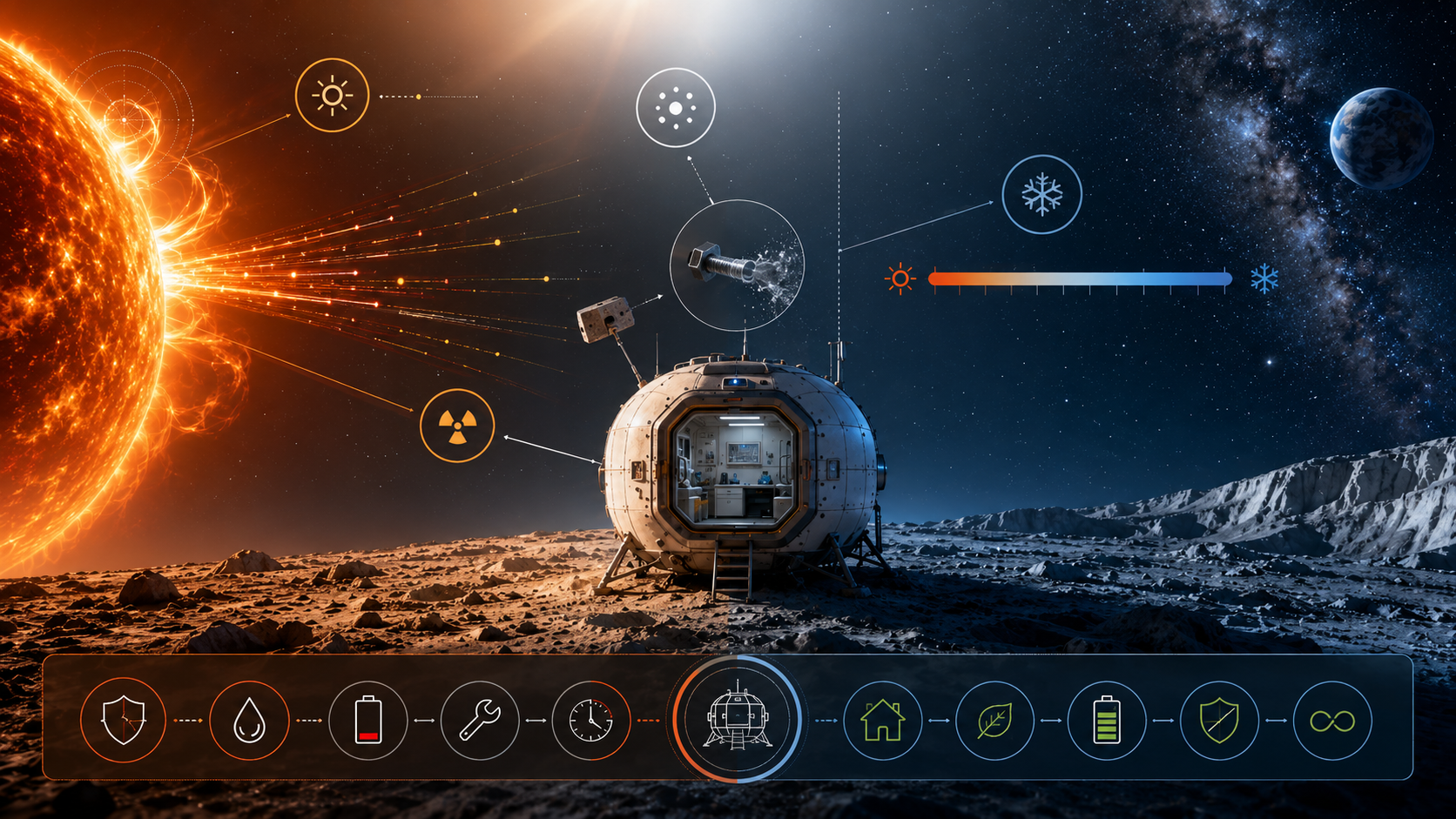
On Earth, air quietly helps you move heat around. In space, convection effectively disappears outside the spacecraft. Heat must be handled mainly by conduction through structures and radiation to or from space. Sunlit surfaces can heat strongly while shaded surfaces cool dramatically.
That is why spacecraft look so engineered: radiators, multilayer insulation, heaters, coatings, louvers, thermal straps and careful orientation all contribute to keeping instruments and crew spaces within operational limits. Space is not simply “cold”; it is thermally inconvenient. You can overheat in sunlight and freeze in shadow, sometimes on the same vehicle.
In vacuum, radiating heat away depends strongly on temperature. The fourth power is the universe’s way of saying thermal design is not a suggestion.
Small particles become serious at orbital speed.
A tiny object moving at kilometres per second can damage spacecraft surfaces, optics, solar arrays or pressure vessels. Size is not the whole story. Velocity arrives with opinions.
This is why micrometeoroids and orbital debris are treated as an engineering environment. Shielding is often layered: an outer bumper can break up or disperse a projectile before the remaining cloud reaches the pressure wall. The point is not to make the spacecraft invincible; it is to make the risk survivable.
The velocity term is squared. Translation: a small particle at orbital speed can behave like a very tiny disaster.
A spacecraft is also an ecosystem, and ecosystems are annoying.
Life support is not only oxygen tanks and dramatic alarms. A real habitat must manage air composition, humidity, temperature, carbon dioxide, trace contaminants, water recycling, food stability, microbes, noise, light cycles, sleep, maintenance and human behaviour. NASA notes that hostile and closed environments are one of the five major human-spaceflight hazard areas for Moon and Mars missions.
The closed environment also changes the social physics. You cannot step outside for fresh air. You cannot call an engineer to come over with a replacement part. For distant missions, communication delay becomes part of the mission design. Autonomy stops being a motivational phrase and becomes a survival requirement.
Space exploration is survival engineering with a view.
Every successful mission is a negotiation with hostile conditions. Shielding, redundancy, thermal control, pressure systems, radiation monitoring, fault tolerance, exercise devices, medical training, software checks and boring-looking procedures are not background details. They are the reason the mission gets to continue.
This is why I like instrumentation and control systems. Spacecraft are full of sensors asking “Are we still alive?” in different dialects: pressure transducers, temperature sensors, radiation monitors, current sensors, flow meters, star trackers, gyros and software watchdogs. The machine survives by continuously measuring itself.
Space is beautiful because Earth is protecting you from it.
The hostility of space does not make exploration less inspiring. It makes it more impressive. Every spacecraft is a small island of controlled conditions in an environment that would otherwise win instantly.
That is the real wonder. Not that space is empty, but that we can build little pockets of Earth inside it, send them away from home, and persuade them to keep working.
References
- NASA (2026) ‘Space Radiation’. Available at: NASA Human Health and Performance.
- NASA (n.d.) ‘The Human Body in Space’. Available at: NASA Humans in Space.
- NASA (n.d.) ‘Space Station Thermal Control Systems’. Available at: NASA Reference.
- NASA Orbital Debris Program Office (n.d.) ‘Orbital Debris and Human Spacecraft’. Available at: NASA ODPO.