Exoplanet Atmosphere Report · JWST NIRISS SOSS + NIRSpec G395H
WASP-96 b
The planet whose transmission spectrum NASA unveiled on 12 July 2022 as JWST's first exoplanet result — a clear water-vapor detection that became one of the most recognized plots in the mission's history. This page works from that reduced data, plus a later analysis of its morning and evening terminators.
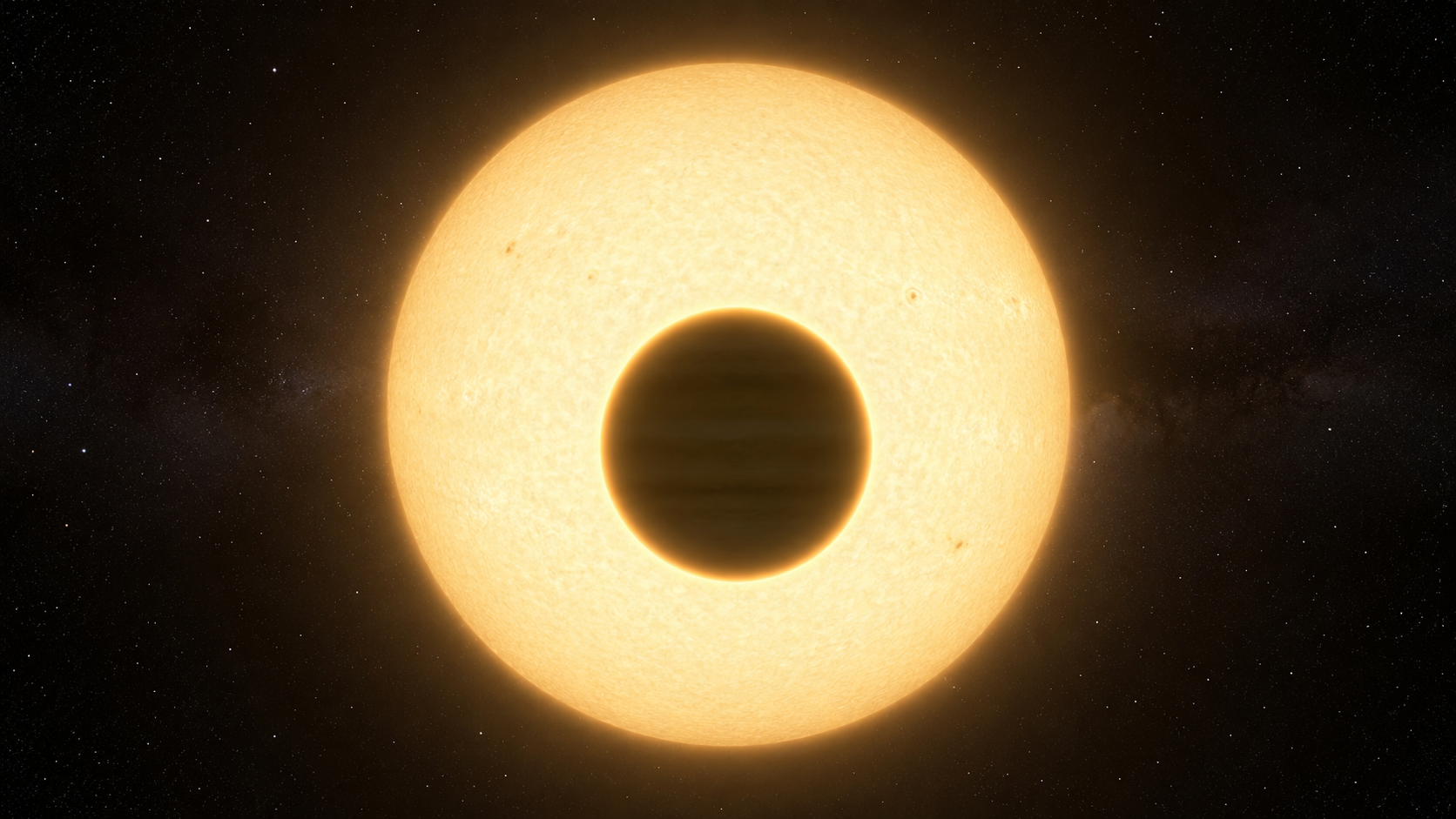
AI-generated artist's concept of WASP-96 b — not a real photograph. All data and figures in this report come from actual JWST NIRISS SOSS and NIRSpec G395H observations (see below).
The planet, in numbers
Queried live from the NASA Exoplanet Archive TAP service (pscomppars).
| Radius | 13.45 Earth radii (~1.20 Jupiter radii) |
|---|---|
| Mass | 152.6 Earth masses (~0.48 Jupiter masses) |
| Orbital period | 3.43 days |
| Semi-major axis | 0.045 AU |
| Equilibrium temperature | 1285 K |
| Host star | WASP-96, G-type dwarf, Teff = 5540 K, 1.05 Rsun, 1.06 Msun |
| Distance | 352.5 parsecs (~1150 light-years) |
| Discovery | 2014, transit photometry (WASP survey) |
Why this planet made history
WASP-96 b is a "textbook" hot Saturn: hot enough for a clear, largely cloud-free atmosphere, orbiting a bright, quiet host star, with a large predicted atmospheric signal. Those three properties made it the ideal target to demonstrate JWST's transmission-spectroscopy capability to the public, and its NIRISS SOSS spectrum — showing an unmistakable water absorption feature near 1.4 microns — was the first exoplanet result released from the telescope.
A later, more detailed study (the source of the data on this page) combined that JWST spectrum with ground-based VLT observations and reported a super-solar atmospheric metallicity and tentative evidence for photochemistry, plus a search for asymmetry between the planet's morning and evening terminators using JWST NIRSpec G395H — a test for real atmospheric circulation patterns, not just bulk composition.
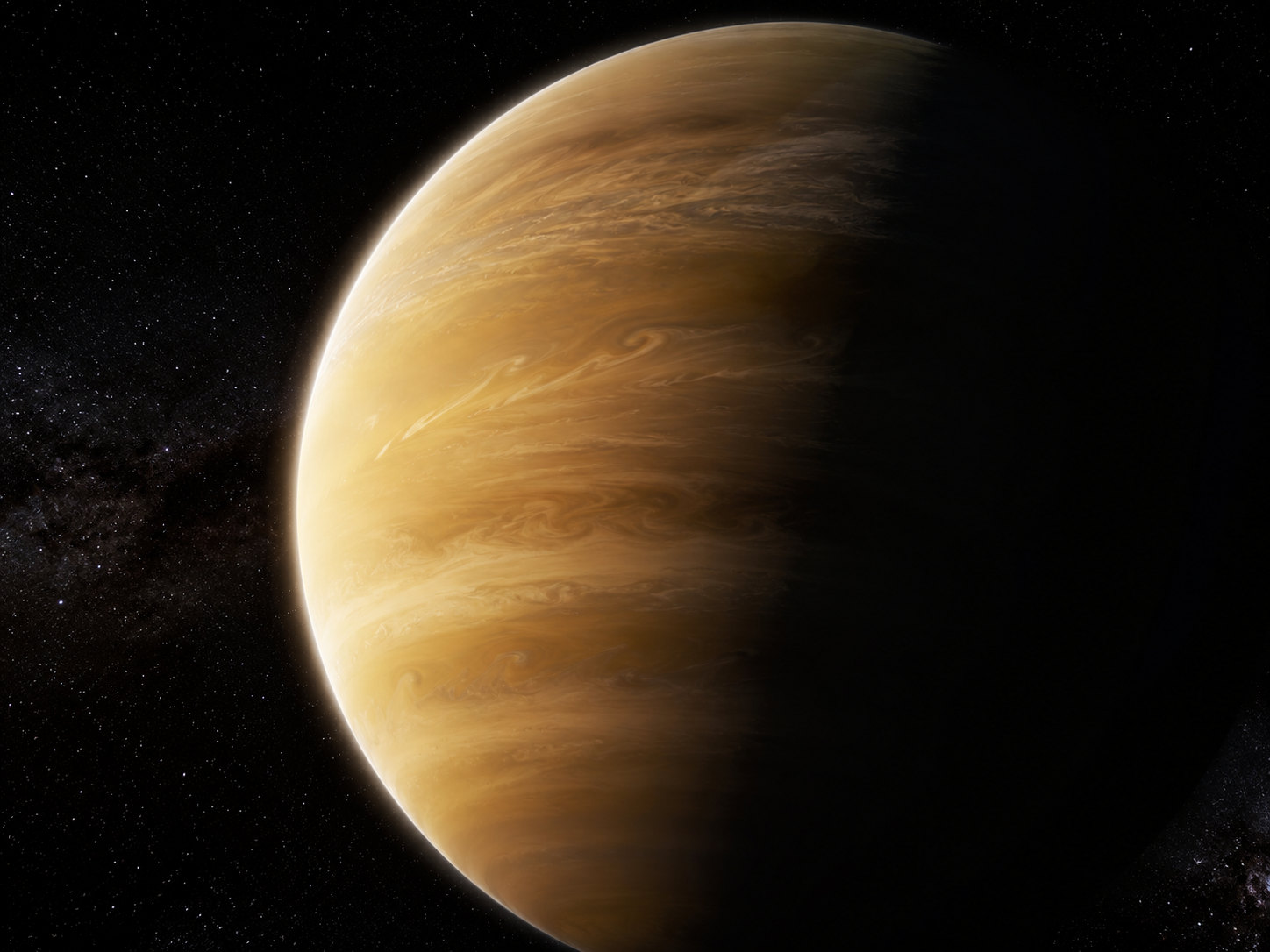
AI-generated 3D-render-style concept of WASP-96 b — not an actual image of the planet.
Two analyses from the same bundled data
The figure reproduces both results directly from the bundled data files.
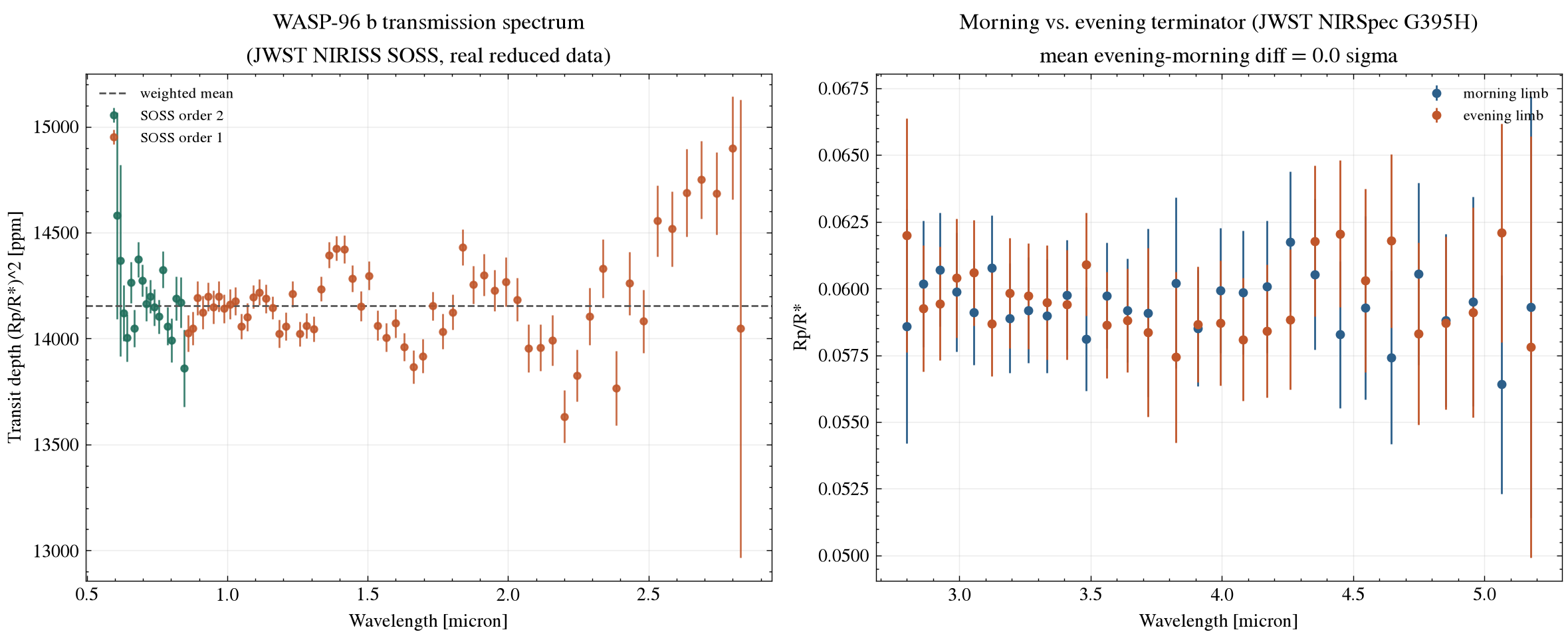
scripts/analyze_spectrum.py.The morning/evening asymmetry in this dataset comes out consistent with zero within the measurement uncertainty — matching the source study's own framing of "tentative" evidence rather than a confident detection. Two things keep this from being a complete asymmetry test on its own. First, the morning and evening Rp/R* values come from the same observations and fitting pipeline, so they can share stellar, instrumental, and fitting covariance that a simple quadrature sum of their quoted per-bin errors doesn't capture — this page's asymmetry test is a useful first-order diagnostic, not a full covariance-aware hypothesis test. Second, the peak-to-trough amplitude quoted for the transmission spectrum (1267 ppm) is an extreme-value statistic with no uncertainty of its own — it's the single largest gap between any two bins, which is more sensitive to one noisy point than a proper feature measurement would be, and is reported here descriptively rather than as a calibrated result.
Data and method notes
System parameters come from the NASA Exoplanet Archive TAP service. Both spectra are reduced JWST data products released publicly by the observing team on Zenodo (record 10.5281/zenodo.17065171) — see data/ for the exact CSV files as downloaded, each still carrying its original header metadata (pipeline, fit parameters, resolution). Reproduce the figure and statistics with python scripts/analyze_spectrum.py.
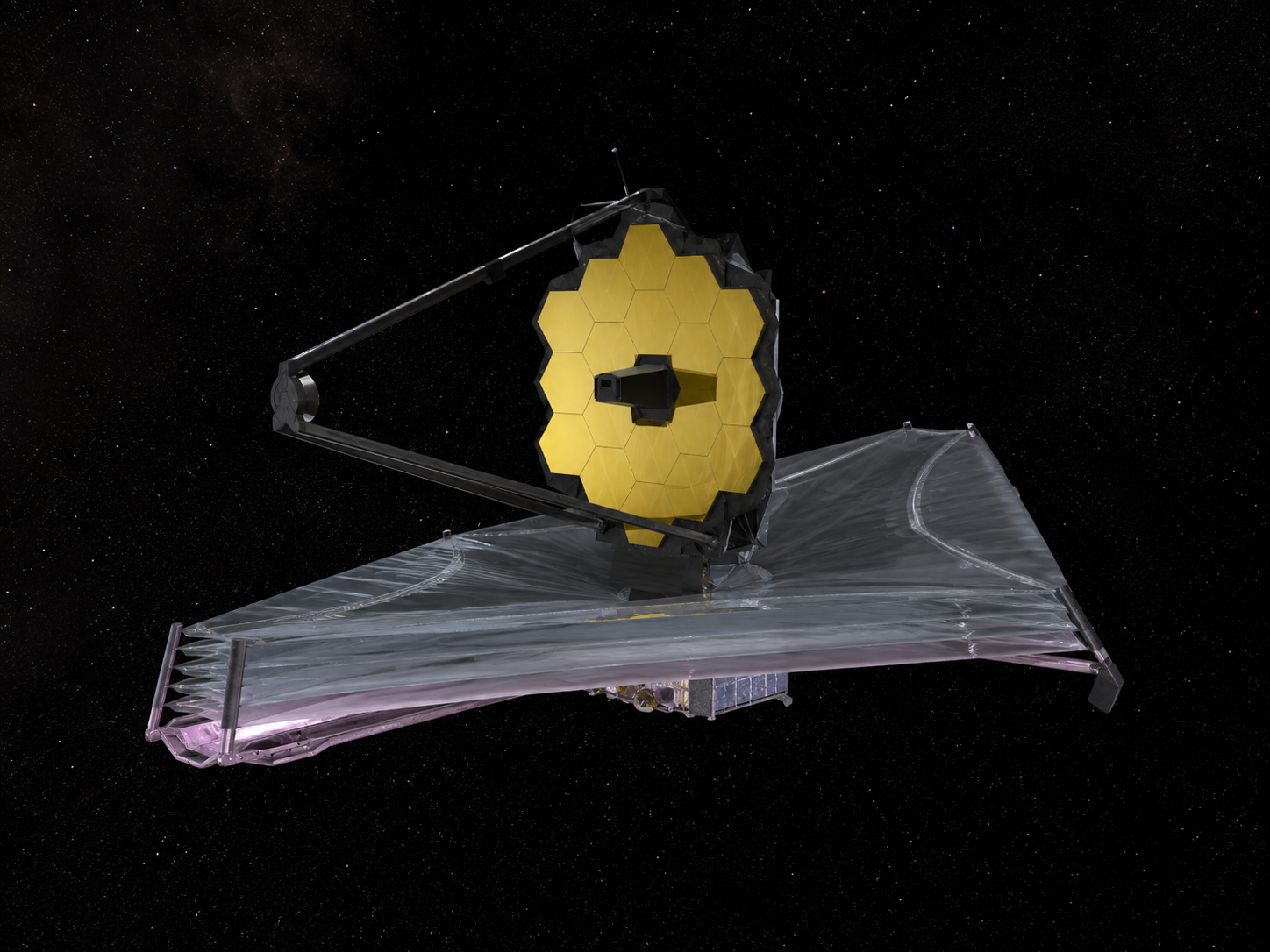
AI-generated illustration of the James Webb Space Telescope, whose NIRISS and NIRSpec instruments took the real spectra used in this report. Not an official mission photograph — see NASA/JWST for real imagery.
References
- JWST Early Release Observations Team, 2022. Webb Reveals Steamy Atmosphere of Distant Planet in Detail. NASA press release, 12 July 2022 (first published JWST exoplanet transmission spectrum, WASP-96 b, NIRISS SOSS).
- Zenodo record 10.5281/zenodo.17065171, "Super-Solar Metallicity and Tentative Evidence for Photochemistry on WASP-96 b from JWST and Ground-Based VLT Transmission Spectroscopy."
- Hellier, C. et al., 2014. WASP-95b and WASP-96b: two new transiting close-in giant planets. Monthly Notices of the Royal Astronomical Society, 440(2), pp.1982-1992 (discovery paper).
- NASA Exoplanet Archive, exoplanetarchive.ipac.caltech.edu — system parameters, queried live via TAP.