What the corrected fit shows
The timing-adjusted transit is strongly preferred by ΔBIC = 194575.8. Its fitted midpoint is -0.009 hours from the historical prediction; the model's mid-transit depth is 25870.4 ± 67.1 ppm. The support decision uses ΔBIC ≥ 10; timing-search p-values are not presented as blind-detection probabilities.
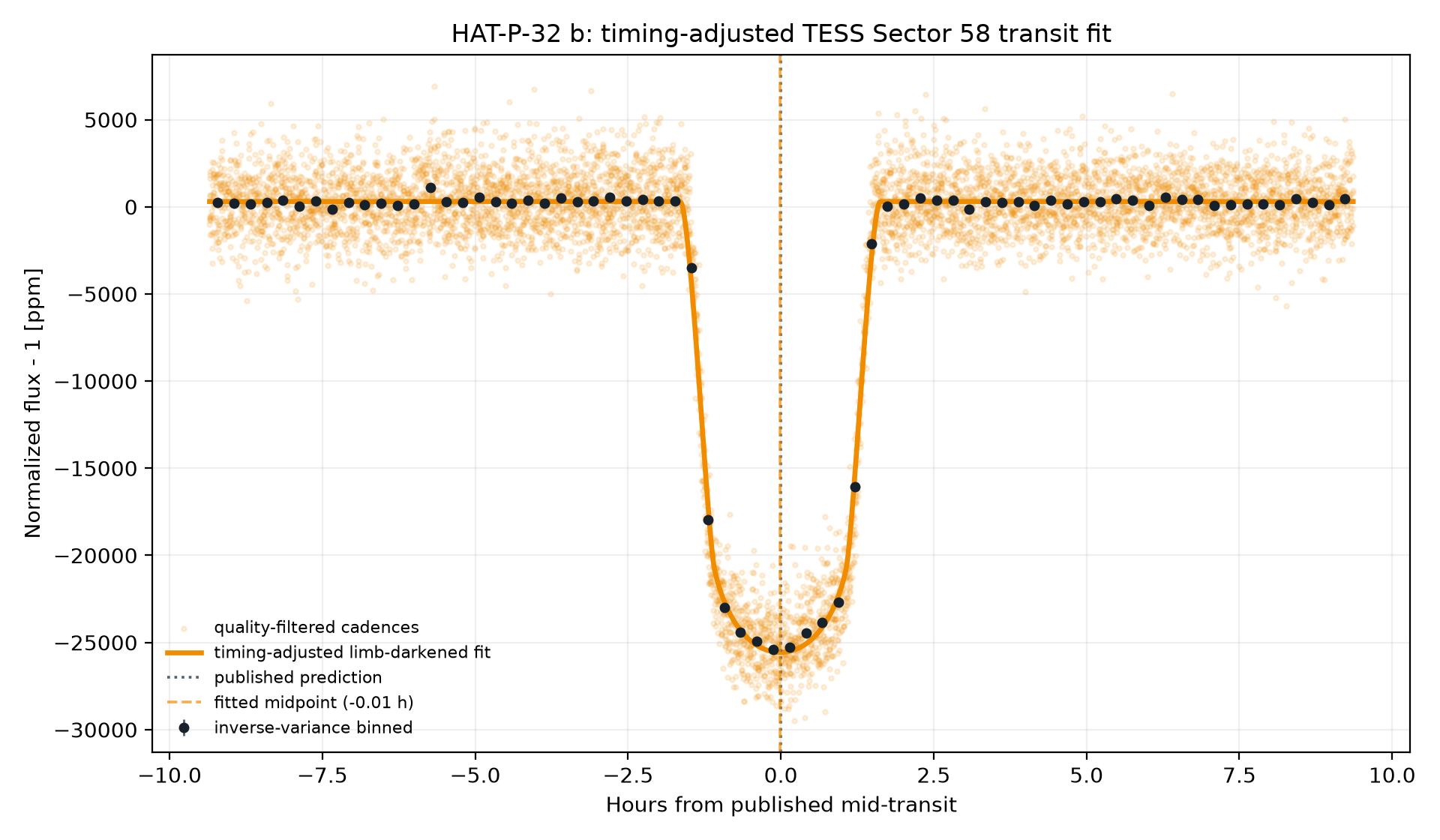
Explicit model comparison
BIC = 202703.31
BIC = 8127.47
The null fits a local intercept and slope. The transit adds bounded midpoint, radius-ratio, and impact-parameter freedom while retaining the same baseline terms. Fixed limb darkening and circular geometry make this a diagnostic fit rather than a full system retrieval.
Multi-sector robustness and noise
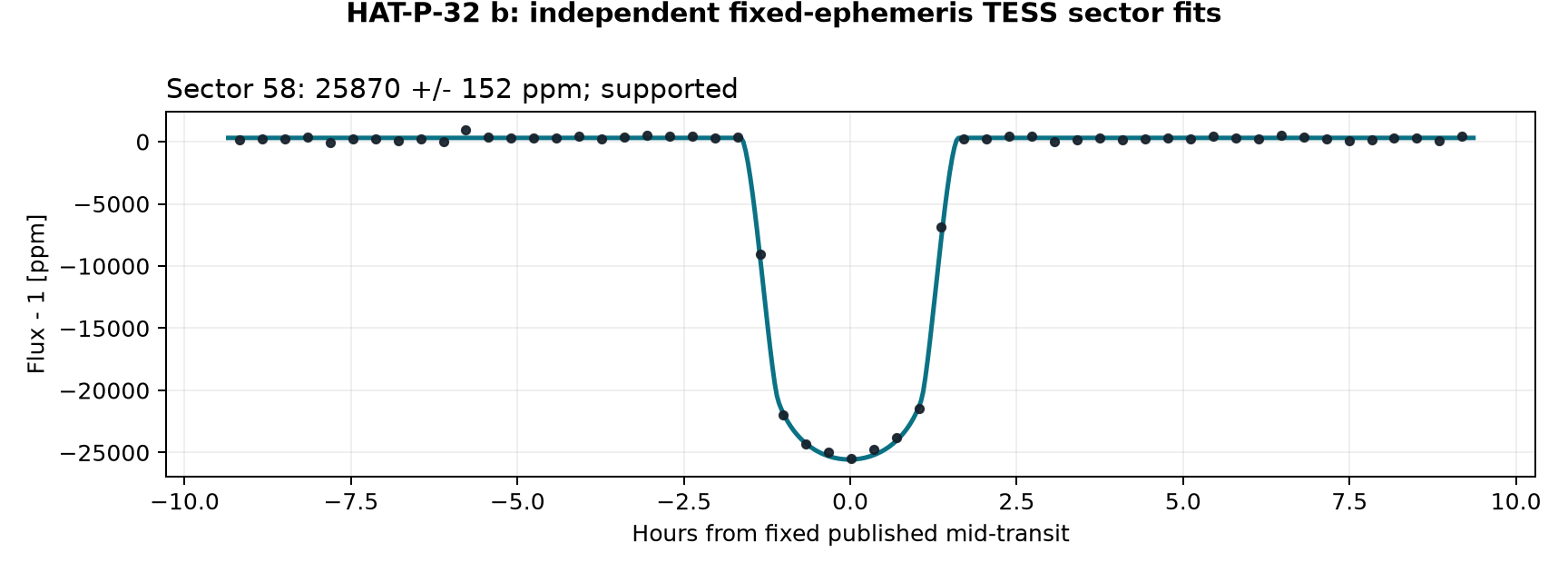
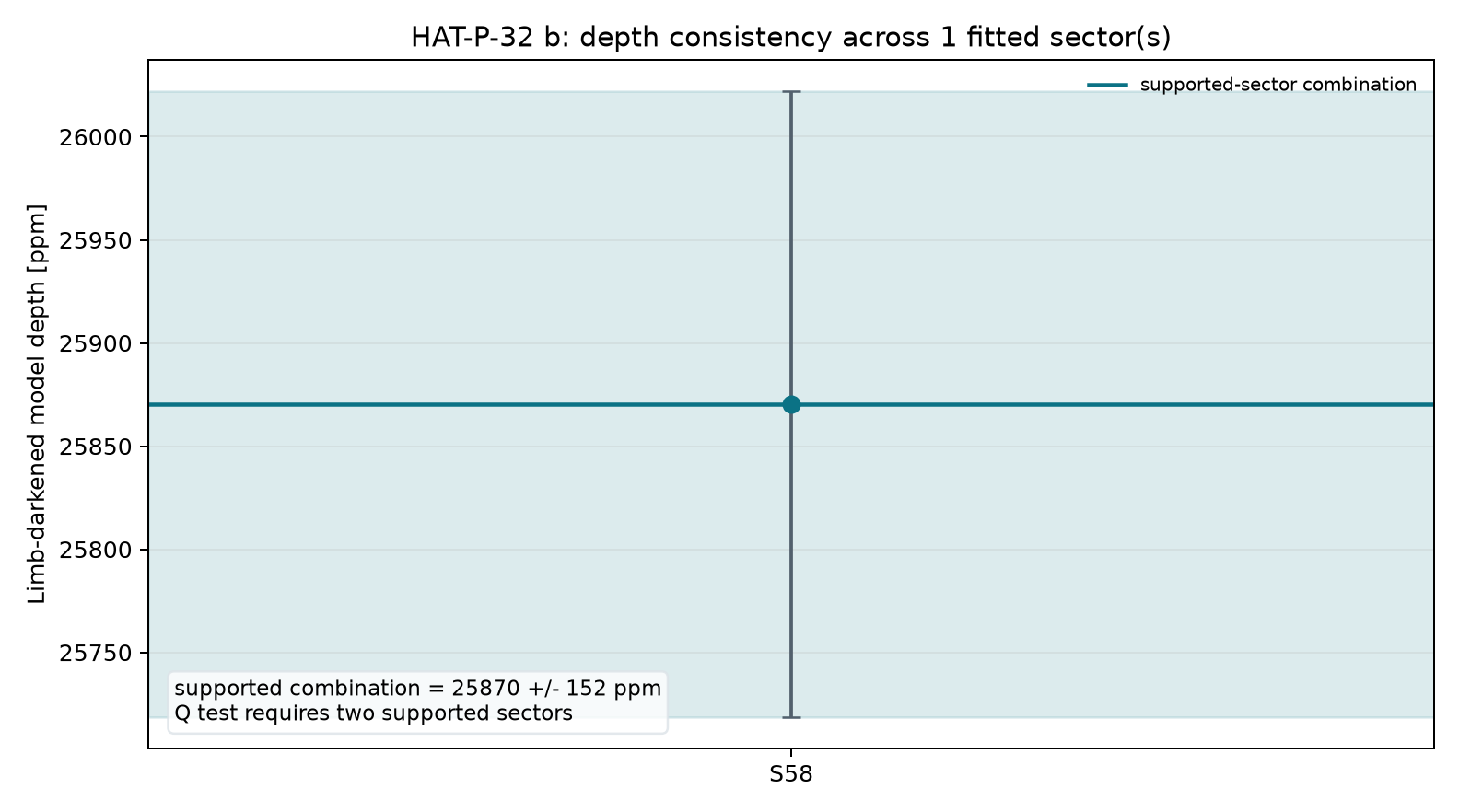
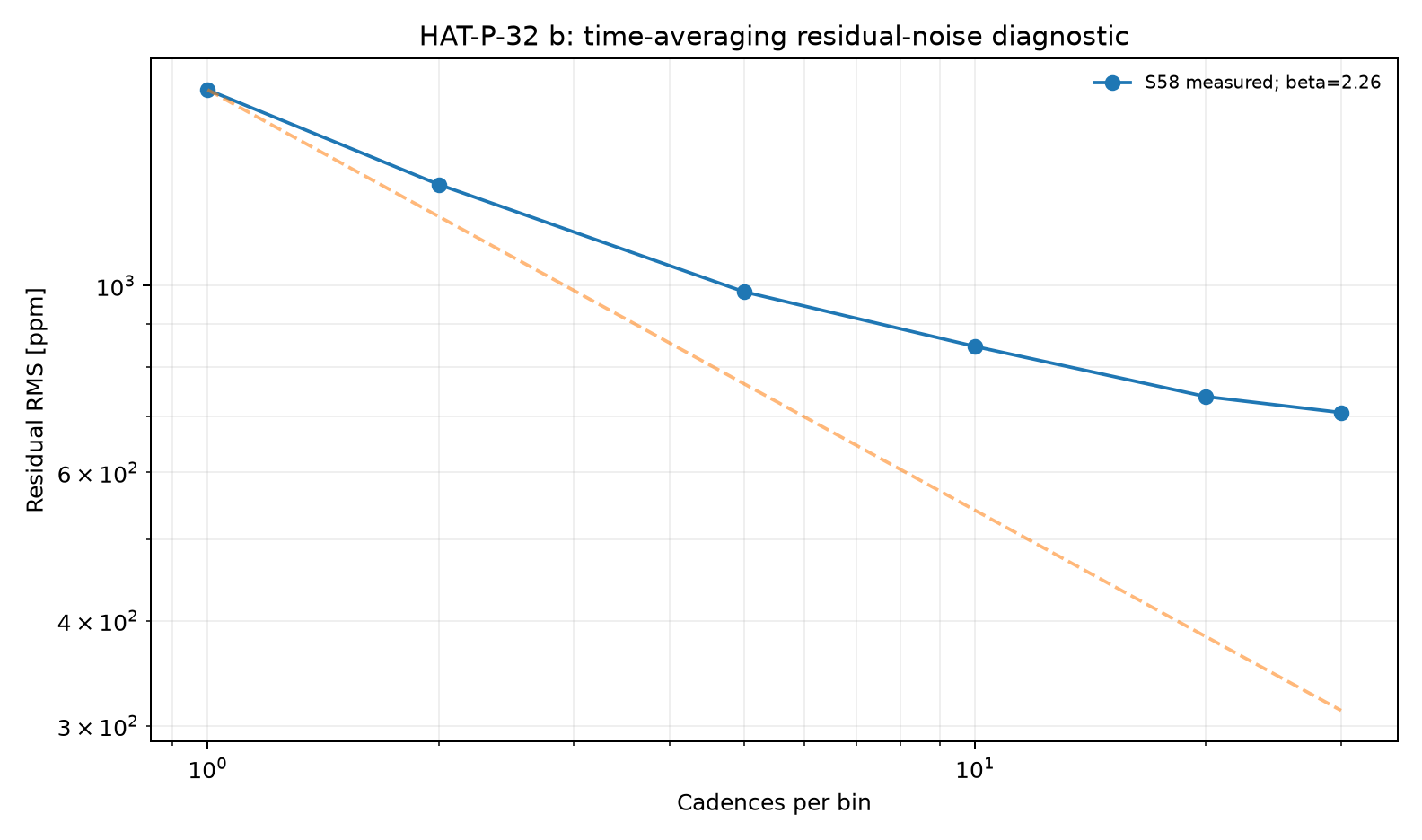
The archive prediction was timing-adjusted independently in 1 fitted sector(s) (S58), of which 1 meet Delta BIC >= 10. Formal depth errors were inflated by sqrt(max(reduced chi-square, 1)) times the residual time-averaging beta factor (observed range 2.26-2.26). The robust inverse-variance model depth across supported sectors is 25870.4 +/- 151.6 ppm; a sector-to-sector Q test requires at least two supported sectors. These scaled errors address underestimated scatter and short-timescale correlation, but they are not a full Gaussian-process or physical limb-darkened transit fit.
The system
| Radius | 22.19 Earth radii |
|---|---|
| Mass | 216.12 Earth masses |
| Orbital period | 2.150008 days |
| Transit duration | 3.120 hours |
| Semi-major axis | 0.0340 AU |
| Equilibrium temperature | 1836 K |
| Host and distance | HAT-P-32 · 289.20 pc |
| Discovery | 2011 · Transit · HATNet |
Values are from the exact saved NASA Exoplanet Archive pscomppars row in data/system_parameters.csv.
Data and reproducibility
The observed photometry is the public MAST file tess2022302161335-s0058-0000000292152376-0247-s_lc.fits, TESS Sector 58, collection DOI 10.17909/t9-nmc8-f686. It is stored unmodified. Exact archive URI, URL, retrieval date, and checksum are in data/SOURCE.md.
Run python scripts/analyze_transit.py and python scripts/analyze_multisector.py to regenerate the figures and CSVs, then pytest tests/ -v to check the documented values against the real file.
Limitations
- The orbit is circular and the quadratic limb-darkening coefficients are fixed representative values.
- The scaled semi-major axis comes from saved composite values whose uncertainties are not propagated.
- The midpoint is searched within a bounded window; ΔBIC is used as the support gate.
- PDCSAP processing, dilution, stellar variability, timing variations, and covariance can bias the geometry.
- Published global fits with physical priors, instrument-specific detrending, and simultaneous sectors remain authoritative.
References
- Hartman et al. 2011 — discovery reference listed by the NASA Exoplanet Archive.
- Ricker et al. (2015), Transiting Exoplanet Survey Satellite (TESS), doi:10.1117/1.JATIS.1.1.014003.
- TESS Team, TESS Light Curves — All Sectors, MAST, doi:10.17909/t9-nmc8-f686; Sector 58 used here.
- NASA Exoplanet Archive, saved TAP row retrieved 2026-08-15.