The planet, in numbers
Queried live from the NASA Exoplanet Archive TAP service (pscomppars).
| Radius | 4.36 Earth radii — a "warm Neptune" |
|---|---|
| Mass | 25.0 Earth masses |
| Bulk density | ~1.4 g/cm³ — a gas/ice-rich envelope, not rocky |
| Orbital period | 4.888 days |
| Semi-major axis | 0.0526 AU |
| Equilibrium temperature | 838 K |
| Host star | HAT-P-11, K4 dwarf, Teff = 4653 K, 0.683 Rsun, 0.811 Msun — a magnetically active star |
| Distance | 37.76 parsecs (~123 light-years) |
| Discovery | 2009, transit photometry (HATNet); one of the first "warm Neptunes" known |
Why helium at 10830 Å reveals an escaping atmosphere
The metastable helium triplet near 10830 Å (infrared) is populated in the extended, heated upper atmospheres of close-in exoplanets exposed to strong stellar UV/X-ray flux. Unlike hydrogen Lyman-alpha, this line is observable from the ground and is not scattered/absorbed by the interstellar medium, making it a clean tracer of atmospheric outflow. If a planet's upper atmosphere is escaping into a comet-like tail of neutral helium, that gas absorbs a small amount of extra starlight specifically during transit, at exactly this wavelength — deeper and longer than the planet's solid transit alone.
Allart et al. (2018) used this technique to make the first spectrally resolved detection of helium escape from an exoplanet, observing HAT-P-11b with the CARMENES spectrograph on the 3.5 m telescope at Calar Alto across two transits. The figures below work directly from their published data files.

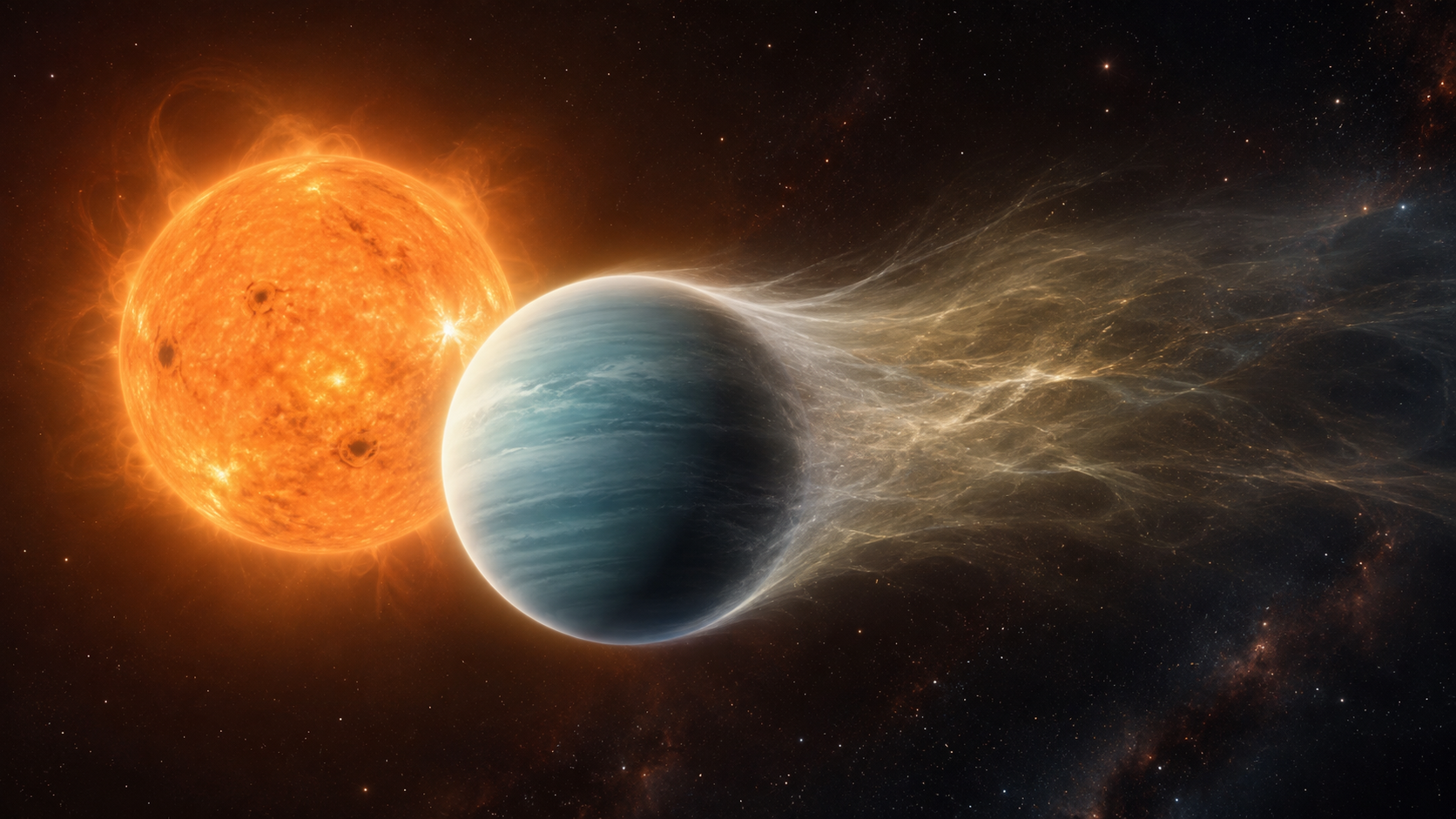
AI-generated 3D-render-style concept of the extended, escaping helium envelope implied by the real absorption signal above — not an actual image of the planet.
Specification sensitivity
The dip persists; its magnitude depends on the estimator
Every valid combination of five in-transit windows, three baseline exclusions, inverse-variance versus uniform weighting, and pre-transit, post-transit, or two-sided baselines retains a positive dip. The wide magnitude envelope shows why the original single 0.827% estimate and its formal 12.9 band S/N should not stand alone.
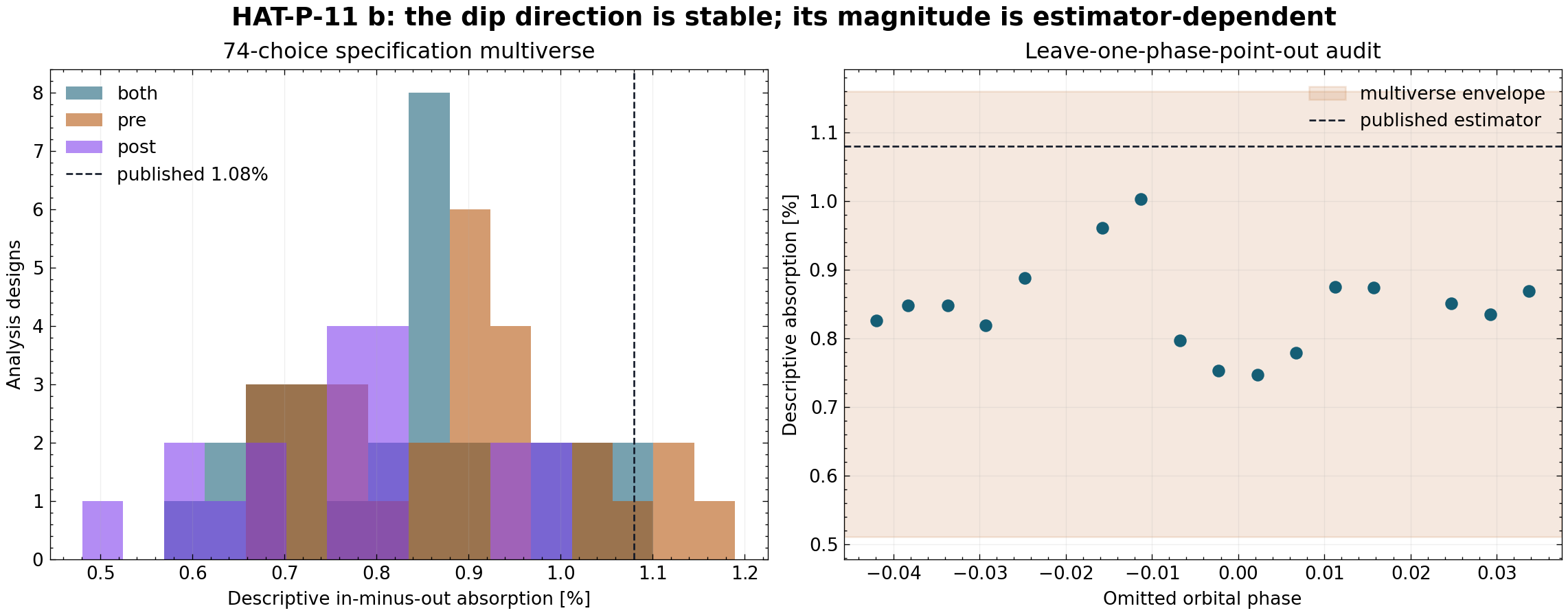
Bounded conclusion: the archived phase-folded product robustly contains a transit-centred flux decrement under every declared descriptive estimator. Its exact magnitude and formal S/N are estimator- and independence-assumption-dependent. The published 1.08% ± 0.05% transit-model result remains the calibrated measurement.
Archived light curve and line profile
The left panel shows the phase-folded flux inside the He I 10830 Å line across both transit nights; the right panel shows the per-wavelength-bin excess absorption across the triplet with the best-fit model from the original paper overlaid.
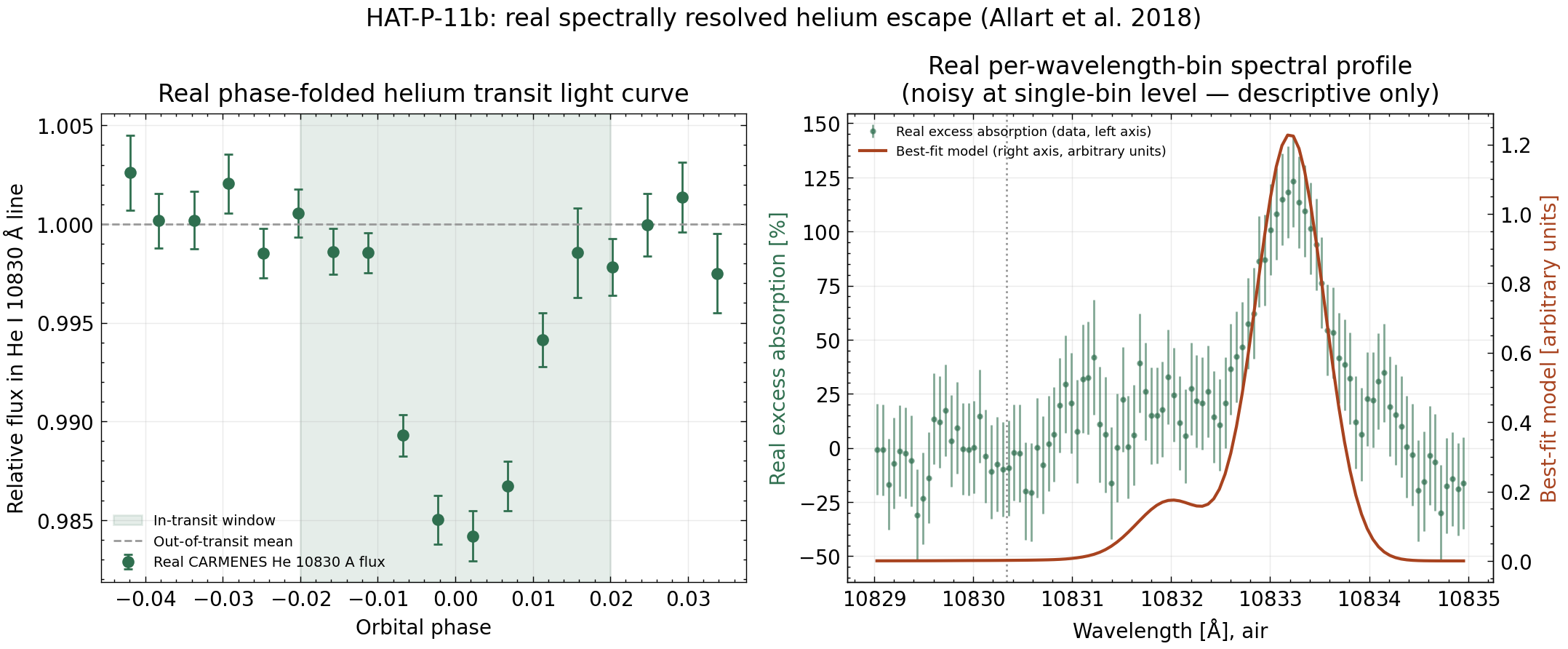
scripts/analyze_spectrum.py.The 0.827% value is one historical repository configuration, not a uniquely selected estimator. Allart et al. (2018) measured 1.08% ± 0.05% using a transit-model fit over a fixed 0.75 Å passband. The literature value is cited context and is not reproduced by this mean-comparison calculation.
Data and method notes
Both renamed inputs match their exact Zenodo archive members after canonical newline normalization. The manifest records the archive receipt, exact member paths, sizes, MD5, and SHA-256 values. The line profile combines only two transit nights per bin and remains descriptive. Formal S/N values assume independent phase-folded points and are not molecular-detection significances.
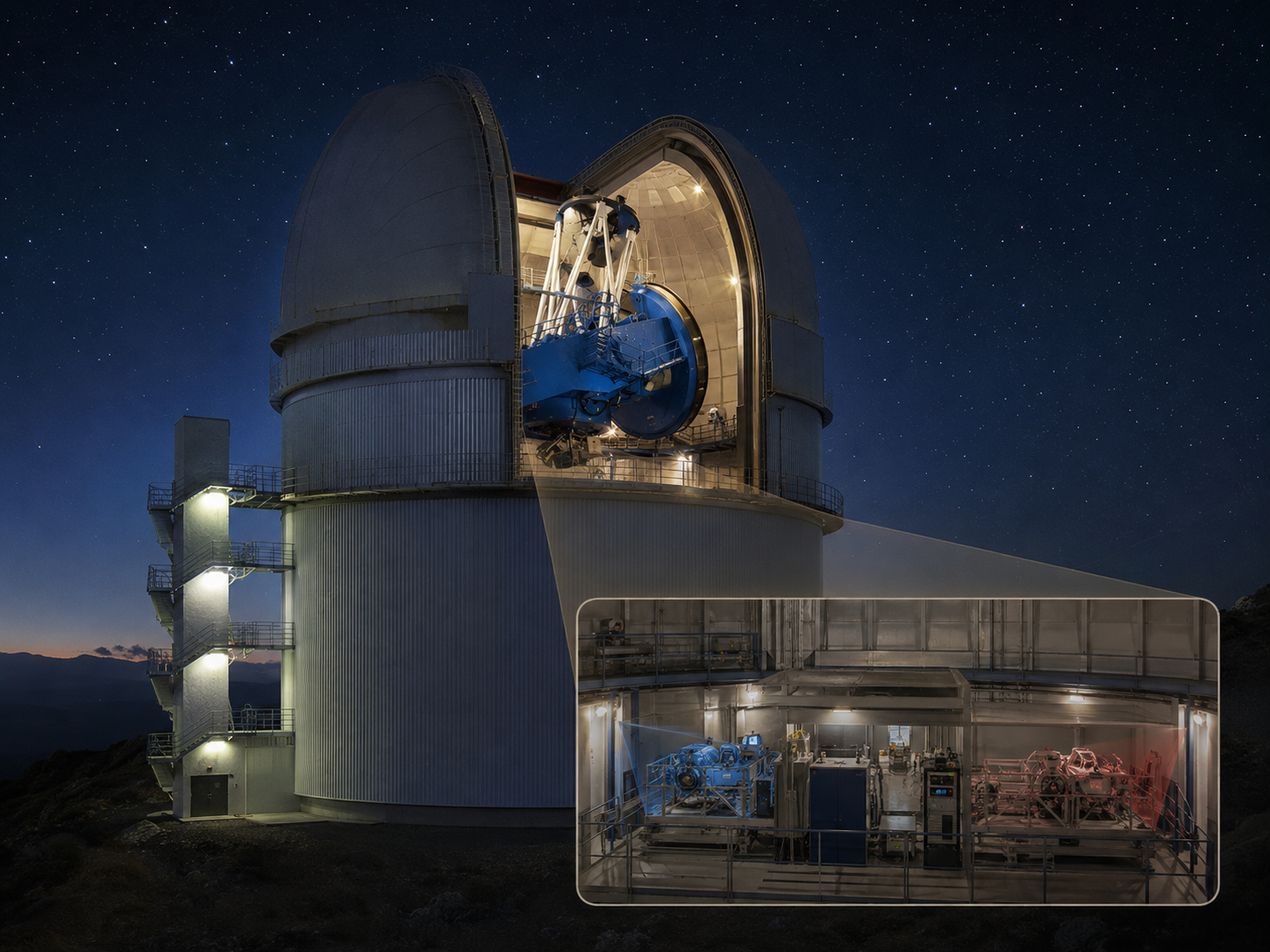
AI-generated illustration of the CARMENES spectrograph at Calar Alto Observatory, which took the real helium-line data used in this report. Not an official observatory photograph — see carmenes.caha.es for real imagery.
Before / after
Research maturity

References
- Bakos, G. A. et al., 2010. HAT-P-11b: A Super-Neptune Planet Transiting a Bright K Star in the Kepler Field. The Astrophysical Journal, 710(2), pp.1724-1745.
- Allart, R. et al., 2018. Spectrally resolved helium absorption from the extended atmosphere of a warm Neptune-mass exoplanet. Science, 362(6421), pp.1384-1387.
- Oklopčić, A. and Hirata, C. M., 2018. A New Window into Escaping Exoplanet Atmospheres: 10830 A Line of Helium. The Astrophysical Journal Letters, 855(1), L11.
- NASA Exoplanet Archive, exoplanetarchive.ipac.caltech.edu — system parameters, queried live via TAP.
- Zenodo record 1473463, zenodo.org/records/1473463 — reduced helium transit data.