COSMICEXPANSION LABOPEN DATA / OPEN QUESTIONS / VOL. 02

A FIELD GUIDE TO THE EXPANDING UNIVERSE

The universe
won’t sit still.

Read the light. Measure the distance.
Explore the evidence for cosmic expansion.

Start exploring
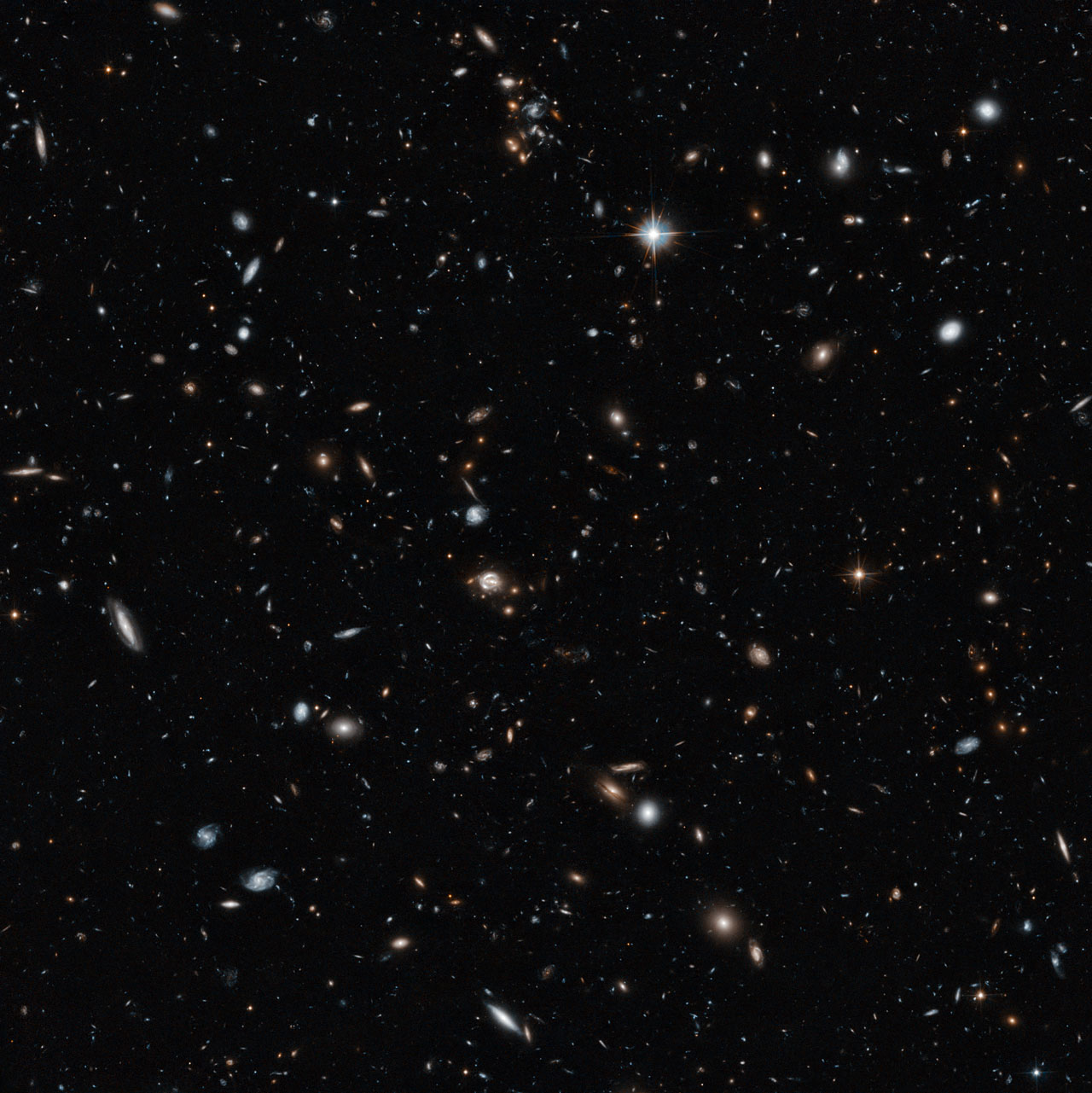
Hubble observation of CLASS B1608+656: a field of galaxies at different distances, with white and orange galaxies against black space.
AN ACTUAL CROSS-SECTION OF THE COSMOSCLASS B1608+656 · NASA, ESA ↗

NEW / TELESCOPES, EVIDENCE & GRAVITY

Explore the Great Attractor.

Real Hubble, Webb, ESO and Chandra observations, an inferred-mass comparison, and a reproducible gravity simulation.

Explore 14 million selected galaxy spectra and 55,877 distance records

New: test what the real distance footprint could distinguish ↗

Explore observations & simulation
1,701 light-curve measurements3 connected measurement stepsFull covariance Python fitsPANTHEON+ × SH0ES

01 / THE LABORATORY

A universe you can experiment with.

Change a parameter. Follow the evidence.

Loading the pinned scientific dataset…
COMOVING GALAXIES / ILLUSTRATIVE SLICEFLAT ΛCDM
Space between galaxies grows.
The galaxies themselves don’t.
a = 1.00

02 / THE OBJECTS BEHIND THE NUMBERS

Before a data point,
there was a star.

Real telescope observations. No generated sky imagery.

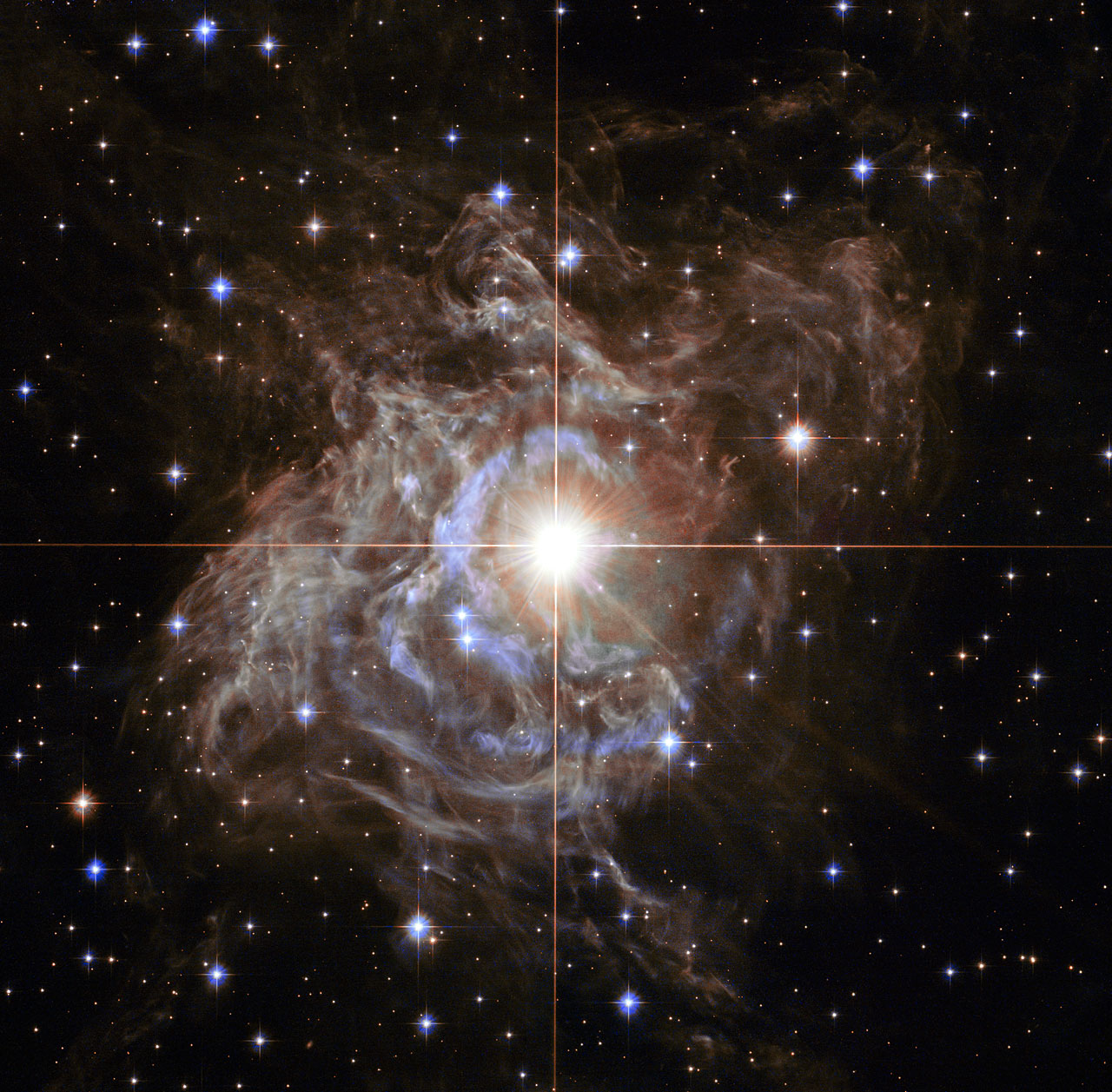
Hubble image of RS Puppis, a bright Cepheid variable surrounded by textured reflecting dust.
NASA, ESA, and the Hubble Heritage Team (STScI/AURA)-Hubble/Europe Collaboration. Acknowledgment: H. Bond (STScI and Penn State University).

THE CEPHEID / RS PUPPIS

A star with
a useful rhythm.

A Cepheid brightens and fades as it pulsates. Its period carries information about its intrinsic luminosity: longer-period classical Cepheids are generally more luminous. Compare that calibrated luminosity with the light we receive, correct for extinction, and a distance becomes possible.

RS Puppis is an especially striking example, surrounded by dust that scatters its changing light. It illustrates what a Cepheid is; it is not presented as one of the individual stars fitted in this project.

What must be calibrated?

The period–luminosity zero point needs an absolute distance anchor. Parallaxes, eclipsing binaries and water masers provide geometric information. Metallicity, dust, photometric calibration and crowding also matter. Our analysis starts downstream of these steps, with published Cepheid-host moduli and their covariance.
Inspect real host calibrators →
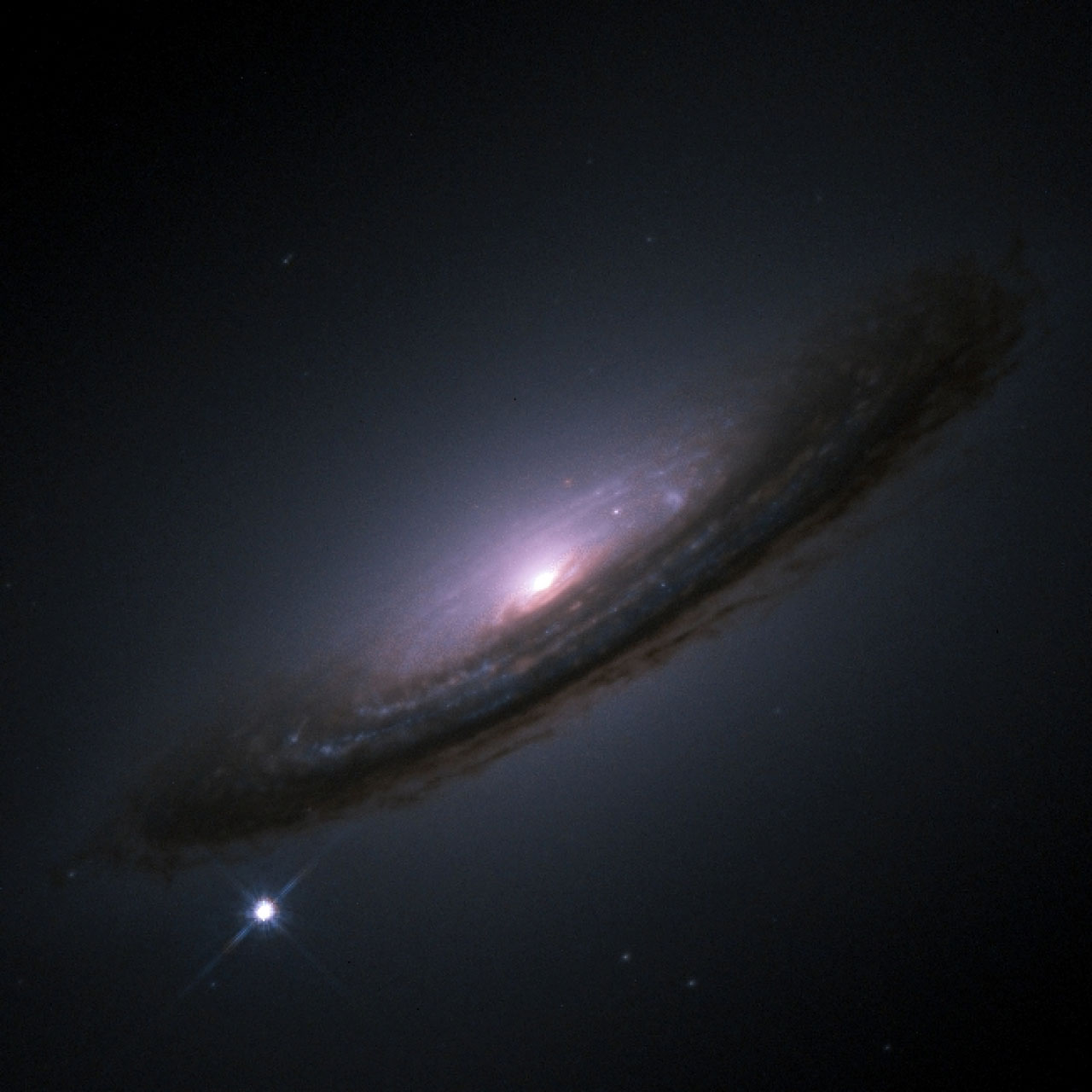
Hubble observation of galaxy NGC 4526 and the bright point source supernova SN 1994D.
NASA/ESA, The Hubble Key Project Team and The High-Z Supernova Search Team.

THE SUPERNOVA / SN 1994D

A brief flash.
A much longer reach.

A Type Ia supernova is a thermonuclear stellar explosion. Its brightness evolves over weeks, giving observers a light curve rather than a single number. After corrections for light-curve shape, color and other effects, these events become standardizable candles.

That distinction matters: the supernovae do not all have identical uncorrected luminosities. Pantheon+ supplies standardized magnitudes and the covariance needed to propagate statistical and systematic uncertainty. SN 1994D is represented in this release; its nearby redshift excludes it from our default cosmology sample unless flagged as a calibrator.

Why not measure H₀ with supernovae alone?

Brightness gives relative distance very well, but the absolute scale depends on the intrinsic magnitude MB. Increasing H₀ while adjusting MB can leave all predicted apparent magnitudes unchanged. A separate absolute-distance calibration breaks that degeneracy.

Find SN 1994D in the catalog →

Observational images: ESA/Hubble collection, CC BY 4.0. Display framing may crop the original; the linked source pages retain the full images. No image is treated as a substitute for photometric measurements.

03 / A PHOTON’S JOURNEY

“How far away?”
has more than one answer.

A numerical workbench for a changing universe.

CHOOSE AN EMISSION REDSHIFT

Imagine light emitted when the universe was smaller. It travels through space that keeps expanding. A single redshift therefore maps to several useful distances.

aemission = 1 / (1 + z)
COMOVING DISTANCE DC—

Present-day proper separation for an object following the cosmic expansion, with a(today) = 1.

LUMINOSITY DISTANCE DL—

The distance in the inverse-square brightness law. Photon energy and arrival rate are both redshifted.

ANGULAR-DIAMETER DISTANCE DA—

Converts an observed angle into an object’s physical size at emission.

LOOKBACK TIME—

Elapsed cosmic time between emission and observation; it is a time, not a present separation.

DL = (1 + z)DC   ·   DA = DC / (1 + z)Flat, transparent cosmology. Radiation neglected. These are model calculations, not new measurements.

04 / GO BEYOND A BEST-FIT NUMBER

A result is only the beginning.
Now try to move it.

Download research results ↓

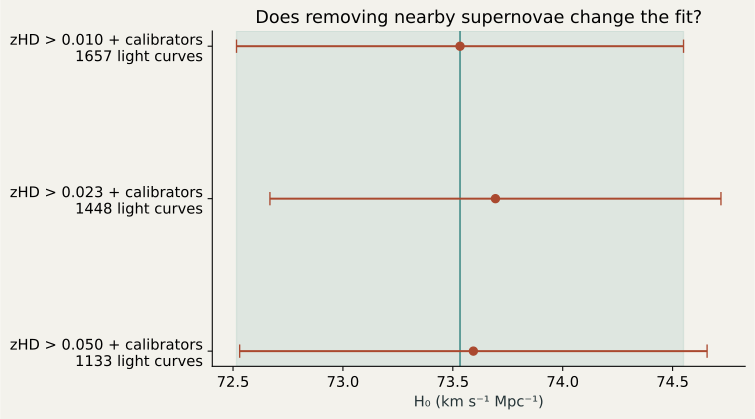
What else fits? What changes when nearby objects are removed? What if dark energy is not a cosmological constant? These experiments rerun the likelihood against the actual release, preserving its full covariance.

Loading reproducible research results…

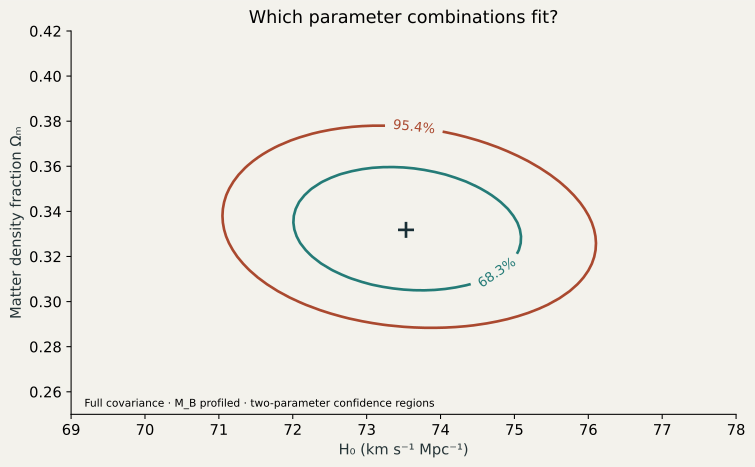
Full-covariance profile-likelihood contours in Hubble constant and matter fraction, showing 68.3 and 95.4 percent joint confidence regions.
Computed here from Pantheon+ / SH0ES. MB is profiled out analytically. Joint two-parameter thresholds: Δχ² = 2.30 and 6.18.

UNCERTAINTY HAS A SHAPE

Explore the neighborhood
of the best fit.

A best-fit point hides nearby combinations that also describe the observations. For every point in this grid, the analysis finds the best absolute supernova magnitude and evaluates the correlated residuals.

——

Readout uses the nearest precomputed grid point. These are approximate frequentist confidence contours under Wilks’ theorem, not a probability that the true parameters lie inside this particular contour.

REMOVE THE ABSOLUTE CALIBRATION

Shape survives.
The distance scale does not.

Loading supernova-only result…

We exclude every calibrator and profile a free brightness offset. The remaining supernovae constrain the shape of the distance–redshift relation, but cannot identify H₀. Setting H₀ = 70 in this calculation is a bookkeeping choice, not a measurement.

05 / THE COSMOLOGY FIELD GUIDE

Make the concepts
as clear as the plots.

Read the model. Know its limits.

A SUBTLE BUT ESSENTIAL DISTINCTION

Expansion can accelerate
while H gets smaller.

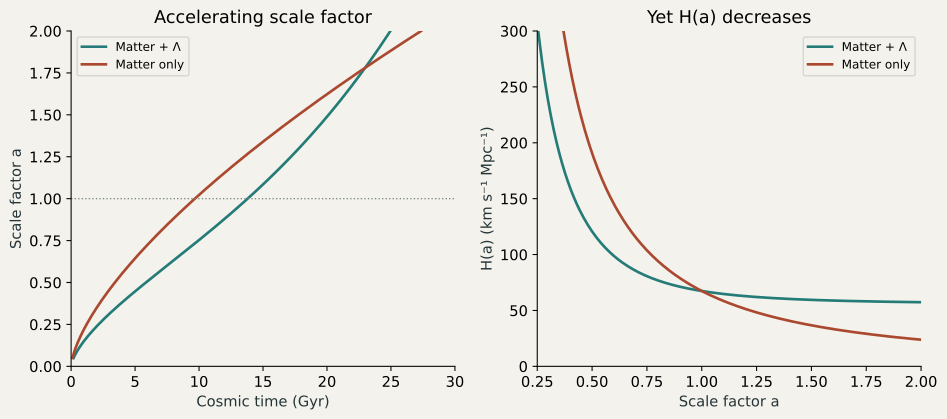
The scale factor a(t) describes how separations between comoving objects change. The Hubble parameter is the fractional growth rate H = ȧ/a. Acceleration asks whether ȧ itself increases: ä > 0. These are different questions.

In a matter-plus-Λ universe, matter density falls as a⁻³ while the vacuum density remains constant. The expansion eventually accelerates, even while H decreases toward a positive asymptote. In the matter-only comparison, a grows forever but its growth continually decelerates.

Where does acceleration begin in this model?

For flat matter + Λ, q(a) = [Ωₘ/a³ − 2ΩΛ] / [2(Ωₘ/a³ + ΩΛ)]. Acceleration starts at q = 0, or a = [Ωₘ/(2ΩΛ)]1/3. With Ωₘ = 0.315 this corresponds to z ≈ 0.63. It is a model-dependent transition, not a switch at a universal date.

Scale factor rises more steeply at late times in a matter-plus-Lambda model, although its Hubble parameter declines toward a constant.
Analytic model comparison at a common H₀ = 67.4 km s⁻¹ Mpc⁻¹. The matter-plus-Λ model uses Ωₘ = 0.315. Radiation is neglected.

Other ways to ask the universe.

Redshift is an ingredient shared by several probes. Candles, rulers and sirens contribute different distance information and carry different assumptions.

ProbeWhat is measured?What sets the scale?In this project
Spectral redshiftObserved/rest wavelength ratioKnown transition wavelengthsCatalog values + wavelength demonstration
Cepheid + SN Ia ladderPeriods, corrected fluxes, host distancesGeometric anchors → Cepheids → SNeCompressed host calibration + SN fit
BAO standard rulerClustering scale across angle and redshiftSound horizon rd, or its external calibrationConceptual comparison; no BAO fit
Gravitational-wave sirensWaveform amplitude and evolution; host redshiftWaveform physics, with inclination uncertaintyHistorical result described below; no waveform fit
CMB inferenceEarly-universe anisotropy patternsEarly-universe physics + cosmological modelDated Planck reference; no map fit
A STANDARD RULER

BAO measures
a fossil sound scale.

Pressure waves in the early photon–baryon plasma left a preferred separation in later matter clustering. Galaxy surveys measure that pattern transversely and along the line of sight, constraining distances and the expansion rate relative to the sound horizon.

A ruler measured in units of its own unknown length does not by itself supply an absolute H₀. An early-universe calculation or another calibration of rd is part of the inference.

Read the PDG dark-energy review ↗
A STANDARD SIREN

Listening for
an absolute distance.

The gravitational-wave signal from a compact binary carries distance information. A host redshift completes the connection to expansion. Binary inclination and local peculiar velocities can broaden the result.

The first bright-siren measurement, GW170817 in 2017, reported H₀ = 70+12−8 km s⁻¹ Mpc⁻¹ at 68% credibility. This is a historical example with asymmetric uncertainty, not a value fitted or updated by this project.

Read the LIGO science summary ↗

Questions worth getting right.

What is the universe expanding into?

The standard cosmological model describes changing distances within space. It does not require an external room into which space expands. The observable universe is a region from which signals can have reached us, not necessarily an edge of the whole universe.

Why don’t galaxies, people and atoms expand with it?

The homogeneous expansion model applies on large scales. Bound systems are controlled by local gravitational or electromagnetic interactions. The animation keeps galaxy sizes fixed while their comoving separation changes; it does not model the detailed dynamics of any particular group.

Can a distant galaxy recede faster than light?

In a cosmological coordinate system, recession v = H D can exceed c at sufficiently large proper distance. That is not a nearby object overtaking light in a local inertial frame. It is why a special-relativistic Doppler velocity is not a general interpretation of cosmological redshift.

Does a redder image automatically mean greater redshift?

No. Display colors depend on filters, processing, stellar populations and dust as well as redshift. A scientific redshift comes from identifying spectral features or from calibrated photometric inference, not from judging a picture’s color.

Does dark energy explain what it is?

No. “Dark energy” names the component or effective behavior used to account for accelerated expansion. A cosmological constant is a simple model with w = −1. Fitting it successfully does not establish its microscopic origin.

Why are there 1,701 rows but fewer supernovae?

Some objects have light curves from more than one survey. We keep each row and its correlations. This pinned table contains 1,543 distinct literal CID strings; the publication describes a 1,550-object compilation. Catalog naming and release bookkeeping are not automatically a physical object reconciliation. We report the directly reproducible table count rather than silently replacing it with the headline publication count.

TRY A SMALL RESEARCH INVESTIGATION

Ask. Change one assumption. Explain the result.

  1. Find the calibration degeneracy. Compare the calibrated and SN-only fits. Explain why one reports H₀ and the other deliberately does not.
  2. Challenge the nearby sample. Compare the zHD cuts. Record the parameter shift and uncertainty change; explain why the fits are correlated.
  3. Separate brightness from geometry. Set z = 1 in the distance workbench. Explain why luminosity, angular-diameter and comoving distances differ.
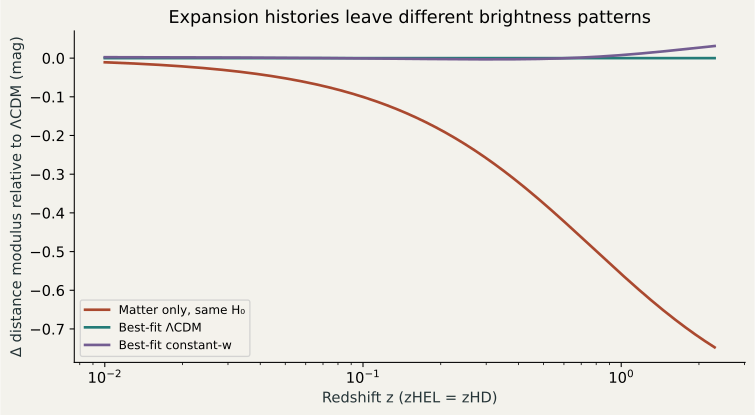
  4. Make an extra parameter justify itself. Compare ΛCDM and constant-w fits. Distinguish a lower χ² from evidence that w differs from −1.
Download the worked Python notebook ↓

THE EQUATIONS BEHIND THE EXPERIMENTS

Different tools. A connected story.

01 / REDSHIFT

How much has
the light stretched?

Compare known spectral wavelengths with their observed positions. The catalog provides heliocentric, CMB-frame and flow-corrected redshifts. The Hubble diagram uses zHD, with zHEL in the luminosity-distance prefactor.

1 + z = a(now) / a(emission)
02 / STANDARD CANDLES

How far did
the light travel?

Cepheids calibrate nearby hosts; standardized supernova brightness then extends the distance scale. Supernovae alone cannot determine H₀ without an absolute luminosity calibration.

μ = m − M = 5 log₁₀(dL / Mpc) + 25
03 / EXPANSION HISTORY

Which universe
fits the evidence?

Fit brightness and redshift jointly using the full covariance matrix. Our model assumes a flat universe containing matter and a cosmological constant. The inferred parameters depend on these assumptions.

H(z) = H₀ √[Ωₘ(1 + z)³ + 1 − Ωₘ]

A QUESTION THAT REMAINS OPEN

One universe.
Different routes to H₀.

Compare our fits with two published reference measurements. These are historical reference results, not a claim about the latest consensus. The two fits here share data and are not independent.

06 / REPRODUCIBLE OPEN SCIENCE

Real data. Traceable results.

Download derived CSV
Pantheon+ measurements; repeated names are separate survey light curves.
SupernovaSurvey IDzHDmB (mag)μ (mag)Sample
Reproduce the analysis & inspect the assumptions

In the repository root, install dependencies and run:

python -m pip install -r requirements.txt
python analysis/download_data.py
python analysis/fit.py
python analysis/research.py
python -m unittest discover -s tests
python -m http.server 8000 --directory web

The pipeline verifies SHA-256 hashes against a pinned upstream commit, fits the full STAT+SYS covariance with a Cholesky solve, and exports the CSV, browser JSON, and publication-ready Hubble diagram. The local fit uses the supplied SH0ES Hubble-flow flags plus calibrators; the wider fit uses zHD > 0.01 plus calibrators. Uncertainties are local Gaussian curvature estimates, not posterior intervals.

Raw spectra, raw Cepheid photometry, BAO measurements and CMB maps are not fitted here. Geometric anchors enter through the released Cepheid-host moduli. This is a reproducible fit to released data products, not a reproduction of every step in the SH0ES pipeline.