Master-Thesis-2024
March 2026 hybrid TEC-AO recovery experiment
Aim
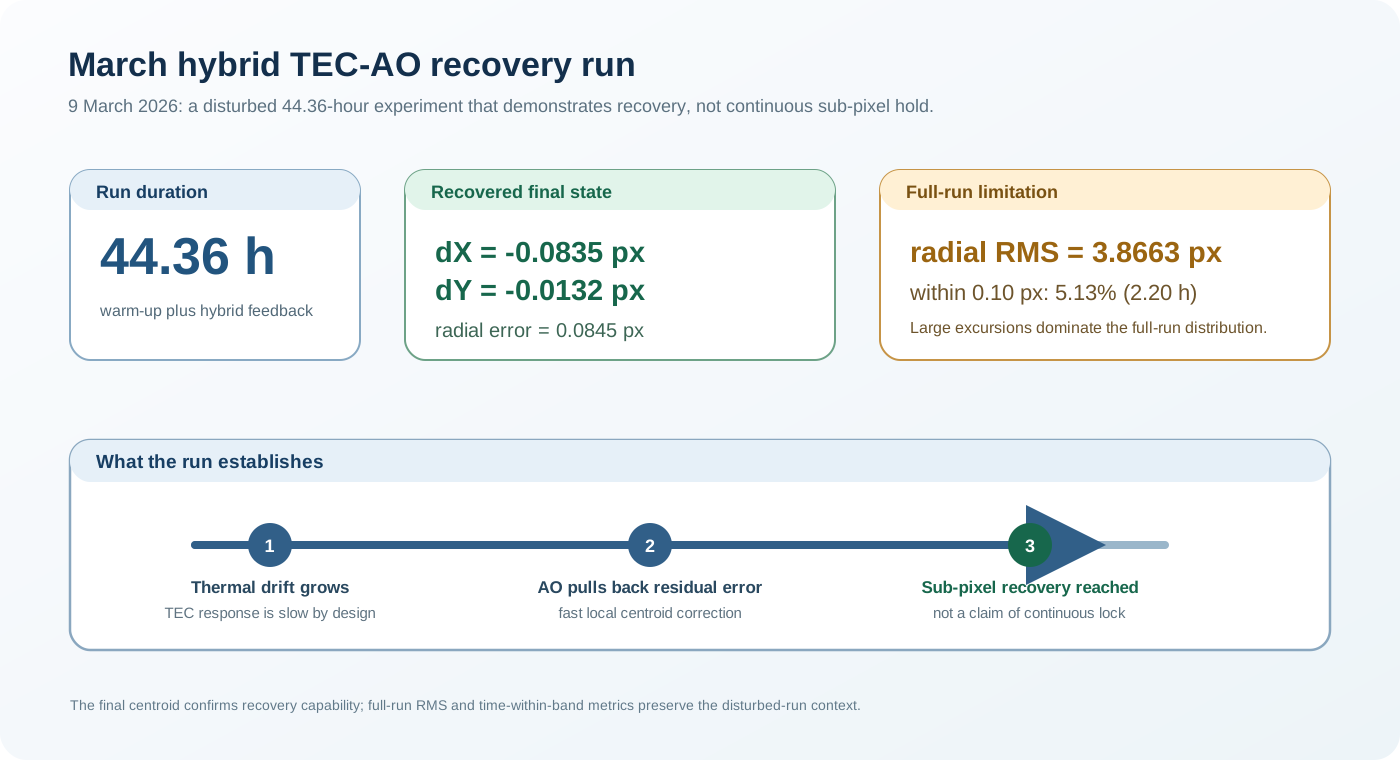
This 44.36-hour experiment tested a hybrid strategy in which the TEC addresses slow thermal drift and active optics (AO) provides a faster local correction when the centroid has moved away from the reference position.
The stability target was:
\[r = \sqrt{dX^2 + dY^2} \leq 0.10\ \mathrm{px}.\]Full-run summary
| Quantity | Value | Reading |
|---|---|---|
| Total duration | 44.36 h | Includes warm-up and hybrid feedback. |
Final dX |
-0.0835 px | Final recovered centroid component. |
Final dY |
-0.0132 px | Final recovered centroid component. |
| Final radial error | 0.0845 px | Final state was inside the 0.10 px target circle. |
| Full-run radial RMS | 3.8663 px | Large disturbed-run excursions dominated the global statistic. |
| Time within 0.10 px radial error | 2.20 h (5.13%) | Strict-band residence time over the full run. |
| Time within 0.20 px radial error | 3.49 h (8.1%) | Relaxed-band residence time over the full run. |
What this experiment demonstrates
The March run is a recovery demonstration, not a continuous-lock benchmark. The full-run RMS was high because the experiment included substantial centroid excursions, particularly along dY. Nevertheless, the hybrid system brought the centroid back to a final radial error of 0.0845 px.
The technical lesson is the division of labour between the actuators:
- the TEC corrects slow environmental and thermal drift but has a delayed response;
- AO provides a rapid local pull-back when the residual image error is already in a manageable range;
- AO travel must remain bounded, so sustained offsets should be transferred back to the thermal loop.
This experiment motivated the later TEC-primary/AO-fine-trim design: AO should not be asked to rescue an unstable thermal state, but it can improve recovery once the coarse drift has been brought within range.
Reporting note
The recovered final point is reported together with the full-run RMS and threshold residence times so that the result is not interpreted as uninterrupted 0.10 px stability.