Master-Thesis-2024
Component studies and public-safe operating notes
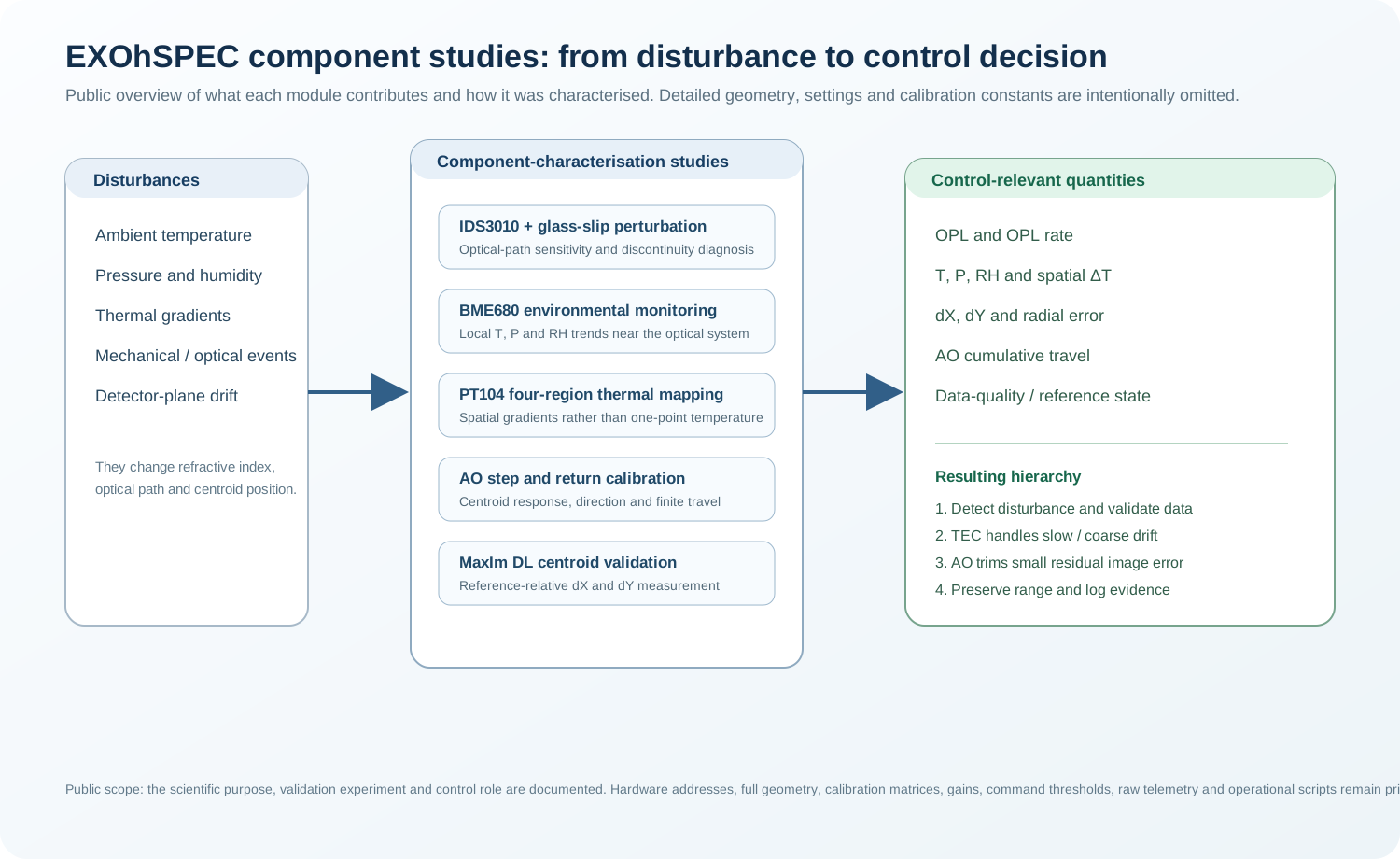
This section records why each major module was used, the experiment that established its role, the minimum equations needed to understand the measurement, and how the result enters the feedback architecture.
It is deliberately an overview rather than a laboratory build manual. The repository does not publish exact optical geometry, electrical wiring, device addresses, COM ports, calibration matrices, PID gains, trigger thresholds, camera coordinates, raw telemetry, full automation code or operational safety configuration.
| Component or study | What the report covers | Characterisation question |
|---|---|---|
| Experimental characterisation programme | How the individual studies form one controlled-development sequence | Which experiment reduced which uncertainty before hybrid control? |
| IDS3010 interferometer and glass-slip perturbation | Optical-path monitoring, interference sensitivity and discontinuity diagnosis | Does a controlled optical-path perturbation produce a measurable and recoverable response? |
| BME680 environmental monitoring | Local temperature, pressure and humidity context | Which environmental trends co-vary with OPL and centroid drift? |
| PT104 four-region thermal mapping | Spatial temperature gradients and thermal health | Is one temperature sensor representative of the whole enclosure? |
| TEC thermal actuation | Slow thermal correction and step-response evaluation | How quickly and how smoothly can thermal drift be corrected? |
| Active-optics calibration | Directional centroid response, return behaviour and travel limits | What fine correction can AO provide before range becomes limiting? |
| MaxIm DL centroid tracking | Reference-relative image measurement and validation workflow | How are dX and dY measured consistently from the spectrum image? |
| Python acquisition and analysis workflow | Time alignment, quality flags and public-safe pseudocode | How are measurements converted into an auditable control record? |
How to read these reports
Each component report follows the same structure:
- Role in EXOhSPEC - what the component measures or actuates.
- Characterisation experiment - what was deliberately perturbed or compared.
- Physics or control relation - the compact equation used to interpret the measurement.
- Control implication - how the result changes the feedback design.
- Public boundary - which operational details remain private.
The reports support the broader conclusion that EXOhSPEC is a disturbance-rejection problem: environmental changes alter optical path and image position, a slow thermal actuator handles coarse drift, and a finite-range AO actuator performs fine correction.