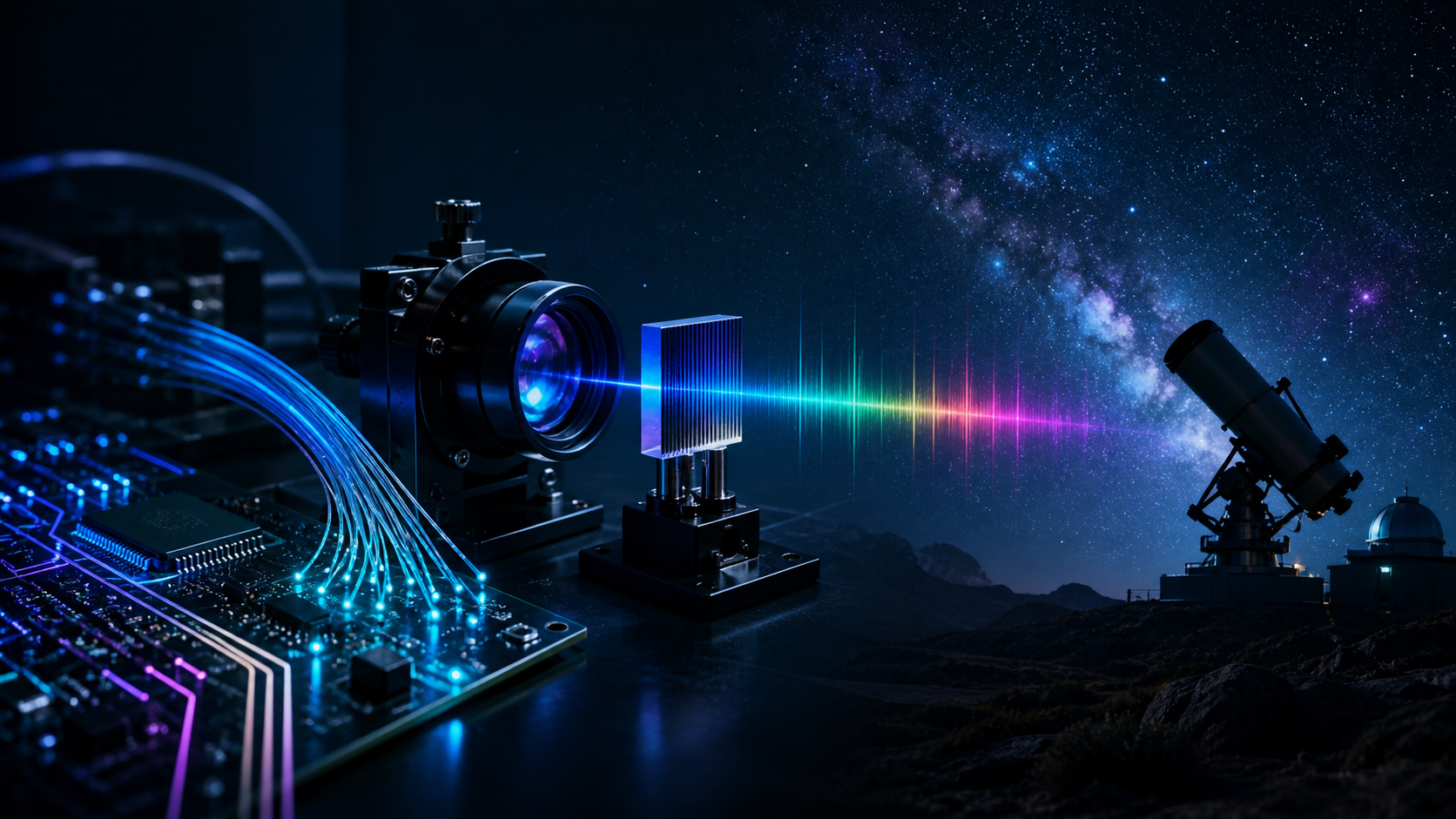
Electronics taught me to respect signals.
Engineering gives you a practical relationship with measurement. A signal is not just a number. It has noise, drift, bandwidth, calibration, grounding, resolution, and failure modes. That mindset matters deeply in astrophysics, because astronomical data also arrive through instruments that must be understood.
Astrophysics gave the questions scale.
Astrophysics asks enormous questions: planets around other stars, brown dwarfs, stellar spectra, galaxies, pulsars, and cosmic history. But those questions reach us through photons, detectors, optics, calibration, and data pipelines.
The beauty of the universe is real. So is the spreadsheet.
The bridge was not abstract. It was physical.
Instrumentation connects the question to the measurement. It includes optical design, detector behaviour, environmental control, feedback loops, calibration sources, mechanical stability, and software. It is where physics becomes hardware and hardware becomes evidence.
The lab teaches the part textbooks politely skip.
Real instruments drift. Sensors disagree. Cables fail. Temperatures change. Humidity does not care about your schedule. A lab experiment makes theory practical by forcing every assumption to pass through hardware.
That is why instrumentation changed how I see astrophysics. It made the field more physical, more technical, and more honest.
Instrumentation became my research language.
I still care about the big questions. But I am most drawn to the systems that let us measure them: spectrographs, optics, detectors, feedback control, environmental monitoring, and scientific computing. That is the bridge I found.