Open-loop control acts without checking.
An open-loop system sends a command but does not verify whether the desired result was achieved. It simply assumes the world will cooperate. Sometimes this is perfectly acceptable. A toaster heats for a fixed time. A timed irrigation system waters for a fixed duration. A motor may be driven for a known interval when the load is predictable. The appeal of open-loop control is that it is simple, cheap, and easy to implement.
The weakness is equally obvious: if the environment changes, or if the system behaves differently from expected, the controller does not know. If your toaster is old, your bread is thick, or the voltage fluctuates, the result may drift from excellent to tragic with no mechanism for correction.
The command $u(t)$ depends on the reference $r(t)$, but not on the measured result.
Why people like it
Cheap, fast, and structurally uncomplicated. If the system is well known and disturbances are small, open-loop control can be perfectly reasonable.
Why it fails
It cannot compensate for drift, disturbances, ageing hardware, or the deeply inconvenient fact that the real world does not read specifications before behaving.
Closed-loop control listens before acting again.
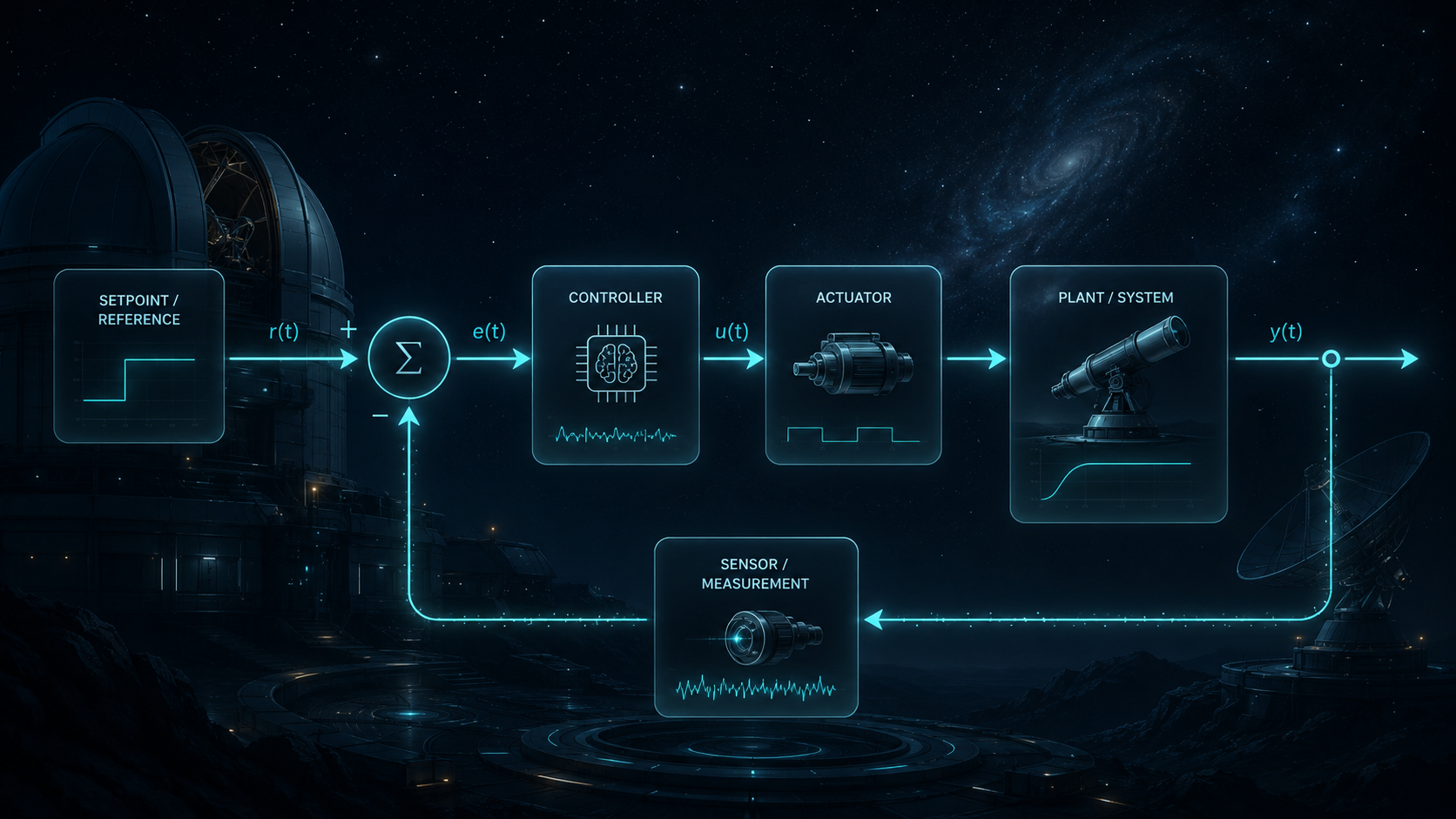
Closed-loop control, usually called feedback control, measures the output, compares it with the target, computes an error, and uses that error to decide the next correction. This single idea is what makes feedback systems so powerful. They do not merely act; they react. That means they can reject disturbances, adapt to modest changes, and actively push the system back toward the desired state.
A thermostat is a familiar example. It measures room temperature, compares it with the setpoint, and switches heating on or off accordingly. In more advanced systems, the control law is continuous rather than on-off. Instead of simply declaring “too cold” or “too warm,” the controller may determine how large the error is, how fast it is changing, and how long it has been present.
The controller acts on the difference between the desired output $r(t)$ and the measured output $y(t)$.
This is the key philosophical difference between open-loop and closed-loop design. Open-loop says, “I issued the command, so my job is done.” Closed-loop says, “I issued the command, but I am going to verify whether anything sensible actually happened.”
Every loop has a cast of characters.
Most feedback systems can be described with the same small group of components. There is a reference or setpoint, which defines the desired state. There is a plant, which is the physical system being controlled. There is a sensor, which measures what the plant is doing. There is a controller, which decides what correction should be applied. And there is an actuator, which physically applies that correction.
There is also one more participant, and it is usually the most irritating one: the disturbance. Disturbances are everything the environment throws at the system while pretending not to be involved. In a telescope, that may be wind or vibration. In an optical instrument, that may be temperature drift. In a spectrograph, it may be pressure change, thermal expansion, refractive-index variation, or mechanical motion. In life, it is usually Monday.
A strong correction is not automatically a good correction.
People new to control often imagine that if a system is not correcting fast enough, the obvious solution is to apply more correction. Unfortunately, control systems are not impressed by enthusiasm alone. If the gain is too low, the system responds sluggishly. If the gain is too high, the response overshoots and may oscillate. If there is delay in the plant or the measurement, the problem becomes even worse, because the controller may react to a state that has already changed.
This is why tuning matters. You are balancing speed, stability, smoothness, robustness, and noise sensitivity. A very aggressive controller may correct quickly in a quiet environment but become unstable in a noisy one. A very cautious controller may be stable but too slow to be useful. In practice, good tuning is often an exercise in engineering humility: you do not ask for perfection, you ask for reliable behaviour under realistic conditions.
The controller $C(s)$ and plant $G(s)$ together determine the overall closed-loop behaviour.
Reality adds delay, noise, and other delightful complications.
In an ideal classroom model, the sensor tells the truth instantly, the actuator responds immediately, and the plant behaves exactly as predicted. In the real world, sensors are noisy, actuators have limits, and physical systems have inertia. Delay is particularly dangerous because it makes the controller act on information from the past. A loop that would have been stable with no delay may become oscillatory once latency is introduced.
Noise causes a different problem. If the controller reacts too strongly to noisy measurements, it may correct fluctuations that are not actually meaningful. That is why filtering, averaging, appropriate sampling, and sensible controller design matter. The goal is not to ignore measurement; the goal is to avoid mistaking noise for signal.
Control systems matter a great deal in astrophysics, even when they stay invisible.
Scientific instruments only look elegant in papers. In practice, they survive by continuous correction. Telescope mounts use feedback to track celestial objects accurately. Adaptive optics systems sense wavefront distortion and command mirrors to compensate. Thermal-control systems keep detectors, optics, or spectrograph benches stable enough that the instrument does not quietly drift away from calibration. Guiding software measures position errors and corrects them before the star image walks away across the detector like it owns the place.
This is one reason I find control systems deeply interesting. They sit at the point where physics, measurement, software, electronics, and hardware all have to cooperate. In exoplanet instrumentation, for example, you do not get to say, “The environment was difficult.” The instrument still has to remain stable. Feedback is often the mechanism that turns that demand from impossible into merely difficult.
Even outside astronomy, the same philosophy applies. If a system matters, someone eventually builds a loop around it.
Feedback is powerful, but it is not magic.
The great advantage of feedback control is robustness. A well-designed closed-loop system can reject disturbances, compensate for moderate modelling errors, and remain useful even when conditions are imperfect. It does not need the world to behave exactly as expected. That is a remarkably practical quality.
But feedback does not solve everything. A controller cannot compensate for an actuator with no authority, a sensor with no useful information, or a plant whose dynamics are fundamentally too fast or too unstable for the chosen hardware. Poorly designed feedback can also create its own problems: oscillation, chatter, excessive wear, amplified noise, or spectacularly confident instability.
Advantages
Handles disturbances, corrects drift, improves accuracy, and makes systems more reliable under changing conditions.
Limitations
Needs good measurements, reasonable modelling, actuator authority, and careful tuning. Otherwise it becomes an expensive way to generate oscillations.
Feedback is disciplined correction.
At its core, control engineering is not about domination. It is about response. A control system measures what is happening, compares that reality with an intended state, and applies corrections in a structured way. That sounds almost modest, but it is one of the most powerful ideas in engineering.
When it works well, it becomes easy to forget it is there. The telescope tracks smoothly. The room stays near its setpoint. The instrument remains stable. The signal does not drift off into nonsense. In other words, success in control systems often looks boring, and that is exactly the point.
Comments
If this post was useful, confusing, or made you reconsider your relationship with oscillations, you can leave a note below. This comment section is lightweight for the static site version.