Small-Body And Visitor Watch
Inspect returned Earth close approaches with their distance and size assumptions visible, then compare known hyperbolic visitors such as 1I, 2I, and 3I/ATLAS.
Reproducible research audit · sensitivity, not hazard
One threshold can hide two different uncertainties.
AstroBis now tests its 0.05 AU / 140 m encounter screen against the JPL three-sigma distance interval and an explicit geometric-albedo bracket. The result is an evidence audit—not a PHA label, impact probability, or planetary-defence recommendation.
- Returned coverage
- 7,500 / 39,427 19.0% chronological prefix
- Nominal ≤0.05 AU
- 586 396 remain inside at 3σ max
- Boundary-sensitive
- 190 32.4% of nominal-close rows
- Measured diameters
- 235 3.1% of returned rows
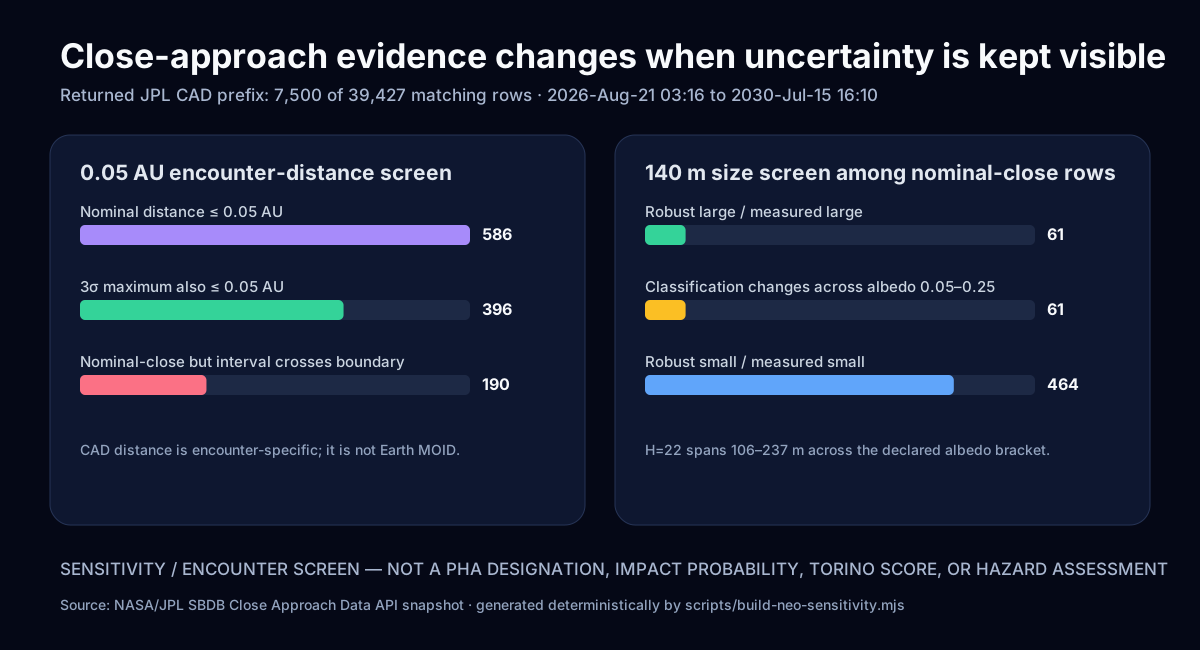
What changed scientifically
The original interface converted missing JPL diameters to zero. The new parser preserves missingness, uses measured diameters when present, and otherwise evaluates the standard H–albedo relation. At H=22, the declared albedo range 0.05–0.25 spans 106–237 m; the familiar 140 m value is the pV=0.14 reference, not a measured size.
The source query asks for dates through 2050, but its 7,500-row limit and date sort end the committed response at 2030-Jul-15 16:10. AstroBis now exposes that truncation instead of implying complete 2050 coverage.
| Geometric albedo | Nominal-close rows | 3σ-robust-close rows |
|---|---|---|
| 0.05 | 122 | 109 |
| 0.10 | 92 | 86 |
| 0.14 | 75 | 72 |
| 0.20 | 65 | 63 |
| 0.25 | 61 | 59 |