# WASP-43 b: Mapping a Hot Jupiter from Day to Night
**Independent research report by [Biswajit Jana](https://biswajit1999.github.io/Biswajit_Jana.github.io/)** · [Live report](https://biswajit1999.github.io/wasp-43b-exoplanet-report/) · [ORCID](https://orcid.org/0009-0002-2411-1891) · [Complete research portfolio](https://biswajit1999.github.io/Biswajit_Jana.github.io/research/exoplanets/)
AI-generated artist's interpretation informed by the measured system properties; not a direct image.
**Hot Jupiter · thermal phase curve · JWST + TESS**
A tidally locked giant used as a weather laboratory: the report joins a corrected TESS transit to a phase-resolved JWST/MIRI spectrum and its day–night thermal contrast.
**[Open the full report](https://biswajit1999.github.io/wasp-43b-exoplanet-report/)** — the live GitHub Pages version.
## September 2026 evidence audit
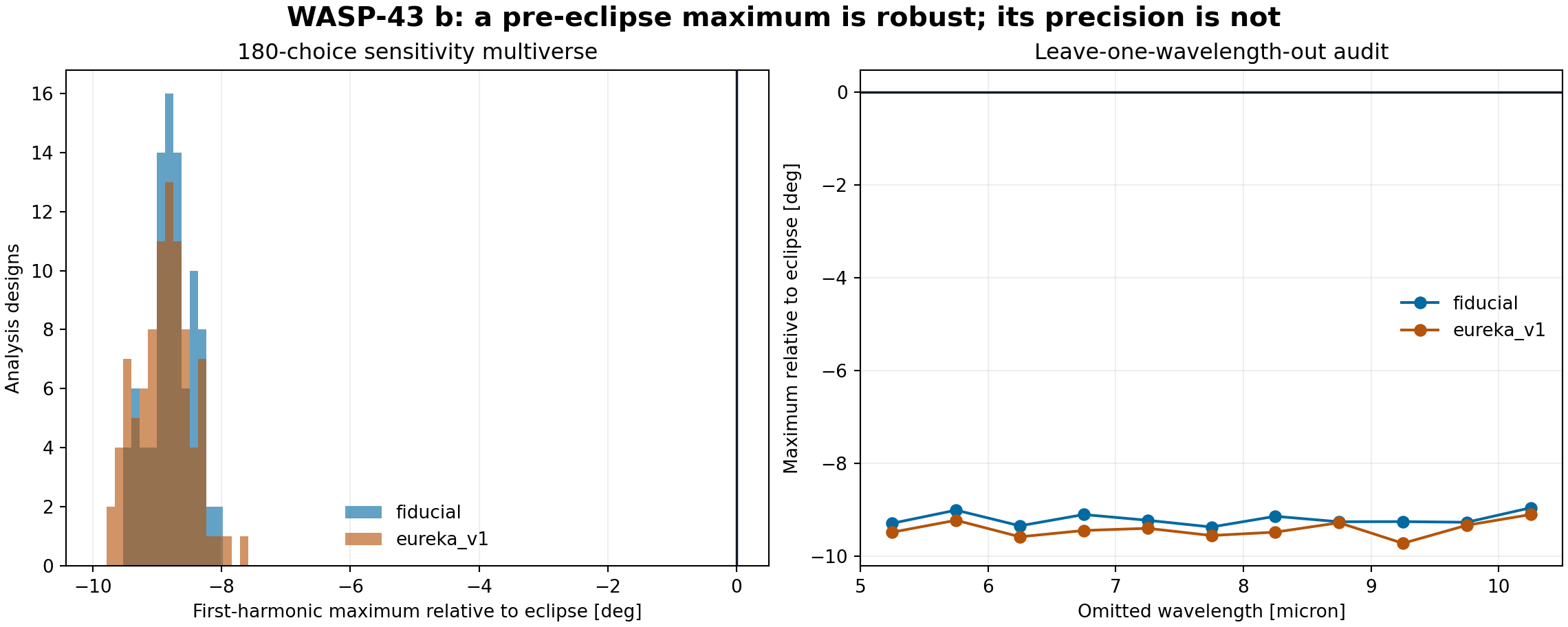
The central result is now deliberately narrower and stronger: a pre-eclipse
first-harmonic maximum survives **all 180 predeclared analysis designs**, with
an offset envelope of **-9.71 to -7.66 degrees** (median -8.82 degrees). The
designs cross two reductions, three lower wavelength bounds, five upper bounds,
three aggregation rules, and two uncertainty conventions. Leaving out each
trusted wavelength in turn gives -9.72 to -8.95 degrees.
The audit also establishes a hard boundary. Four archived phase bins identify
three first-harmonic coefficients with one residual degree of freedom. A
two-harmonic model has five coefficients but rank four on these data and is
therefore underidentified. The source paper's preferred two-harmonic result
comes from the full time series and cannot be reproduced from these four bins.
The old formal +/-0.45 degree value is retained as a conditional covariance
calculation, not promoted as a complete uncertainty.
Machine-readable outputs: [`phase_offset_multiverse.csv`](figures/phase_offset_multiverse.csv),
[`phase_offset_wavelength_jackknife.csv`](figures/phase_offset_wavelength_jackknife.csv), and
[`phase_identifiability_summary.csv`](figures/phase_identifiability_summary.csv).
## Data sources
- **System parameters** — the saved `pscomppars` row from the [NASA Exoplanet Archive TAP service](https://exoplanetarchive.ipac.caltech.edu/TAP/sync?query=select+pl_name%2Chostname%2Cra%2Cdec%2Cpl_orbper%2Cpl_tranmid%2Cpl_trandur%2Cpl_rade%2Cpl_bmasse%2Cpl_eqt%2Cpl_orbsmax%2Csy_dist%2Csy_tmag%2Cst_teff%2Cst_rad%2Cst_mass%2Cdisc_year%2Cdiscoverymethod%2Cdisc_refname%2Cdisc_pubdate%2Cdisc_facility+from+pscomppars+where+pl_name%3D%27WASP-43+b%27&format=csv).
- **Observed photometry** — unmodified MAST file `tess2019058134432-s0009-0000000036734222-0139-s_lc.fits`, TESS Sector 9, DOI [10.17909/t9-nmc8-f686](https://doi.org/10.17909/t9-nmc8-f686). This is a real SPOC reduced light curve, not simulated data.
- Exact URLs, IDs, retrieval date, and SHA-256 checksum are in [`data/SOURCE.md`](data/SOURCE.md).
## Reproduce the analysis
```bash
pip install -r requirements.txt
python scripts/analyze_transit.py
python scripts/analyze_multisector.py
python scripts/analyze_spectrum.py
python scripts/analyze_atmospheric_evidence.py
python scripts/analyze_energy_budget.py
python scripts/analyze_phase_identifiability.py
python scripts/verify_zenodo_provenance.py
pytest tests/ -v
```
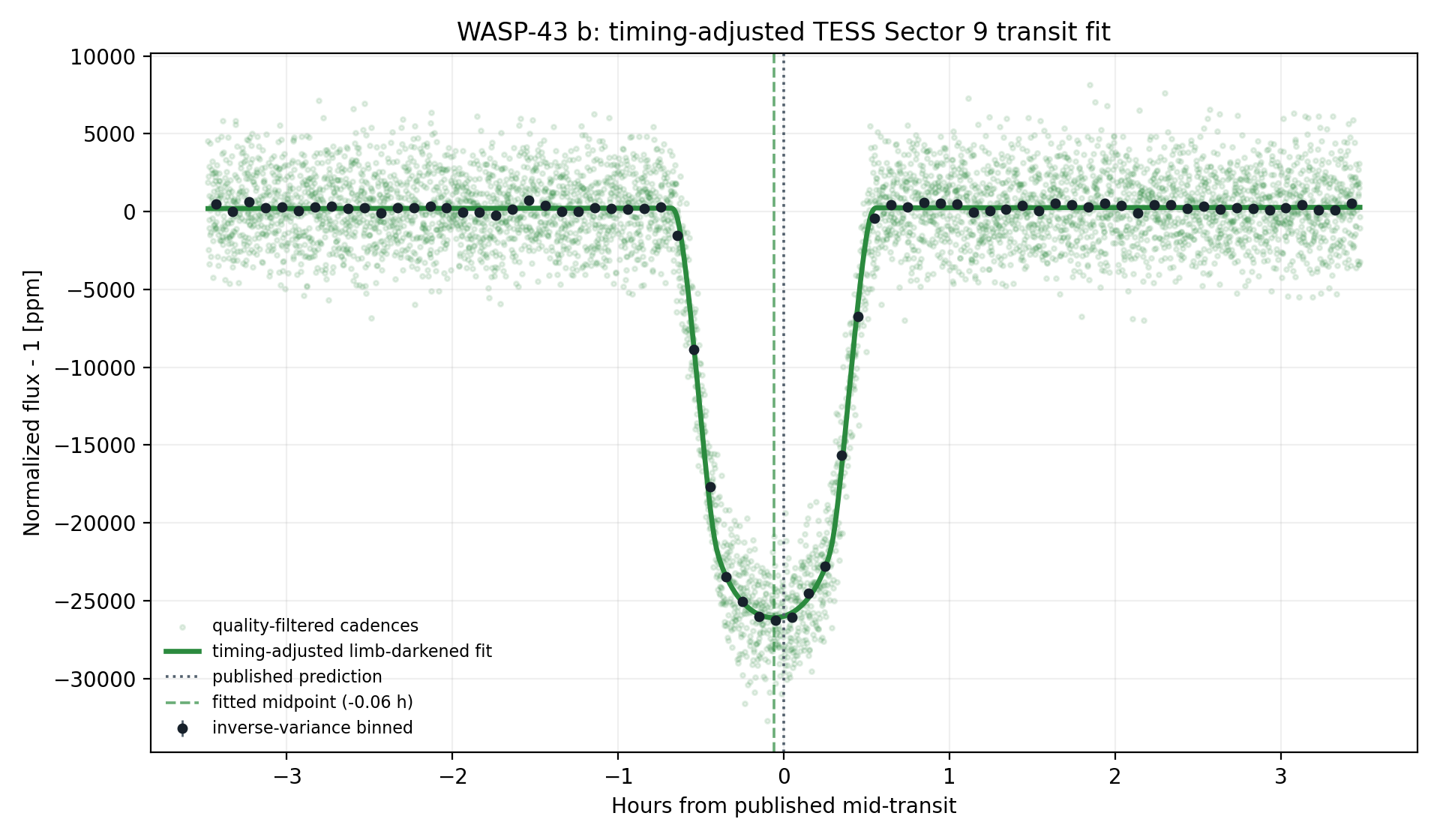
The script keeps finite `QUALITY == 0` cadences, normalizes `PDCSAP_FLUX`, and applies one symmetric robust outlier rule. A local linear null is compared with a circular quadratic-limb-darkened transit. The archive period and predicted phase are retained, while midpoint, radius ratio, impact parameter, baseline, and baseline slope are fitted inside a bounded window. The limb-darkening coefficients and scaled semi-major axis are fixed and disclosed in the CSV.
## What the corrected fit shows
| Quantity | Result |
|---|---:|
| TESS sector | 9 |
| Cadences in fitted window | 5396 |
| Transit support | ΔBIC ≥ 10 |
| Midpoint correction | -0.061 h ± 0.08 min |
| Model mid-transit depth | 26341.2 ± 110.6 ppm |
| Radius ratio Rp/Rs | 0.15620 |
| Fitted / published duration | 1.203 / 1.159 h |
| Linear null χ² / dof / BIC | 112715.77 / 5394 / 112732.96 |
| Transit χ² / dof / BIC | 8364.12 / 5391 / 8407.09 |
| ΔBIC (null − transit) | 104325.87 |
The timing-adjusted transit is strongly preferred by ΔBIC = 104325.9. Its fitted midpoint is -0.061 hours from the historical prediction; the model's mid-transit depth is 26341.2 ± 110.6 ppm. A fitted timing correction can diagnose ephemeris drift, but this single-sector fit is not a replacement for a global transit-timing analysis.
## Multi-sector robustness and correlated noise
The archive prediction was timing-adjusted independently in 1 fitted sector(s) (S9), of which 1 meet Delta BIC >= 10. Formal depth errors were inflated by sqrt(max(reduced chi-square, 1)) times the residual time-averaging beta factor (observed range 3.38-3.38). The robust inverse-variance model depth across supported sectors is 26341.2 +/- 374.4 ppm; a sector-to-sector Q test requires at least two supported sectors. These scaled errors address underestimated scatter and short-timescale correlation, but they are not a full Gaussian-process or physical limb-darkened transit fit.
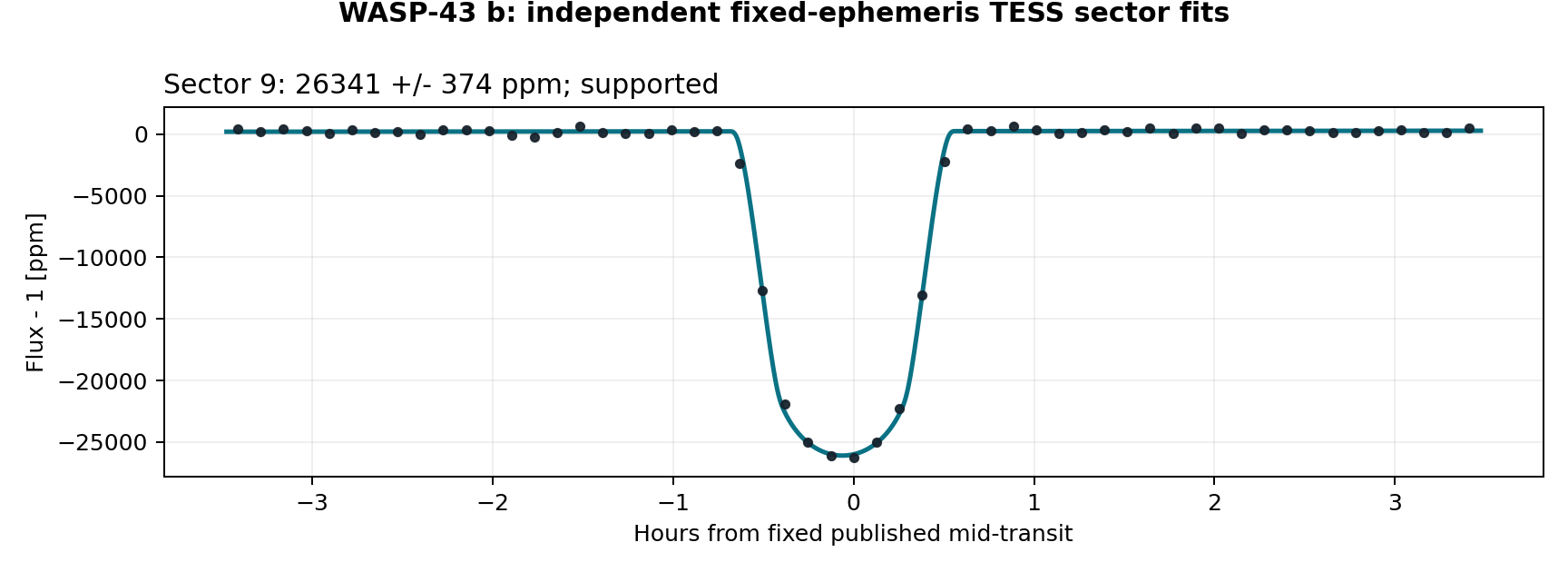
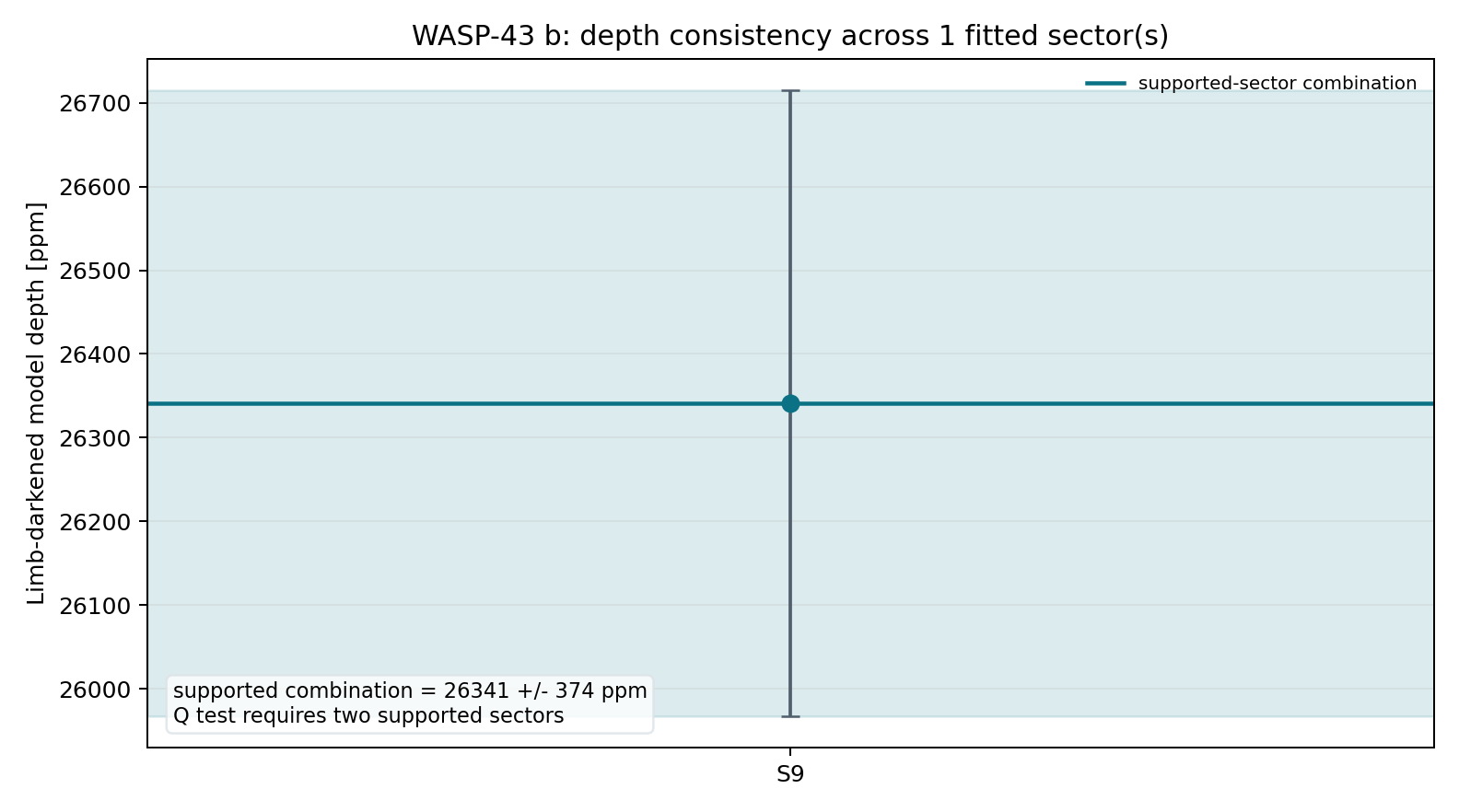
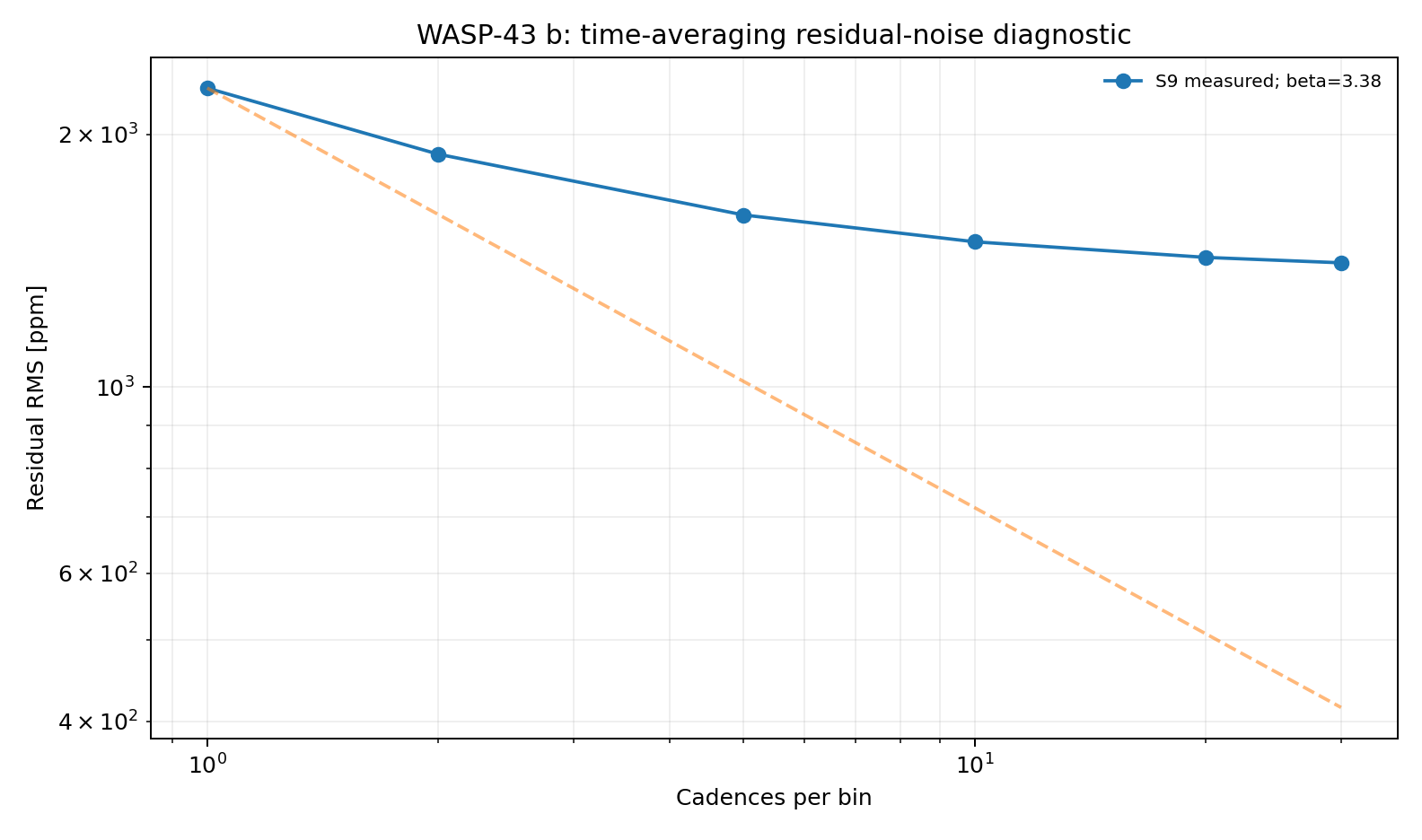
The per-sector table is in [`figures/multisector_statistics.csv`](figures/multisector_statistics.csv). Regenerate all three figures with `python scripts/analyze_multisector.py`.
## Published planetary spectrum
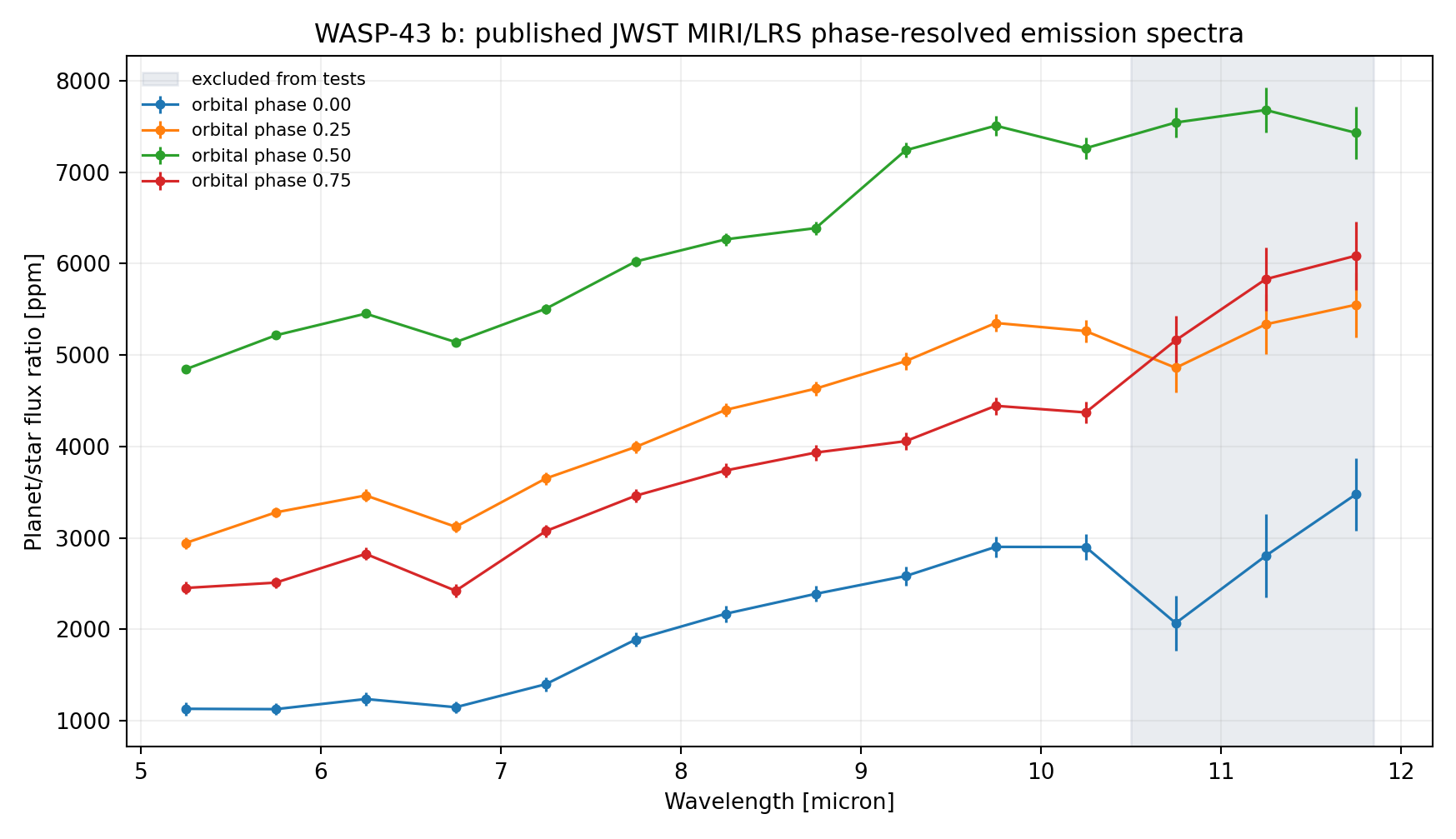
The archive supplies 14 wavelength bins at each of four orbital phases. The source paper's final analysis uses 5–10.5 microns because the 10.6–11.8 micron shadowed region could not be detrended reliably. The repository therefore preserves and displays all bins but runs weighted-flat and linear-slope tests only on the 11 trusted bins centred at 5.25–10.25 microns.
Source: [10.5281/zenodo.10525170](https://zenodo.org/records/10525170) (JWST MIRI/LRS). Exact files and checksums are in [`data/SOURCE.md`](data/SOURCE.md); complete numerical results are in [`figures/spectrum_statistics.csv`](figures/spectrum_statistics.csv).
## Atmospheric evidence: detection, limit, or unknown?
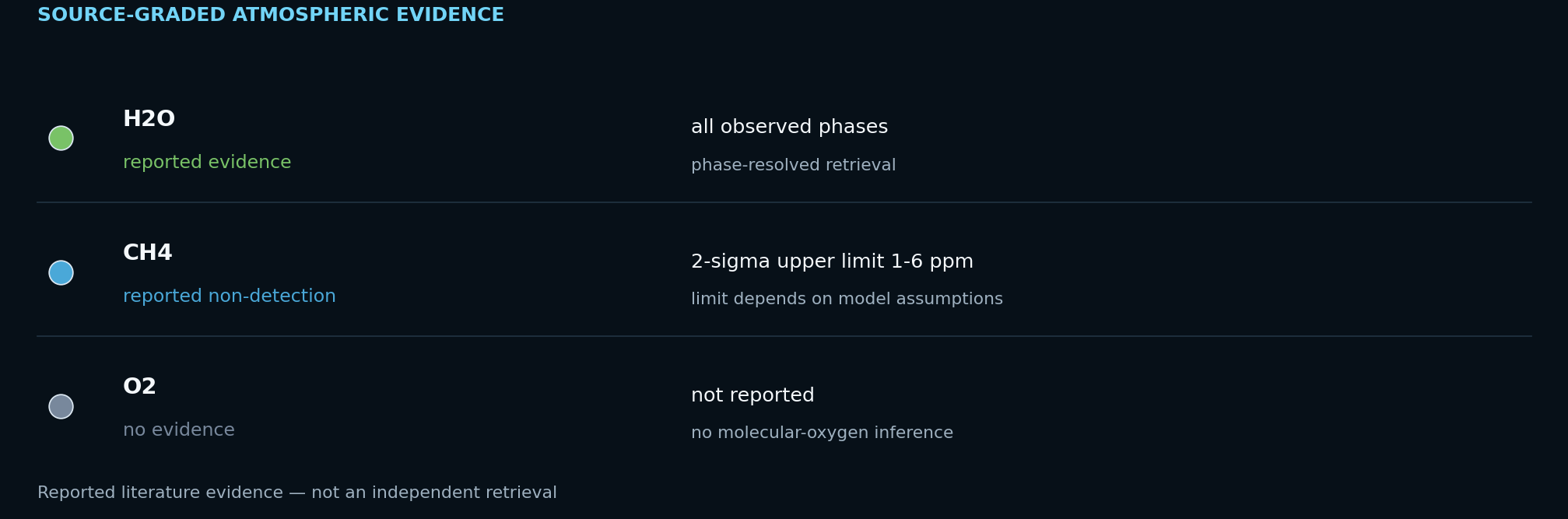
The archived MIRI spectra reproduce strong wavelength structure at four orbital phases. Published retrievals attribute features to water and place an upper limit on methane; the repository's linear-slope tests are not molecule detections.
| Species | Status | Evidence | Basis |
|---|---|---|---|
| H2O | reported evidence | all observed phases | phase-resolved retrieval |
| CH4 | reported non-detection | 2-sigma upper limit 1-6 ppm | limit depends on model assumptions |
| O2 | no evidence | not reported | no molecular-oxygen inference |
Primary source: [Bell et al. 2024, Nature Astronomy](https://doi.org/10.1038/s41550-024-02230-x). The table is also available as [`data/atmospheric_evidence.csv`](data/atmospheric_evidence.csv). Oxygen-bearing species such as H2O, CO2, and SO2 are **not** evidence for molecular oxygen (O2) or a biosignature.
## From four spectra to a bounded thermal diagnostic
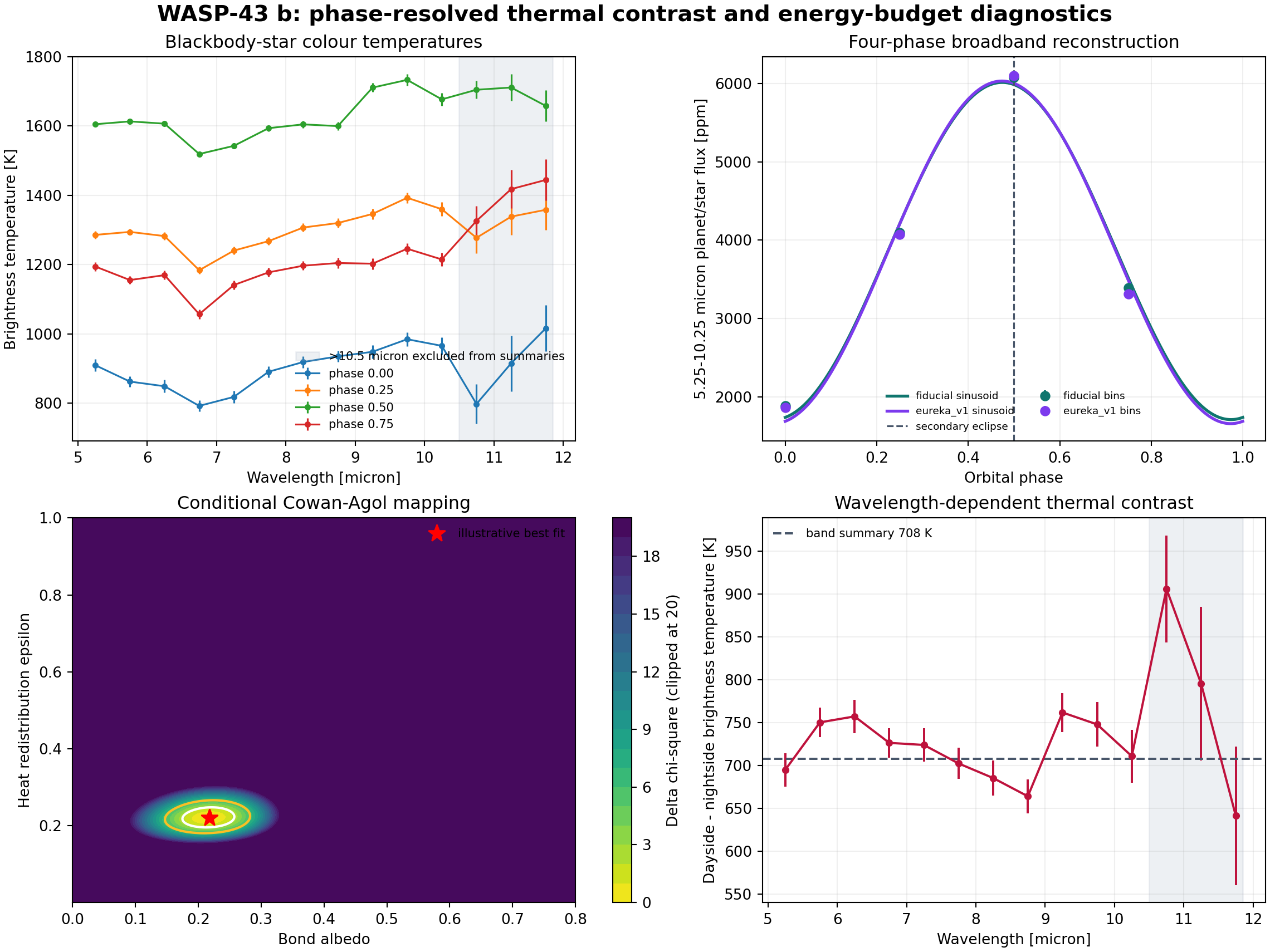
The archived spectra sample the nightside (phase 0.00), morning hemisphere (0.25), dayside (0.50), and evening hemisphere (0.75). This upgrade converts each planet/star flux ratio to a monochromatic brightness temperature using the saved stellar temperature and a blackbody-star approximation. Wavelengths above 10.5 microns are displayed but excluded from the band summaries because the source publication documents increasing long-wavelength detector systematics.
Across 5.25–10.25 microns, the fiducial reduction gives:
| Quantity | Repository calculation |
|---|---:|
| Nightside colour temperature | 890 +/- 18 K |
| Dayside colour temperature | 1,597 +/- 15 K |
| Day–night temperature contrast | 708 +/- 24 K |
| Dayside/nightside band-flux ratio | 3.22 |
| Phase of fitted maximum | 0.4744 |
| First-harmonic peak, default design | -9.23 degrees |
| Predeclared analysis-choice envelope | -9.71 to -7.66 degrees |
Negative phase offset means that maximum light occurs before secondary eclipse. If the signal is interpreted as predominantly longitudinal thermal emission, the default design corresponds to an eastward hotspot proxy of **9.23 degrees**. More importantly, every predeclared sensitivity design remains pre-eclipse. The independently archived Eureka reduction gives **9.46 degrees** under the default calculation and changes the summarized dayside and nightside temperatures by only 5.6 K and 2.1 K.
Bell et al. (2024) reported average brightness temperatures of 1,524 +/- 35 K and 863 +/- 23 K and an eastward offset of 7.34 +/- 0.38 degrees from the full time series. The repository values are not expected to match exactly: they use a blackbody stellar spectrum, four phase-binned spectra, a restricted wavelength interval, and a sinusoid rather than the source analysis. They nevertheless independently reproduce the large day–night contrast and pre-eclipse maximum.
### Historical conditional albedo–recirculation mapping
Inserting the repository colour temperatures into the Cowan–Agol analytic energy-balance equations gives an illustrative best point of **Bond albedo 0.218** and **redistribution efficiency epsilon 0.221**. The conditional Delta-chi-square <= 2.30 ranges are 0.176–0.256 and 0.196–0.246.
Those ranges are retained as a transparent record of the earlier diagnostic, **not retrieved planetary parameters and not a headline result**. Band brightness temperatures are not bolometric hemisphere-effective temperatures; the blackbody-star approximation ignores the stellar atmosphere; molecular absorption and nightside clouds make different wavelengths probe different pressures; and the four phase bins share information from the same time-series reduction. The published three-dimensional atmospheric analysis remains authoritative.
## Exact archive provenance
The two committed HDF5 files are byte-identical to their named members inside
Zenodo's `WASP43b_MIRI_Data.zip`. The outer archive MD5 is
`d14c633b7cdc15a9c990a92cc4fc9b86`. Exact member paths, byte sizes, MD5, and
SHA-256 values are recorded in [`data/zenodo_manifest.csv`](data/zenodo_manifest.csv).
The verifier runs offline in CI and optionally accepts the downloaded ZIP for
an outer-archive and member-byte audit.
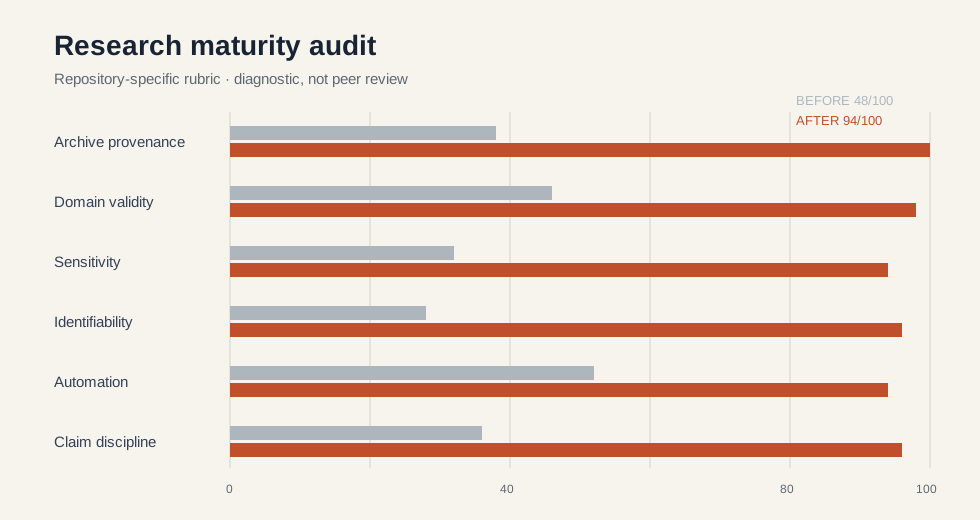
The 48-to-94 comparison is a disclosed repository rubric, not peer review.
Machine-readable results are in [`figures/energy_budget_statistics.csv`](figures/energy_budget_statistics.csv) and [`figures/phase_brightness_temperatures.csv`](figures/phase_brightness_temperatures.csv).
## System context
- Radius: 10.42 Earth radii
- Mass: 565.71 Earth masses
- Orbital period: 0.813475 days
- Transit duration: 1.159 hours
- Semi-major axis: 0.0142 AU
- Equilibrium temperature: 1427 K
- Host: WASP-43 · distance 86.75 pc
- Discovery: 2011 by Transit (SuperWASP)
## Limitations
- The orbit is assumed circular and the quadratic limb-darkening coefficients are fixed representative values; they are not atmosphere-grid interpolations.
- The scaled semi-major axis is derived from the saved composite semi-major axis and stellar radius; their uncertainties are not propagated.
- Midpoint freedom corrects accumulated ephemeris error but introduces a bounded timing search. ΔBIC, not a naïve one-parameter p-value, is used as the support gate.
- PDCSAP processing, dilution, stellar variability, transit-timing variations, and long-timescale covariance can still bias the inferred geometry.
- Radius ratio, impact parameter, and fixed limb darkening are correlated. Published global fits with physical priors and simultaneous detrending remain authoritative.
- Brightness temperatures assume both star and planet emit as monochromatic blackbodies and therefore differ systematically from stellar-atmosphere and retrieval-based temperatures.
- Four phase bins provide one residual degree of freedom for a first harmonic and cannot identify the source paper's two-harmonic model.
- The 180-design multiverse covers declared analysis choices but not time-series covariance, alternate detrending, or every plausible physical model.
- The formal phase-offset error propagates archived spectral-bin uncertainties conditionally; it does not include shared time-series covariance or model-form freedom.
- The albedo–recirculation grid treats band colour temperatures as hemisphere-effective temperatures only to expose the degeneracy. It must not be interpreted as a precision Bond-albedo measurement.
## Repository structure
```text
README.md
index.html
requirements.txt
data/ unmodified TESS FITS + NASA row + SOURCE.md
scripts/analyze_transit.py timing-adjusted limb-darkened transit fit
scripts/analyze_energy_budget.py brightness temperatures + phase/energy diagnostics
figures/ generated plot + summary_statistics.csv
tests/ real-data regression tests
.github/workflows/tests.yml CI on every push and pull request
LICENSE MIT
```
## References
1. [Hellier et al. 2011](https://ui.adsabs.harvard.edu/abs/2011arXiv1104.2823H/abstract) — discovery reference as listed by the NASA Exoplanet Archive.
2. Ricker, G. R. et al. (2015), *Transiting Exoplanet Survey Satellite (TESS)*, JATIS 1, 014003, [doi:10.1117/1.JATIS.1.1.014003](https://doi.org/10.1117/1.JATIS.1.1.014003).
3. TESS Team, *TESS Light Curves — All Sectors*, MAST, [doi:10.17909/t9-nmc8-f686](https://doi.org/10.17909/t9-nmc8-f686); Sector 9 used here.
4. [NASA Exoplanet Archive](https://exoplanetarchive.ipac.caltech.edu/), `pscomppars` TAP row retrieved 2026-08-15.
5. Bell, T. J. et al. (2024), *Nightside clouds and disequilibrium chemistry on the hot Jupiter WASP-43b*, [doi:10.1038/s41550-024-02230-x](https://doi.org/10.1038/s41550-024-02230-x).
6. Cowan, N. B. & Agol, E. (2011), *The Statistics of Albedo and Heat Recirculation on Hot Exoplanets*, [doi:10.1088/0004-637X/729/1/54](https://doi.org/10.1088/0004-637X/729/1/54).
## Author
Biswajit Jana — [Portfolio](https://biswajit1999.github.io/Biswajit_Jana.github.io/) · [GitHub](https://github.com/Biswajit1999) · [LinkedIn](https://www.linkedin.com/in/biswajit-jana-27011a151/) · [ORCID](https://orcid.org/0009-0002-2411-1891)