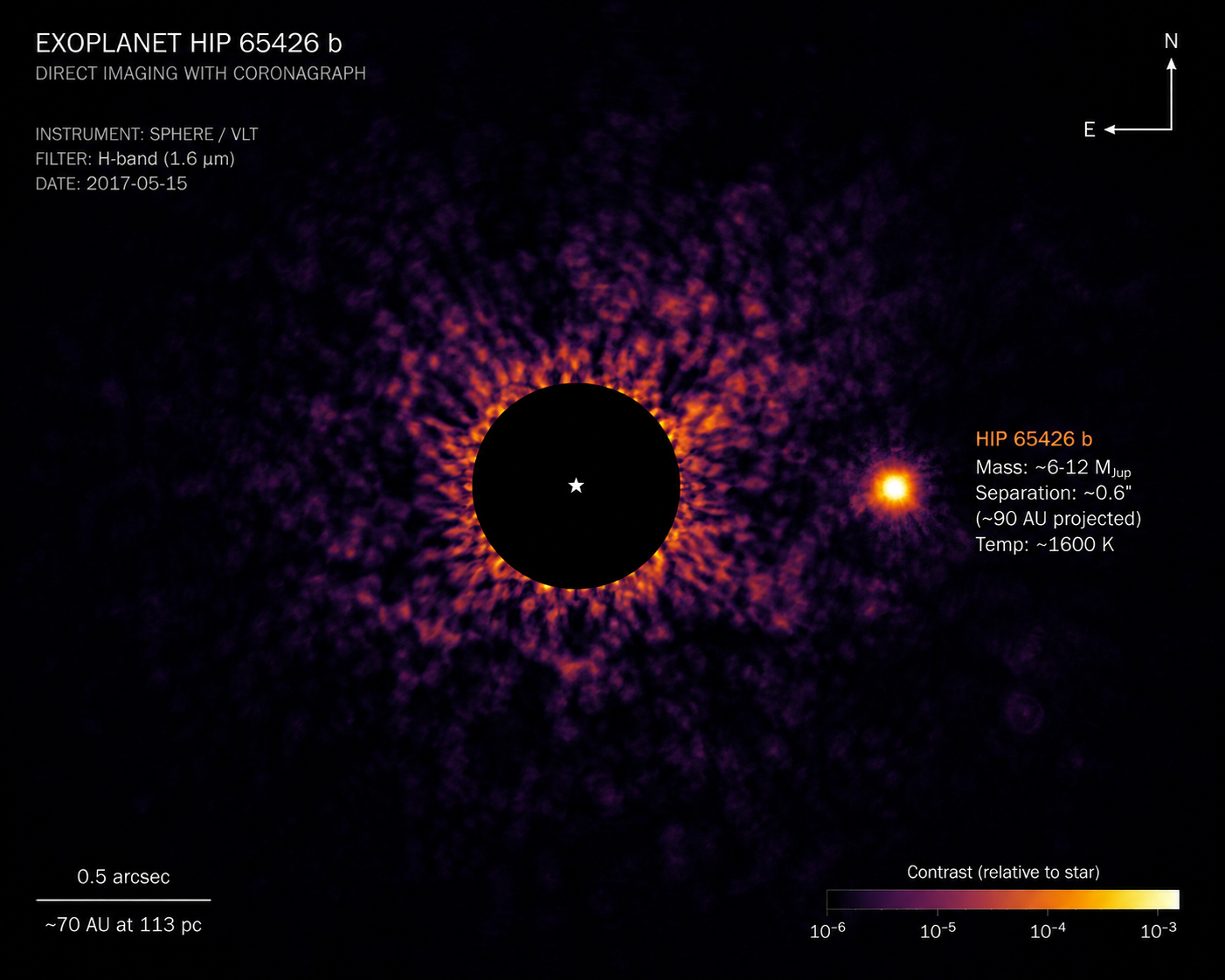
AI-generated artist's concept — not a real photograph. See the report for the real physics and detection statistics.
The only method that produces an actual picture of a planet: resolve its light as a separate point source next to its host star. This repo works through the physics, implements an Angular Differential Imaging (ADI) reduction pipeline in Python from scratch, and validates it by injecting a companion into a simulated speckle-limited sequence and recovering it — including a contrast curve calibrated in proper flux- ratio units with a correction for how few independent noise samples exist close to the star. **[Open the full report](https://biswajit1999.github.io/direct-imaging-detection-method/)** — the live GitHub Pages version. You can also open `index.html` locally in a browser, or serve it with `python -m http.server` from this directory. ## The physics ### Two problems at once Direct imaging faces two combined challenges: **contrast** (a Jupiter- mass planet is roughly $10^{-4}$ to $10^{-9}$ times fainter than its star, depending on age and wavelength) and **angular separation** (most known planets sit far too close to their star to be resolved from typical distances — the angular separation of a planet at 1 AU seen from 10 parsecs is only 0.1 arcseconds, comparable to or smaller than the diffraction limit of even a large telescope at visible wavelengths). Both have to be overcome simultaneously: a wide-orbit planet is easier to separate from its star angularly but usually fainter in absolute terms too, since it intercepts less starlight and formed farther from the heat of formation. ### Why speckles, not just diffraction, set the floor A telescope's diffraction pattern (the Airy pattern for a circular aperture) sets a hard geometric limit on angular resolution, but real high-contrast imaging is usually limited by something else entirely: adaptive optics correct atmospheric turbulence in real time, but leave behind residual, slowly-evolving "quasi-static" speckles — small imperfections in the optics and imperfect AO correction that produce a mottled pattern of bright and dark spots across the field, each one looking exactly like a faint point source would. These speckles evolve on minutes-to-hours timescales (as temperature and mechanical flexure shift the optics slightly) and typically dominate over ordinary photon noise at the separations where planets are found, which is why simply integrating longer doesn't help much — the noise doesn't average down the way photon noise does, because it isn't random from exposure to exposure. ### How ADI tells a planet from a speckle Angular Differential Imaging (Marois et al. 2006) exploits geometry: on an alt-az telescope with the image derotator switched off (or deliberately disabled), the sky appears to rotate around the field center over the course of a night while the telescope's own optics — and their speckle pattern — stay fixed relative to the detector. A real companion, fixed on the sky, traces an arc across the detector as the field rotates; the speckles don't move at all. Building a reference image from the sequence (the simplest version: the median of all frames) captures the star and its speckles well, since they're present in every frame in the same place, while the companion is smeared across many different positions and contributes little to the median. Subtract that reference from each frame, and what's left is mostly the moving companion signal on a much fainter noise floor. De-rotating each residual frame back to a common sky orientation before combining makes the companion's signal add up coherently while the leftover speckle residue, no longer at a fixed detector position, partially cancels. ## Why this method matters Direct imaging is the only technique that yields a planet's own light directly: its spectrum, its temperature, sometimes resolved orbital motion over years, all without needing a fortunate transit alignment or a large reflex velocity. It works best for young, still-warm, self- luminous giant planets on wide orbits — systems like HR 8799 (four imaged giant planets) and Beta Pictoris b were found and characterized this way, and it remains the main way to study a planet's atmosphere independent of transmission or emission spectroscopy during transit. Per the NASA Exoplanet Archive's confirmed-planet counts by discovery method (accessed 2026-08-14), direct imaging accounts for 98 of 6,336 confirmed exoplanets (~2%) — the least numerically productive of the four major methods (transit 4,676, ~74%; radial velocity 1,197, ~19%; microlensing 282, ~4%), for a structural reason rather than a technological one: it is fundamentally biased toward a narrow, rare demographic of young, massive, wide-separation, self-luminous giant planets, while the other methods are better matched to the close-in planets that dominate the census by selection effects. **Limitation:** direct imaging is strongly biased toward young (hot, still glowing from formation), massive, wide-separation planets around nearby stars — it's currently close to blind to older, cooler, close-in planets like most of the archival JWST/HST targets covered elsewhere in this portfolio, which is exactly why transit and radial-velocity spectroscopy remain necessary for characterizing the bulk of the known exoplanet population. ## What this repo's code does `scripts/direct_imaging_demo.py`: 1. Simulates a 30-frame ADI sequence: a fixed stellar point-spread function plus a quasi-static speckle pattern at a realistic amplitude, with a faint injected companion at a young-giant- planet-like contrast ($6\times10^{-4}$) whose position angle rotates with the sky across 90 degrees of parallactic-angle coverage while the speckles stay fixed on the detector. 2. Builds a reference PSF from the median of all frames, subtracts it from each frame, de-rotates each residual to align the sky, and combines them — the ADI algorithm from Marois et al. (2006). 3. Measures the companion's detection significance via aperture photometry against an annulus noise estimate, comparing a single raw frame against the final ADI-reduced image. 4. Computes a 5-sigma contrast curve versus separation, normalized to the star's own aperture flux (so it's a genuine dimensionless contrast, comparable directly to the injected value) and corrected for the number of independent noise samples actually available at each separation (Mawet et al. 2014). The number of independent apertures is derived from geometry — annulus circumference divided by the aperture diameter — rather than fixed, so it correctly shrinks close to the star and grows further out, rather than assuming the same sample count everywhere. Run it yourself: ```bash pip install -r requirements.txt python scripts/direct_imaging_demo.py ``` ## Tests `tests/test_direct_imaging.py` checks the PSF/aperture photometry against closed-form analytic integrals, verifies the independent- aperture count actually scales with separation (a regression guard — an earlier version used a fixed count of 12 everywhere), and confirms the Mawet et al. (2014) small-sample correction converges to the plain Gaussian threshold for large sample counts while penalizing small ones. Runs automatically on every push via GitHub Actions; run locally with: ```bash pytest tests/ -v ``` ## Sanity check against a real target's published parameters HR 8799 b, one of the first planets ever directly imaged (Marois et al. 2008), separates the two challenges from "The physics" above cleanly. Its real measured angular separation is 1.713 arcseconds at a distance of 39.4 parsecs — a physical separation of about 67 AU. The discovery used Keck (10 m primary mirror) and Gemini North (8 m) in the near-infrared H band (1.6 microns); the diffraction limit for a 10 m telescope there, using the standard Rayleigh-criterion convention (the factor of 1.22 is specifically for resolving two point sources with a circular aperture, not a universal constant — see "The physics" above), is: ``` theta = 1.22 * lambda / D = 1.22 * 1.6e-6 m / 10 m = 1.95e-7 rad = 0.040 arcsec ``` The real separation (1.71 arcsec) is roughly 40 times larger than that diffraction limit, so diffraction-limited angular resolution alone was not what made this particular detection hard at this particular separation. That's a narrower claim than saying resolution is never a factor in direct imaging generally: a coronagraph's inner working angle, residual uncorrected starlight, and achievable contrast all still set real limits on detectability even for well-separated companions, and closer-in planets routinely are blocked by exactly these factors regardless of the raw diffraction limit. For HR 8799 b specifically, what made the detection hard was contrast: it's roughly $10^{-5}$ times fainter than its star in the near-infrared, well into the regime where quasi-static speckle noise, not the diffraction limit, sets the real detection floor, which is exactly the problem ADI (used in this repo's simulation) was built to solve. ## Result | Quantity | Value | |---|---| | Injected contrast | 6.0×10⁻⁴ | | Raw single-frame SNR | 0.64σ — not detectable | | ADI-reduced SNR | 27.0σ — clear detection | | SNR improvement | 42.2x | | Recovered flux | 88.3% of injected | | 5σ contrast limit at the companion's separation | 1.5×10⁻⁴ (23 independent apertures) | In a single raw frame the companion is buried in speckle noise (0.64σ — indistinguishable from a random fluctuation). After ADI reduction it becomes an isolated point source at 27.0σ, and the injected contrast sits above the 5σ detection limit everywhere on the contrast curve — a quantified demonstration of why this technique, not longer integration time on its own, is what makes direct imaging of exoplanets practical. ## Limitations The contrast curve shows a documented ADI artifact: elevated noise right around the companion's own separation, caused by **self-subtraction** — with only 90 degrees of parallactic-angle rotation, the companion's own signal partially contaminates the median reference frame and leaves negative "side lobes" near its true position (Milli et al. 2012). That's not a bug; it's a real limitation of ADI with limited field rotation, and real observing sequences are often planned specifically to maximize parallactic-angle coverage to reduce it. Separately, the quasi-static speckle field here is a static Gaussian-random texture rather than a correlated, slowly evolving PSF residual, and algorithmic throughput (how much real companion flux ADI itself removes through self-subtraction, beyond what this repo's 88.3%-recovery number already shows) isn't independently calibrated via fake-planet injection at multiple separations, which a published contrast curve would do. ## Extending this A natural next step: inject fake companions at a grid of separations and position angles, run the same pipeline on each, and use the fraction of flux recovered at each point as an empirical throughput correction for the contrast curve — this is standard practice in real high-contrast imaging pipelines and would tighten the gap between this repo's simplified curve and a publication-grade one. You could also replace the median-combination reference PSF with a more capable algorithm like KLIP (Karhunen-Loève Image Projection, Soummer et al. 2012) or LOCI (Lafrenière et al. 2007), both of which build a smarter reference from a weighted combination of the other frames and typically recover more companion flux at fixed self-subtraction — implemented in real pipelines such as `pyKLIP`. ## Why this repo uses simulated (not raw archival) data This repo demonstrates the *method itself* — how ADI turns an undetectable signal into a clear one, and where its own approximations break down — which is best shown with a known "ground truth" to validate recovery against. This portfolio's companion `*-exoplanet- report` repositories instead each analyze one real target's archival JWST/HST/Spitzer/ground-based spectra directly, with no simulated data. Both approaches are stated plainly here rather than blurring the two. ## Repository structure ```text scripts/direct_imaging_demo.py ADI simulation + reduction pipeline + calibrated contrast curve figures/ generated plot + summary_statistics.csv ``` ## References 1. Marois, C. et al., 2006. Angular Differential Imaging: A Powerful High-Contrast Imaging Technique. *The Astrophysical Journal*, 641(1), pp.556-564. 2. Marois, C. et al., 2008. Direct Imaging of Multiple Planets Orbiting the Star HR 8799. *Science*, 322(5906), pp.1348-1352. 3. Chauvin, G. et al., 2004. A giant planet candidate near a young brown dwarf. *Astronomy & Astrophysics*, 425(2), L29-L32. 4. Milli, J. et al., 2012. Impact of angular differential imaging on circumstellar disk images. *Astronomy & Astrophysics*, 545, A111 — self-subtraction bias in ADI. 5. Mawet, D. et al., 2014. Fundamental Limitations of High Contrast Imaging Set by Small Sample Statistics. *The Astrophysical Journal*, 792(2), 97 — the small-sample correction applied above. 6. Soummer, R., Pueyo, L. and Larkin, J., 2012. Detection and Characterization of Exoplanets and Disks Using Projections on Karhunen-Loeve Eigenimages. *The Astrophysical Journal Letters*, 755(2), L28. 7. NASA Exoplanet Archive,