Interstellar-Link-Lab
Interstellar communication, from the first bit to the detector
An illustrated laboratory walk-through, 26 October 2026 · Research lead: Biswajit Jana
The original question: Could a newly chosen message on Earth reach Proxima Centauri sooner than a light signal? Our work must distinguish increased data rate from faster-than-light propagation. At an illustrative static distance of 4.24 light-years, the ordinary light time is approximately 4.24 years. Real targets move, so a mission needs time-tagged astrometric data.
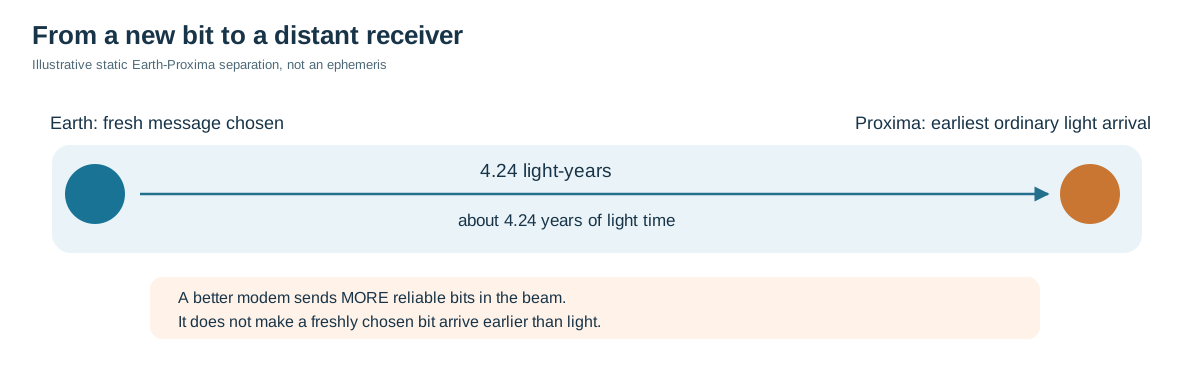
What happens to a message?
A new scientific observation is packaged with error-detection information, protected by an error-correcting code, and converted into a time-dependent optical signal. A telescope directs the laser energy into space. Only a very small fraction of the photons are collected at the other end. A photon-counting detector provides electronic event times, and a decoder estimates the source bits.
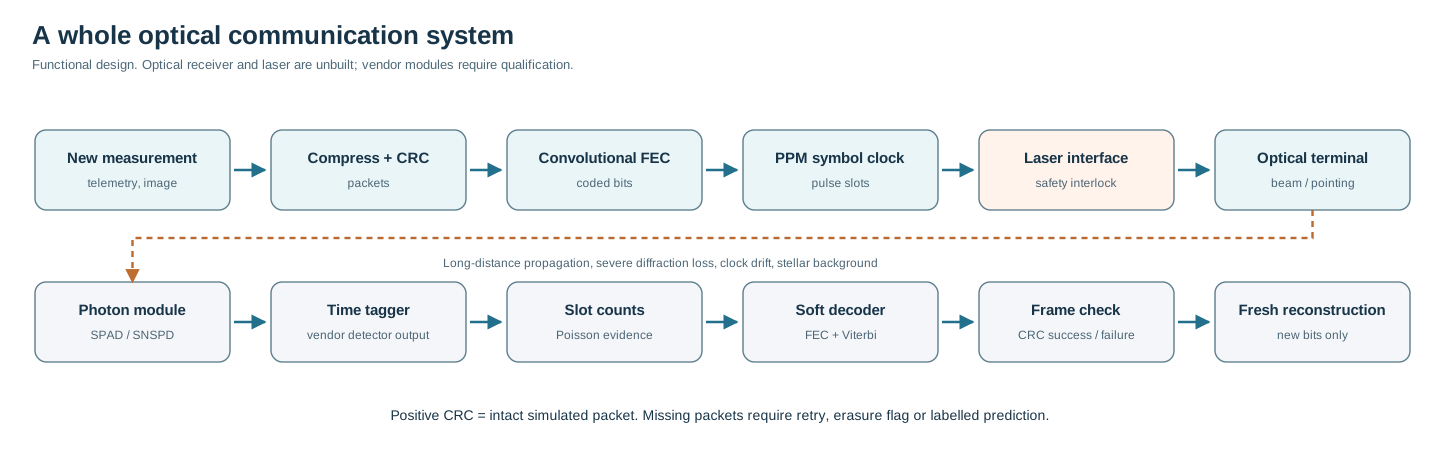
This block diagram separates data preparation, electronic pulse timing, optics, propagation, detector readout and receiver decisions. A robust implementation needs acquisition, clock recovery, pointing feedback and calibrated backgrounds in addition to the illustrated blocks.
Modulation: moving the flash
With on-off keying (OOK), an illuminated time interval can represent one and darkness can represent zero. With 8-position pulse-position modulation (8-PPM), a single pulse is assigned to one of eight time slots; that position encodes three raw bits. Low photon counts make slot decisions uncertain, especially if background photons arrive.
The existing modulation code compares simplified Poisson OOK and PPM channels. The advanced soft decoder and coding experiments model more of the receiver chain, but do not constitute a standard-compliant flight modem.
Electronics we can physically investigate
A useful first demonstration needs no hazardous laser and no avalanche detector. A 3.3 V digital controller drives a small visible LED through a current-limiting resistor. A phototransistor on the other side of a short gap generates a changing voltage at a resistor pull-up node. A suitable Schmitt input records the transitions.
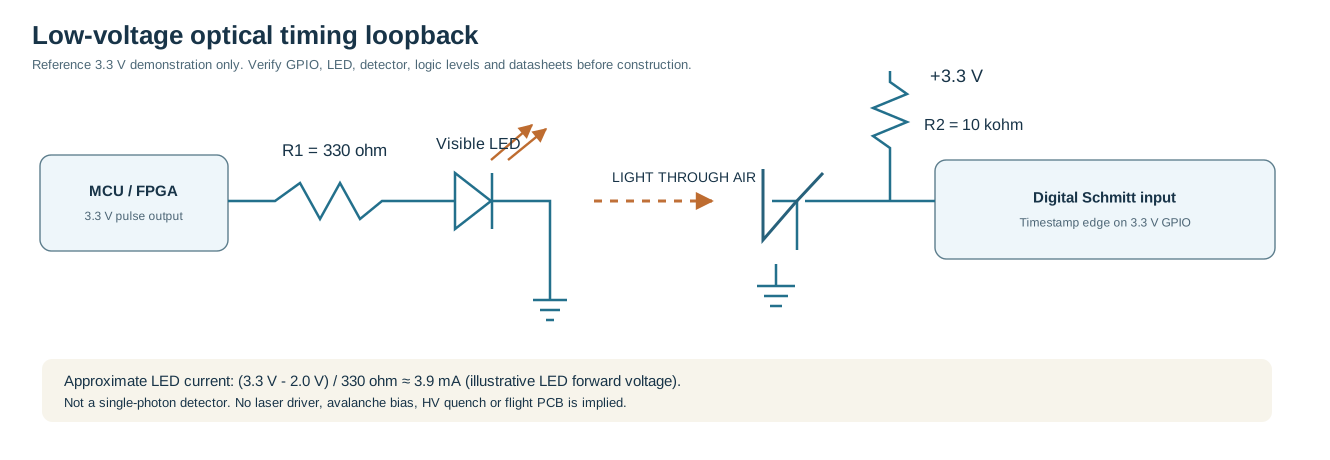
Assuming a forward voltage of 2.0 V, a 330-ohm series resistor produces an approximate current of (3.3 - 2.0) / 330 = 3.9 mA. That 2.0 V is illustrative, not measured. The exact GPIO drive limit, device pinout, LED forward voltage, collector current, rise time, voltage threshold and pull-up requirements must be checked against the chosen components before wiring. This is a conceptual circuit, not a validated PCB.
The later single-photon architecture is different: optical filters, a qualified SPAD or SNSPD module, a time-to-digital converter, and an FPGA or computer implementing slot alignment, photon counts and soft decoding. SPAD bias/quenching, SNSPD cryogenics and laser-driver circuits require equipment-specific safety engineering; they are not supplied as a ready-to-build high-voltage circuit here.
Why coding and prediction help
Some pulses cannot be distinguished from background or are never detected. The coded-PPM model estimates whole-frame acceptance rather than treating each raw bit as perfect. Report every simulated frame-success rate with the photon/noise assumptions, trial count and uncertainty interval.
A predicted image can reduce the number of bits to send: the sender transmits changes relative to shared earlier data. The receiver reconstructs a fresh pixel only when the corresponding protected packet arrives. The synthetic 36-tile demonstration accepted all 36 tiles under a strong toy channel but only nine under a weaker channel; the remainder showed explicitly marked fallback predictions. Prediction is not early delivery of newly observed information.
Why entanglement does not make the message arrive early
For the ideal Bell pair, Bob’s reduced quantum state is one-half of the identity matrix. Bob’s unread local result probabilities remain 50/50 whether Alice secretly chooses the X or Z measurement basis. Correlations appear when the two records are brought together later.
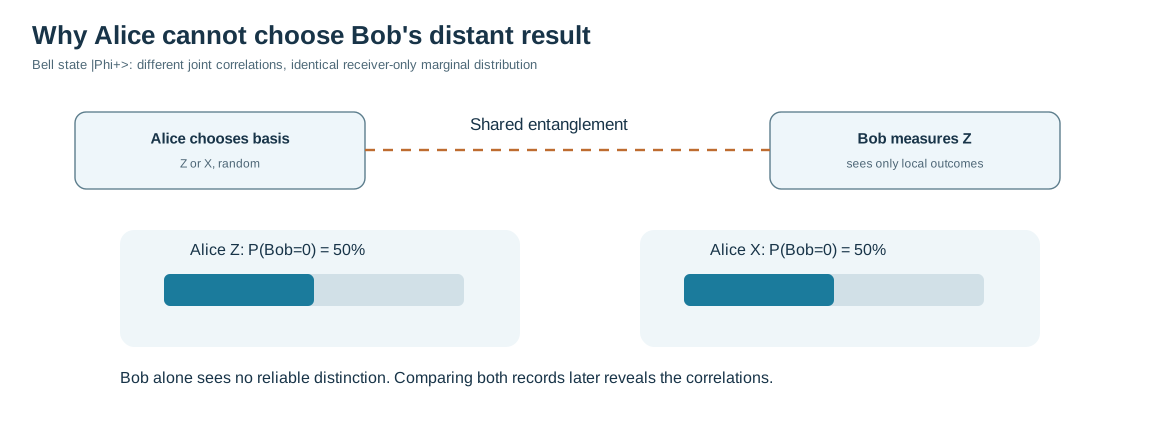
The no-signalling derivation and Python experiment test this result with a null control and a deliberately introduced classical leak. Quantum teleportation also requires classical communication; see Bennett and colleagues, 1993.
What would count as a genuine FTL result?
A fresh independently random message chosen at event A must be locally recoverable from a remote event B outside the actual physical causal future of A. Earlier arrival than a reference light ray does not suffice for a speculative curved metric: its physical causal structure, stress-energy sources, energy conditions and global chronology must be validated. The causal test protocol specifies the side-channel and timing checks. No validated FTL channel exists in the current project.
What we need to measure next
| Study | What we log | What it tests |
|---|---|---|
| Digital timing loopback | GPIO pulse edges, jitter | Real clock timing |
| Visible LED optical loopback | Detector voltage and timestamp errors | Actual electronic-to-optical coupling |
| Qualified photon-counter experiment | Photon time tags, background, dark counts | Model-to-detector agreement |
| PPM and FEC link | Symbol, bit and whole-frame errors | Noise, coding and synchronisation |
| Earth-Proxima geometry | Source epoch, distance, transverse motion | Light-time and pointing uncertainty |
| Hypothetical spacetime metric | Causal sets, stress-energy, source model | Physical consistency of proposed paths |
This guide is an accessible companion to the original Beyond the Light Cone research report. The earlier material contains exploratory hypotheses and must not be read as a verified demonstration. A 15-page PDF version with additional generated illustrations, modulation plots, synthetic reconstruction images, detector architecture and circuit diagrams was also produced; that binary PDF is distributed separately and has not been uploaded to this GitHub repository.
The NASA/JPL DSOC technology demonstration is a valuable real optical-communication precedent, but its 267-Mb/s result at about 31 million km is not an interstellar link demonstration.
All diagrams are explanatory or functional designs. No constructed hardware, qualified PCB, experimentally verified photon-starved channel or faster-than-light communication is claimed.