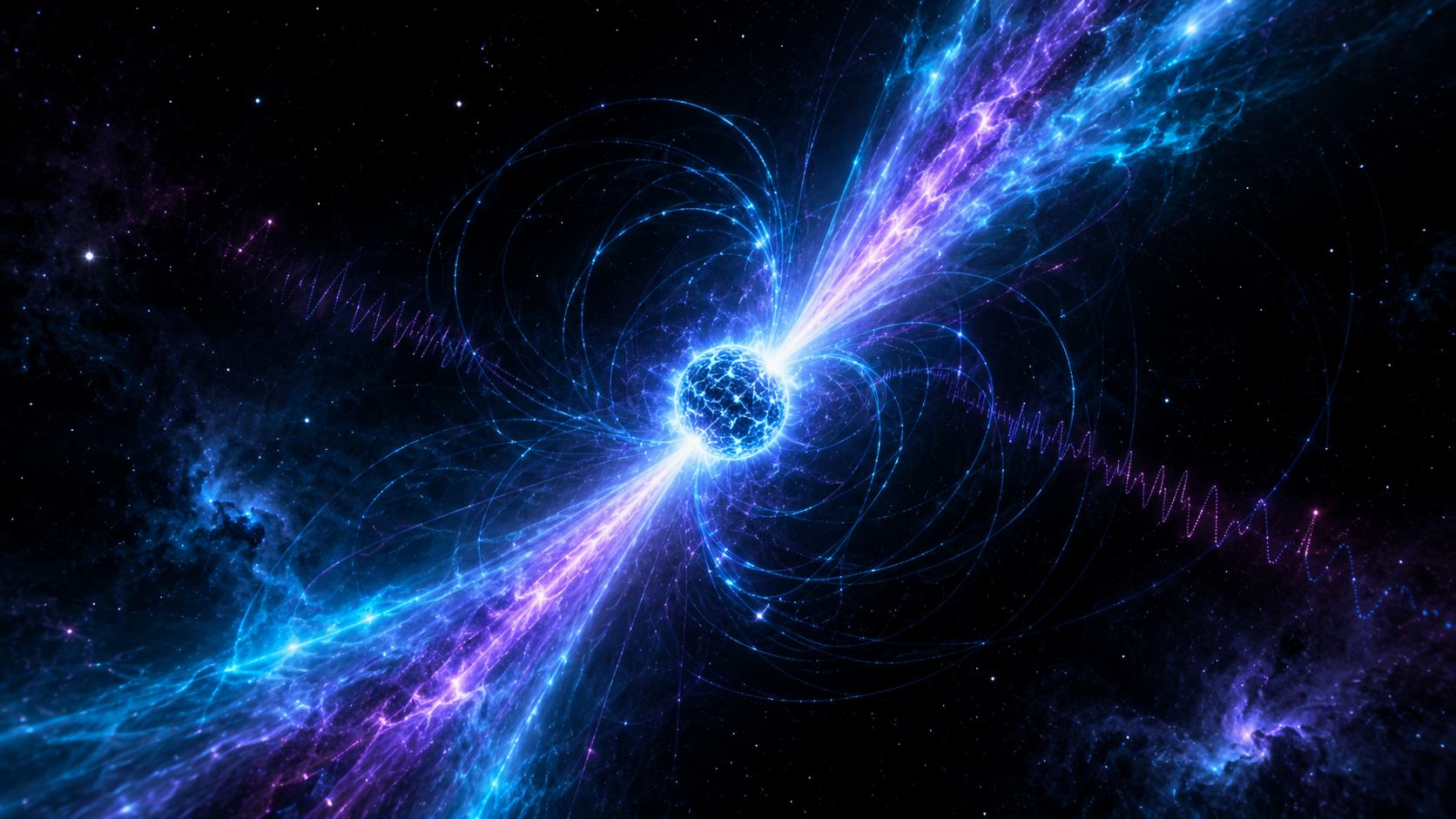
What is a pulsar?
A pulsar is a rotating neutron star whose magnetic environment produces beams of radiation. The star itself is not blinking like a lamp. Instead, the beam sweeps through space; if Earth lies inside that sweep, our telescopes record a pulse once per rotation.
Modern pulsar catalogues contain thousands of sources. They are not all the same: some are young and energetic, such as the Crab pulsar; some are recycled millisecond pulsars spinning hundreds of times per second; some live in binaries where their companion is being stripped by the pulsar wind.
How many pulsars have been detected?
The answer changes because pulsar catalogues are living databases. The ATNF Pulsar Catalogue began as a structured reference set of 1,509 published pulsars in the early 2000s, and modern radio, X-ray and gamma-ray surveys have pushed the total well beyond 3,000 catalogued pulsars.
A good way to see how fast the field is still moving is FAST. The FAST Galactic Plane Pulsar Snapshot survey reported 473 new pulsars in one 2024 release and stated that its survey programme had discovered 751 pulsars over its first five years of operation. So the sensible public number is not a single frozen value, but: over three thousand known pulsars, with hundreds still being added by modern surveys.
From Supernova to Neutron Star
A pulsar begins its story as a massive star that has run out of profitable ways to bargain with gravity. When the core can no longer support itself, it collapses to extraordinary density and the outer layers are expelled in a supernova.
What remains is a neutron star: an object with a mass comparable to the Sun packed into a radius of only about ten to fifteen kilometres. The collapse conserves angular momentum and compresses magnetic flux, turning a stellar remnant into a fast-spinning, strongly magnetised compact object.
The visible “surface” should not be imagined as a normal gaseous stellar photosphere. It is closer to an ultra-dense crust with a thin plasma environment above it. Localised hot regions, especially near the magnetic poles, are important because accelerated particles can return energy to the surface and create bright X-ray hot spots.
For \(M \sim 1.4M_{\odot}\) and \(R \sim 12\,\mathrm{km}\), the mean density is nuclear-scale rather than ordinary stellar-scale.
The Lighthouse Model
A pulsar is not simply flashing on and off. It is a rotating neutron star whose magnetic axis is tilted relative to its spin axis. Emission is channelled along magnetic regions, so the beam sweeps through space as the star rotates.
When Earth lies in the path of that beam, we detect a pulse. The source may be emitting continuously in its own rotating frame, but our telescope sees periodic flashes because the beam only points at us during a narrow phase window.
A smaller period \(P\) means faster spin. Millisecond pulsars can rotate hundreds of times per second.
The nearest pulsar is still absurdly far away
One of the closest ordinary radio pulsars is PSR J0108−1431, usually quoted at roughly 130 parsecs, or about 424 light-years. That is about \(4.01 \times 10^{15}\) km. In human terms: not “near”, just “astronomically less ridiculous than the others”.
For scale, Parker Solar Probe reaches around 690,000 km h⁻¹ at its fastest solar flybys. At that speed, a direct trip to a 424 light-year pulsar would take roughly 663,000 years. So yes, technically we have fast spacecraft; no, you should not pack a weekend bag.
Pulsar Wind Nebulae
A young energetic pulsar can also drive a wind of relativistic particles and electromagnetic energy into surrounding supernova ejecta. The result is a pulsar wind nebula: a glowing laboratory where particle acceleration, magnetic fields, and shocks become visible.
The Crab Nebula is the reference object. Its central pulsar spins about thirty times per second and powers a luminous nebula across the electromagnetic spectrum. In the simulator, the magnetic field lines are deliberately softer than the beam so the viewer reads the beam as the observable lighthouse signal.
Here \(I\) is the moment of inertia and \(\dot{P}\) measures how quickly the pulsar slows down.
Timekeeping and Atomic Clocks
Pulsars are often called cosmic clocks, but the comparison needs care. A pulsar has a magnetosphere, plasma, timing noise, orbital motion if it is in a binary, and sometimes sudden rotational glitches. Yet after careful corrections, some millisecond pulsars are extraordinarily stable astronomical clocks.
The measured signal is normally represented as pulse arrival times. Astronomers build a timing model that includes the pulsar spin, sky position, interstellar dispersion, binary motion if present, and relativistic corrections. The remaining residuals can reveal unmodelled astrophysics or gravitational-wave signatures.
A good timing solution predicts pulse arrival times and studies the residuals.
Pulsars as Gravitational-Wave Detectors
Ground-based detectors such as LIGO, Virgo, and KAGRA listen for high-frequency gravitational waves from compact-object mergers. Pulsar timing arrays search in a different regime. They use millisecond pulsars spread across the Galaxy as a network of clocks.
If a very low-frequency gravitational wave passes between Earth and a pulsar, it slightly changes the spacetime path travelled by the radio pulse. The effect is tiny, but it can appear as correlated timing residuals across many pulsars.
References
- Manchester, R.N., Hobbs, G.B., Teoh, A. and Hobbs, M. (2005) ‘The Australia Telescope National Facility Pulsar Catalogue’, The Astronomical Journal, 129(4), pp. 1993–2006. Available at: ATNF Pulsar Catalogue.
- Han, J.L. et al. (2024) ‘The FAST Galactic Plane Pulsar Snapshot survey: VI. The discovery of 473 new pulsars’. Available at: arXiv:2411.15961.
- Deller, A.T., Tingay, S.J., Bailes, M. and Reynolds, J.E. (2009) ‘Precision southern hemisphere VLBI pulsar astrometry II: Measurement of seven parallaxes’. Available at: arXiv:0906.3897.
- Pavlov, G.G., Kargaltsev, O., Wong, J.A. and Garmire, G.P. (2008) ‘Detection of X-ray emission from the very old pulsar J0108−1431’. Available at: arXiv:0803.0761.
- NASA (n.d.) ‘Hubble: Pulsars’. Available at: NASA Science.
- NASA / Johns Hopkins APL (2024) ‘Parker Solar Probe closest approach and speed records’. Available at: NASA Parker Solar Probe.
- NANOGrav Collaboration (n.d.) ‘Pulsar timing array science’. Available at: NANOGrav.
- LIGO Laboratory (n.d.) ‘What are gravitational waves?’ Available at: LIGO.
Comments & reactions
Powered by GitHub Discussions via giscus. Leave questions, corrections, or ideas for the next interactive astronomy post below.